
EUR/JPY forecast: Third-party price targets
Euro / Japanese yen (EUR/JPY) is trading around 180.63 as of 1:26pm UTC on 4 December 2025, moving within an intraday range of 180.46–181.36 on Capital.com’s forex CFD feed. The pair continues to trade near levels seen around 181.3 in recent sessions, broadly in line with external spot benchmarks that have also held close to the 181 area. Past performance is not a reliable indicator of future results.
As of 4 December 2025, EUR/JPY trades against a backdrop of firmer eurozone services activity, with November services PMIs revised higher across several major economies (Trading Economics, 3 December 2025). At the same time, the yen has found some support from expectations that the Bank of Japan (BoJ) could raise interest rates as early as December, following recent comments by Governor Kazuo Ueda (Reuters, 1 December 2025). Broader commentary highlights that the pair remains near historically elevated levels following strong gains through 2025 (FXStreet, 3 December 2025).
Past performance is not a reliable indicator of future results.
EUR/JPY forecast 2025–2030: Analyst price target view
Third-party euro yen forecasts published in October–December 2025 show a wide dispersion of possible paths. Forecasts tend to present indicative levels or ranges rather than point estimates, and generally hinge on expectations for interest-rate differentials, the progression of eurozone growth, and the tone of global risk sentiment.
Euroexchange.org.uk (retail FX forecaster)
Euroexchange.org.uk indicates a central scenario for EUR/JPY at around 174.65 by the end of 2025, with projections suggesting a 174.4299 - 174.6465 range by January 2026. The outlook assumes some yen recovery as BoJ policy normalises and eurozone growth moderates, although the pair is still expected to trade above pre-2020 averages (Exchange Rates UK, 4 December 2025).
ING (FX outlook 2026)
ING’s November 2025 outlook suggests that yen softness and constructive global risk appetite could keep EUR/JPY near the 180 area in the near term. The bank also outlines downside risks in 2026 if global equities markets correct, noting that the pair’s performance has often moved in step with equity-market trends and carry-trade appetite (ING Think, 10 November 2025).
MUFG (monthly FX outlook)
MUFG Research reports that the yen weakened from about 177.7 to 181.1 against the euro over November. It frames this move as consistent with a broader trend of yen underperformance despite an earlier BoJ rate hike. MUFG’s interest-rate projections still assume relatively low Japanese policy rates compared with the eurozone, with these differentials expected to support elevated EUR/JPY levels into early 2026 (MUFG Research, 1 December 2025).
ForexTraders.com (key levels)
ForexTraders.com highlights indicative technical reference zones for December 2025 at 182 on the topside and 173.80 on the downside. These levels are presented as broad directional markers within a wider trading band, with the article noting mixed signals around global risk appetite and close scrutiny of BoJ communication on potential intervention and future policy shifts (ForexTraders, 3 December 2025).
Predictions and third-party forecasts are inherently uncertain, as they cannot fully account for unexpected market developments. Past performance is not a reliable indicator of future results.
Euro–yen: Technical overview
EUR/JPY is trading around 180.63 as of 4 December 2025, holding above a rising cluster of daily moving averages, with the 20/50/100/200-day SMAs near 49.1 / 48.8 / 48.3 / 45.9 respectively. The 14-day RSI at around 71.8 shows stretched conditions, while an ADX reading near 26 suggests the presence of an established trend rather than a range-bound environment.
On the topside, the nearest classic pivot resistance is around R1 at 49.7, with R2 near 50.1 potentially coming into view following a sustained daily close above the first barrier. On pullbacks, initial support sits near the classic pivot at 49.0, followed by the 100-day SMA around 48.3, with S1 near 48.6 as a deeper reference point (TradingView, 4 December 2025).
This technical analysis is for information only and does not constitute financial advice or a recommendation to buy or sell any instrument.
EUR/JPY history
EUR/JPY consolidated within a broad 155–170 band through much of 2024 and early 2025 before breaking higher in the second quarter of 2025. The pair traded near 158.3 at the start of December 2024, dipped towards 155 in January and then moved higher through the spring. It closed around 163.3 on 30 May 2025 as yen softness and steady euro demand provided support.
From mid-2025, EUR/JPY extended its uptrend. The pair moved above 170 in late June, held in the low- to mid-170s range through July, and then advanced further through the autumn, rising from about 172.6 at the start of October to above 180 by late November. As of 4 December 2025, EUR/JPY closed at 180.64, roughly 10.8% higher than its 162.83 level on 31 December 2024 and about 14.2% above early December 2024. The past two years have featured several consolidation phases, though the broader trend has been upward.

Past performance is not a reliable indicator of future results. Share prices are indicative and may differ from live market prices.
Capital.com analyst view
EUR/JPY has climbed steadily over the past two years, moving from the mid-150s in late 2023 to around 180.64 as of 4 December 2025. The latest rise in 2025 reflects persistent yen softness and relatively firm euro demand. Although the pair has pushed into new territory near 180, progress has been interspersed with short-lived corrections, underscoring the inherent volatility of leveraged forex markets.
Market participants commonly cite wide interest-rate differentials between the eurozone and Japan, shifting expectations around BoJ policy normalisation, and evolving global risk sentiment as key influences. A stronger focus on BoJ tightening or weaker eurozone data could, in one scenario, support the yen and weigh on EUR/JPY. In another scenario, renewed risk appetite or a slower policy shift in Japan could keep the cross elevated. Both outcomes carry uncertainty and remain sensitive to incoming economic and policy signals.
CFDs are complex instruments and come with a high risk of losing money rapidly due to leverage. Past performance and third-party forecasts are not reliable indicators of future results.
Capital.com’s client sentiment for EUR/JPY CFDs
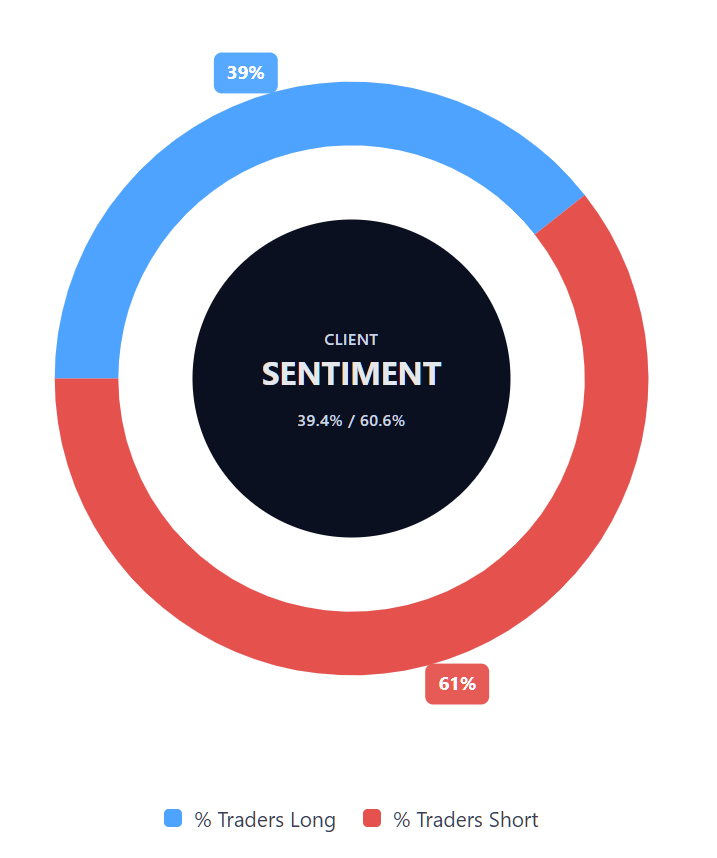
As of 4 December 2025, Capital.com’s EUR/JPY CFD positioning currently shows 39.4% buyers versus 60.6% sellers, leaving sellers ahead by about 21.2 percentage points. This reflects the balance of open positions at the time of writing and may shift as traders adjust their exposure.
Summary – EUR/JPY 2025
- EUR/JPY has moved higher through 2025, rising from the low-160s in January to around 180.64 by 4 December.
- The pair has broken above the broad 155–170 range that characterised late 2023–2024, trading near its strongest levels of the past two years.
- Gains in 2025 have been steady but punctuated by brief consolidations and pullbacks, consistent with an upward-trending market.
- Analyst views published in late 2025 generally place broad EUR/JPY ranges in the mid-170s to low-180s, reflecting uncertainty around BoJ policy timing and eurozone growth.
- Technical readings show the price holding above key moving averages with firm momentum, though stretched indicators leave scope for both corrections and trend continuation.
- Client sentiment on Capital.com currently shows a majority of short EUR/JPY positions despite elevated spot levels.
Past performance is not a reliable indicator of future results.
FAQ
What is the euro yen forecast?
Recent third-party forecasts published between October and December 2025 outline a broad range of possible EUR/JPY outcomes, generally clustering between the mid-170s and low-180s. These projections reflect different assumptions about interest-rate differentials, eurozone growth, and shifts in global risk sentiment. Analysts typically highlight that policy signals from the European Central Bank and the Bank of Japan, together with equity-market trends, remain important influences. Keep in mind that most analysts do not provide longer-term forecasts – such as a euro to yen forecast 2030 – due to the inherent uncertainty of global markets. Past performance is not a reliable indicator of future results.
Why has EUR/JPY been dropping or rising?
EUR/JPY moves in response to several factors, including changing expectations for eurozone and Japanese interest rates, economic data releases such as purchasing managers’ indices, and broader market sentiment. Firmer eurozone data or expectations of slower policy normalisation in Japan may support the euro, while increased focus on potential BoJ tightening or weaker eurozone data may support the yen. Price fluctuations usually reflect a combination of economic developments, positioning and sentiment rather than a single factor.
Could EUR/JPY go up or down?
EUR/JPY can move in either direction depending on how new information shapes expectations for monetary policy and economic conditions in the eurozone and Japan. If the BoJ tightens policy more decisively or eurozone indicators soften, the yen could strengthen and weigh on the pair. Alternatively, if risk appetite improves or Japanese rates rise more gradually than anticipated, EUR/JPY could remain elevated. These scenarios are uncertain, and currency markets can adjust quickly as conditions evolve.
How can I trade EUR/JPY CFDs on Capital.com?
You can trade EUR/JPY CFDs on Capital.com’s platform, choosing to go long or short depending on your view, without having to own the underlying currencies. You can access EUR/JPY alongside thousands of other markets on our CFD trading platform, and explore a free demo account to build experience before trading with real funds. Contracts for difference (CFDs) are traded on margin, leverage amplifies both profits and losses.