
Banco de Sabadell stock forecast: TSB sale, capital returns
Banco de Sabadell is a Spanish bank listed in Madrid. Its recent updates include the completed TSB sale, which increased capacity for shareholder distributions. Explore third-party SAB price targets and technical analysis. Past performance is not a reliable indicator of future results.
Banco de Sabadell S.p.A. (SAB) is trading near €3.73 at 9.35am UTC on 7 September 2026, at the top of its intraday range of €3.66–€3.73. Past performance is not a reliable indicator of future results.
Recent developments include Banco Sabadell's confirmation that the completed sale of its UK subsidiary, TSB, removed associated capital charges and increased its capacity for shareholder distributions, following a €0.50 per-share extraordinary dividend paid in May 2026 (Expansión, 1 September 2026). The update came as Spain's Ibex 35 banking sector traded mixed amid rising eurozone sovereign bond yields (MarketScreener, 1 September 2026), while the euro held near $1.16 against the US dollar (Trading Economics, 4 September 2026). Trading also continues against the backdrop of BBVA's lapsed takeover bid, after Spain's CNMV confirmed in October 2025 that the offer failed to reach its minimum acceptance threshold (Bloomberg, 16 October 2025).
Banco de Sabadell outlook: €331m buyback, TSB sale
As of 7 September 2026, third-party Banco de Sabadell stock predictions show a range of 12-month valuations following Banco Sabadell's second-quarter results and €331m buyback announcement.
Deutsche Bank (house view)
Deutsche Bank sets a €3.75 price target, citing a projected return on tangible equity of around 17% and Banco Sabadell's capital surplus. It estimates close to €2.7bn in total capital returns to shareholders by 2027 (Investing.com, 23 February 2026).
Bankinter (house view)
Bankinter sets a price target of €3.80, citing commercial activity, containing non-performing loans and signs of improvement in net interest margin as supporting factors (Grupo Banco Sabadell, 3 September 2026).
Renta 4 (house view)
Renta 4 places its price target at €3.85, implying around 7% upside from the previous closing level. The broker cites Banco Sabadell's buyback announcement as a factor in its revised outlook (Grupo Banco Sabadell, 3 September 2026).
Predictions and third-party forecasts are inherently uncertain, as they cannot fully account for unexpected market developments. Past performance is not a reliable indicator of future results.
Banco de Sabadell: latest and upcoming earnings
Banco de Sabadell published its second-quarter results on 24 July 2026, reporting first-half net profit of €971m. This included TSB's contribution during four months of the year before its sale and was broadly in line with the same period of 2025, down 0.5% year on year (Banco Sabadell via CNMV, 24 July 2026).
Excluding TSB and one-off items, recurrent net profit stood at €691m, down 14.1% year on year, while second-quarter recurrent net profit rose 8.4% quarter on quarter to €359m. The common equity tier 1 (CET1) capital ratio, which measures a bank's core capital relative to its risk-weighted assets, stood at 13.11%, while the non-performing loan ratio was 2.47%. The bank also confirmed a €331m share buyback programme, equivalent to around 2.1% of its share capital.
Banco Sabadell has not yet formally confirmed the date of its third-quarter 2026 results. Third-party data providers project either 21 October or 12 November, although both dates remain estimates pending an official filing with Spain's securities regulator, the CNMV (MarketScreener, 23 July 2026).
SAB stock price: technical overview
As of 9.35am UTC on 7 September 2026, the SAB stock price trades near €3.73, above its 20/50/100/200-day simple moving averages at roughly €3.64/€3.42/€3.28/€3.25, respectively, according to TradingView. The 20-day average remains above the 50-day average, while the 20-day exponential moving average is near €3.62 and the nine-period Hull moving average around €3.72 .
The 14-day relative strength index (RSI) stands at 68.3, below the commonly used overbought level of 70. The average directional index (ADX) is 26.8; readings above 25 can indicate the presence of a trend, although they do not show its direction or whether it will continue.
The classic R1 pivot at €3.81 is the nearest reference above the current price, followed by R2 near €3.98. Below the market, the classic pivot point at €3.57 provides the nearest reference, with the 100-day simple moving average near €3.28 further below.
A move above resistance could bring higher technical levels into focus, while a fall below support could shift attention towards lower levels. Neither outcome is certain, and technical levels can fail to hold (TradingView, 7 September 2026).
This technical analysis is for informational purposes only and does not constitute financial advice or a recommendation to buy or sell any instrument.
Banco de Sabadell share price history (2024–2026)
SAB’s stock price has risen since late 2024, when the stock traded around €1.83 in September before closing the year near €1.88.
The shares fell to an intraday low of €1.99 on 7 April 2025 during a broader sell-off linked to global tariff announcements, before recovering through the summer. The stock ended 2025 at €3.37, up roughly 79% on the year, while BBVA's takeover bid remained in focus before lapsing in October.
In 2026, Banco Sabadell reached €3.46 on 26 May around the bank's extraordinary dividend distribution, then fell to a 2026 low near €2.81 on 11 June. The shares subsequently rose through the summer alongside completion of the TSB sale and announcement of a new buyback, reaching €3.73 on 4 September.
Banco de Sabadell closed at €3.73 on 7 September 2026, approximately 10.7% higher year to date and 14.6% higher year on year. Past performance does not indicate future returns.

Past performance is not a reliable indicator of future results. Share prices are indicative and may differ from live market prices.
Banco de Sabadell (SAB): Capital.com analyst view
Banco de Sabadell's share price rose from around €3.37 at the start of 2026 to €3.73 by early September (Yahoo Finance, 4 September 2026). The move coincided with completion of the TSB sale, which the bank says increased its capacity for shareholder distributions, alongside a new share buyback and the lapse of BBVA's takeover bid (Banco Sabadell press release, 24 July 2026).
Greater capacity for capital returns could support expectations around shareholder distributions, while the buyback may reduce the number of shares in circulation (Reuters, 24 July 2026). However, neither factor guarantees a higher share price. The end of takeover-related uncertainty may also remove demand previously linked to expectations of a deal (Bloomberg, 16 October 2025).
The stock's performance has also coincided with gains across European banks and rising bond yields (Euronews, 1 September 2026). Higher yields can support net interest margins, potentially benefiting bank earnings, but they can also weaken credit demand or increase pressure on borrowers. A reversal in rate expectations, slower eurozone growth or weaker sector sentiment could therefore weigh on Banco Sabadell shares (Reuters, 3 September 2026).
The outlook remains sensitive to both company-specific and broader market factors. Earnings, capital returns and margins may support the price if they develop favourably, while weaker profitability, deteriorating credit quality or changing interest-rate expectations could have the opposite effect.
Capital.com’s client sentiment for Banco de Sabadell CFDs
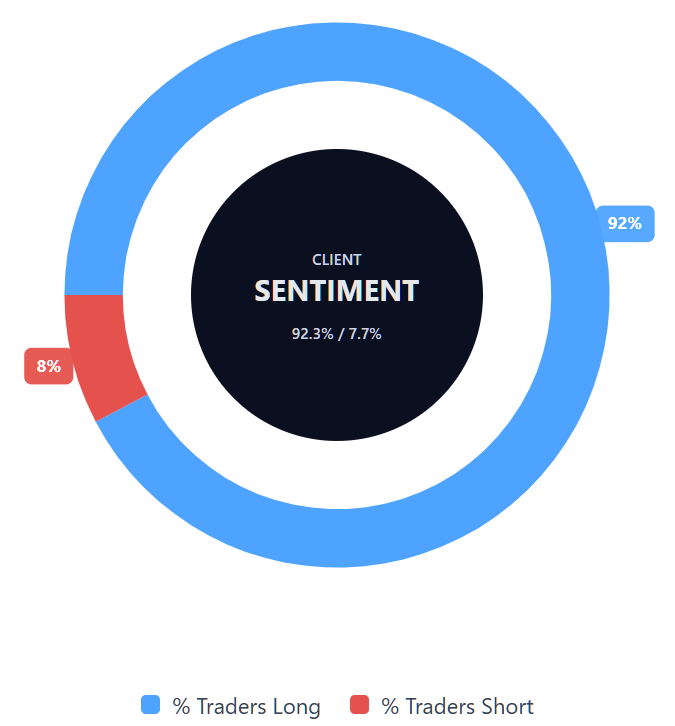
As of 7 September 2026, Capital.com client positioning in Banco de Sabadell CFDs shows 92.3% buyers and 7.7% sellers, a difference of 84.6 percentage points. This is a snapshot of open positions among Capital.com clients rather than a market-wide indicator or forecast of future price direction, and it can change as positions are opened and closed.
Summary – Banco de Sabadell 2026
- As of 9.35am UTC on 7 September 2026, Banco de Sabadell traded at €3.73, within an intraday range of €3.66–€3.73.
- According to TradingView data, the price was above its 20/50/100/200-day moving averages, while the RSI stood at 68.3, below the commonly used overbought level of 70.
- The completed TSB sale and €331m buyback may support expectations around capital returns, although they do not guarantee higher share prices.
- Rising bond yields can support bank margins but may also weaken credit demand or increase pressure on borrowers.
- Recent developments include the lapsed BBVA takeover bid, first-half net profit of €971m and differing analyst price targets.
Past performance is not a reliable indicator of future results.
FAQ
Who owns the most Banco de Sabadell stock?
What is the five-year Banco de Sabadell share price forecast?
Is Banco de Sabadell a good stock to buy?
Could Banco de Sabadell stock go up or down?
Should I invest in Banco de Sabadell stock?
Can I trade Banco de Sabadell CFDs on Capital.com?
Yes, you can trade Banco de Sabadell CFDs on Capital.com. Trading share CFDs lets you speculate on price movements without owning the underlying asset and to take long or short positions. However, contracts for difference (CFDs) are traded on margin, and leverage amplifies both profits and losses. You should ensure you understand how CFD trading works, assess your risk tolerance, and recognise that losses can occur quickly.