

US and Iran Sign Peace MOU as Crude Prices Fall to Critical Level
Oil continues to face downside pressure as the US and Iran sign a memorandum of agreement which will halt hostilities for 60 days as they finalise their agreement.
Crude prices have tumbled by nearly 25% in just over a week following the breakthrough in peace negotiations between the US and Iran. After a volatile four months, the natural question to ask is: where to from here for oil prices? In the absence of any special expertise in the energy markets, which most people don't have and, even if you do, doesn't mean you'll have perfect visibility on what's happening in the market, the best place to start might be with price action.
The humbling thing about this whole episode is how despite all the prognostications of a broken energy market and an oil price going through $US150 - $US200 plus, it didn't happen and the price action in both the paper and physical market signalled that wasn't going to be the case. There's several lessons here. Global energy markets are more elastic in the past. The 80% move from mid February to mid March seems to have discounted the hit to supply from the closure of the Strait of Hormuz. Alternative supply sources and chains were found, obviously at a cost, but managed to keep prices around where they were. China (and other big consumers) also acted as a shock absorber to an extent, drawing down on their inventories and importing less which took the pain out of the physical market.
Now, looking forward, the market's current view is essentially that the geopolitical premium is mostly gone, even if the physical normalisation hasn't happened yet. There’s a bull case and a bear case for where the market could head next. The bull case is that the MOU doesn't instantly create new barrels. Physical flows, tanker availability, insurance, refinery contracts, and export logistics take time to normalize. This could keep prices higher throughout the summer. The bear case is that markets are forward-looking. If traders believe Iranian exports will return, sanctions will be eased, and Hormuz will remain open, they don't wait for every barrel to show up before repricing. That's why oil has sold off despite ongoing uncertainty about implementation and despite the agreement.
A lot of the war premium has been removed, but not necessarily all of the tightness premium. A move back to the low-$60s would probably require not just the MOU holding, but also clear evidence of rising Iranian exports, higher OPEC+ supply, and softer demand. There's also technical factors to consider, with the move over the past week a squeeze of long positions in the paper market probably fuelled by CTAs and other momentum chasing strategies driving the price lower. This means prices could see a quick snap back if the headlines turn.
A gut instinct view would be to say that a fair price for oil could be around the low $US80s for WTI. This isn’t a forecast, meaning it’s an even less reliable view than the forecasters who predicted catastrophically higher prices when the war began. However, to circle back to the beginning, the best decision for any trader is to stick to first principles. That is: follow the price action and make judgements based on that. Critically, the price of WTI has reverted to and found support at the 200-day MA. A break of it will be a strong indicator of the long-term trend and whether the market may extend its downward move or rebound.
US crude (WTI) daily chart
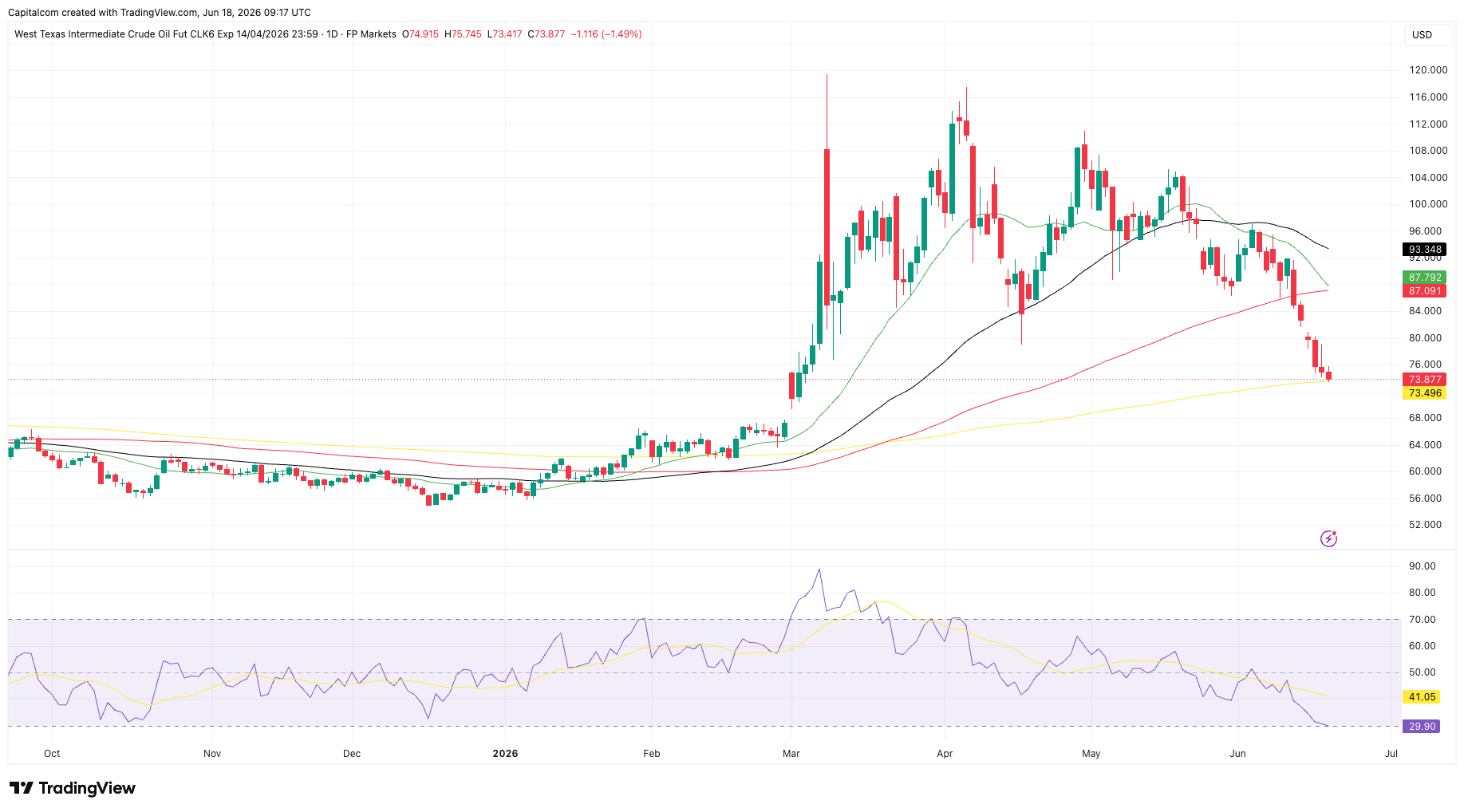
(Past performance is not a reliable indicator of future results)