

Cocoa price forecast: Ghana-Ivory Coast pricing deal
Cocoa is a soft commodity shaped by West African supply, weather conditions, inventories and demand from chocolate manufacturers. Explore third-party Cocoa price targets and technical analysis. Past performance is not a reliable indicator of future results.
Cocoa (US Cocoa) traded near $5,700 in early European hours as of 9:59am UTC on 13 July 2026, after moving within an intraday range of $5,645–$6,337.50.
The move followed a period of sharp volatility. Cocoa had rallied to a roughly 24-week high near $5,723 per tonne in early July, as heavy rains flooded cocoa farms in Ivory Coast and Ghana and early crop surveys pointed to a weaker 2026/27 harvest (Huanda Cocoa, 7 July 2026). Supply-side policy also remained in focus after Ghana and Ivory Coast, which together supply more than 60% of global cocoa, signed a joint declaration on 16 June 2026 to align farm-gate pricing and harmonise their crop calendars from the 2026/27 season (Rio Times Online, 29 June 2026). Volatility remained elevated as forward curves continued to reflect questions over whether global supply could expand quickly enough to meet demand, given the crop's biological constraints on rapid output growth (Santa Barbara Chocolate, 27 January 2026).
Third-party Cocoa outlook: West Africa policy and supply risks
As of 13 July 2026, third-party Cocoa predictions point to a wide dispersion of views, shaped mainly by West African weather risk, supply recovery expectations and speculative positioning. The mini-briefs below are ordered from lower to higher price references.
Vaibhav Joshi market analysis (near-term range view)
The analysis projects cocoa consolidating near $5,000 per tonne through the third quarter of 2026, broadly in line with levels seen at the start of the year. The view cites a stabilising West African harvest outlook alongside continued demand-side caution from chocolate manufacturers still working through high-cost inventory (LinkedIn, 6 July 2026).
CocoaIntel technical outlook (support/resistance target)
The outlook sets $5,224 per tonne as a key near-term technical marker for the September New York contract, following the strongest single-day close since late January. The projection is based on continued short-covering momentum, with a break above this level potentially bringing the year's highs back into focus (CocoaIntel, 26 June 2026).
Trading Economics quarterly model (quarter-end target)
Trading Economics projects cocoa reaching $5,818.28 per tonne by the end of the current quarter, based on its global macro models and analyst inputs . The forecast followed a 39.21% rise over the month to 13 July 2026, although the provider also noted an 8.83% single-session decline on the same date, underlining the short-term volatility around the projection (Trading Economics, 13 July 2026).
Predictions and third-party forecasts are inherently uncertain, as they cannot fully account for unexpected market developments. Past performance is not a reliable indicator of future results.
Cocoa spot: latest and upcoming market context
Cocoa markets remained volatile heading into mid-July 2026, with prices retreating from a multi-month peak after several weeks of gains. Futures reached their highest level in roughly 24 weeks on 6 July 2026, closing at $5,723 per tonne after a near 14% single-day rise. Heavy rains across Ivory Coast and Ghana disrupted cocoa farms, while early crop surveys pointed to a weaker 2026/27 harvest, according to Huanda Cocoa (Huanda Cocoa, 7 July 2026).
The rally then partly unwound. Barchart reported that cocoa prices settled sharply lower the following session as signs of stronger supplies from Ivory Coast encouraged profit-taking and long liquidation. Cumulative farmer shipments to ports reached 2.07m metric tonnes in the current marketing year, up 21% year-on-year, while ICE cocoa inventories rose to a nearly two-year high of 3.15m bags. That inventory build offered a potentially bearish counterweight to ongoing weather disruption, which could still affect access to farms and ports, according to Barchart (Barchart, 13 July 2026).
On the broader market context, ICCO's daily price statistics showed New York cocoa averaging $6,171 per tonne across the 2 and 6 July trading sessions, reflecting the scale of the recent price swing (ICCO, 9 July 2026). Looking ahead, market participants may focus on incoming Ivory Coast and Ghana port arrival data, updated mid-crop weather reports for the March to August season, and any revisions to 2026/27 surplus or deficit estimates from major trade houses (Barchart, 13 July 2026). Each of these has been cited as a possible swing factor for cocoa prices through the second half of 2026 (Huanda Cocoa, 7 July 2026).
Cocoa futures: technical overview
Cocoa spot traded near $5,700 at 9:59am UTC on 13 July 2026, while cocoa futures held above the 20-, 50-, 100- and 200-day moving averages (DMAs) at roughly $4,934, $4,371, $3,807 and $4,698. The 20-day average remained above the 50-day average, supporting a constructive technical reading. The 200-day EMA sat higher near $4,932, closer to spot than the SMA equivalent, which TradingView data flagged as a nearby long-term reference level. Momentum appeared stretched, with the 14-day RSI at 72, while the ADX(14) at 35 pointed to an established trend according to TradingView.
The nearest classic pivot resistance sat at R1 near $5,647. A daily close above that level would make the R2 area near $6,215 the next upside reference, according to TradingView’s pivot data. Within the same broad zone, the Fibonacci R2 reference near $5,360 and Camarilla R1 near $5,219 provided additional markers.
On the downside, the classic pivot (P) near $4,678 served as the initial support reference, with the 100-day SMA near $3,807 forming the closest longer-term moving-average reference below spot, per TradingView. A move through S1 near $4,110 would bring that moving average more clearly into focus. This does not imply that such a move is likely; it only identifies the next chart reference (TradingView, 13 July 2026).
This technical analysis is for informational purposes only and does not constitute financial advice or a recommendation to buy or sell any instrument.
Cocoa price history (2024–2026)
The Cocoa spot price has moved sharply over the past two years, reflecting one of the most pronounced runs in commodity markets. Prices peaked near $12,486.60 on 19 December 2024, driven by West African supply shortfalls, before moving lower through much of 2025 as harvests improved and demand softened.
By 21 April 2025, cocoa had fallen to around $8,399.20. The decline continued into early 2026, reaching a low near $2,862.80 on 2 March 2026 amid reports of a global surplus and easing weather concerns.
Sentiment then shifted quickly. Flooding across Ivory Coast and Ghana renewed supply concerns, and cocoa rose from around $3,780.80 on 12 June 2026 to $6,520.10 by 9 July 2026 – a gain of more than 70% in under a month. The rally has since eased, with cocoa closing at $5,702.90 on 13 July 2026, below the recent high but still sharply higher year to date.

Past performance is not a reliable indicator of future results. Prices are indicative and may differ from live market prices.
Cocoa price outlook: Capital.com analysis
Cocoa’s price performance through 2025 and into mid-2026 has been defined by exceptional volatility rather than a single directional trend. The market fell sharply from record 2024 highs as West African harvests improved and inventories rebuilt, then recovered quickly in June and July 2026 when flooding across Ivory Coast and Ghana revived concerns over crop damage and reduced 2026/27 output.
Analysts remain divided on the recent rally. Some view it as a response to material supply tightening, while others note that rising ICE inventories and long liquidation may suggest the market is placing too much weight on short-term weather disruption. This tension between supply risk and inventory rebuilding makes cocoa difficult to characterise as structurally bullish or bearish at this stage.
Demand-side normalisation adds another layer of uncertainty. Reports that chocolate manufacturers have been working through hedged inventories suggest slower demand could offset some supply-driven price gains. Against this backdrop, price direction may continue to depend on incoming weather, port arrival and inventory data rather than any single established trend.
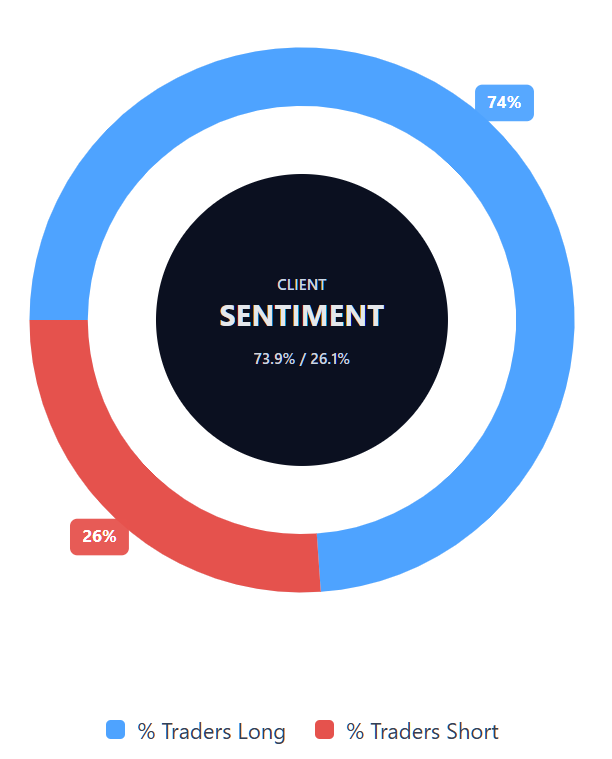
Capital.com’s client sentiment for Cocoa CFDs
As of 13 July 2026, Capital.com client positioning in Cocoa spot CFDs shows 73.9% buyers compared with 26.1% sellers, putting buyers ahead by 47.8 percentage points. This snapshot reflects open positions on Capital.com and can change.
Summary – Cocoa price 2026
- As of 9:59am UTC on 13 July 2026, Cocoa spot traded near $5,700, below its 24-week high of $6,520.10 on 9 July 2026 but well above the March 2026 low near $2,862.80.
- According to TradingView, technical indicators showed the price holding above its 20- and 50-day SMA cluster, with RSI at 72. This suggests stretched but established momentum, without giving a clear reversal signal.
- Key drivers include West African flooding disruption, rising ICE inventories that partially offset supply concerns, and shifting 2026/27 surplus estimates from trade houses.
- Recent news has centred on Ivory Coast and Ghana’s joint pricing declaration, reported port arrivals, and a sharp rally followed by profit-taking into mid-July.
Past performance is not a reliable indicator of future results.
FAQ
What is the Cocoa price forecast?
Third-party Cocoa price forecasts and market references in the article point to a wide range, with recent price captures clustering around $5,800–$6,400 per tonne in late June and mid-July 2026. Trading Economics projected Cocoa at $5,818.28 by the end of the current quarter, while other sources showed higher futures levels. These figures are not guaranteed. Cocoa prices remain sensitive to weather, inventories, port arrivals and demand conditions.
Could Cocoa’s price go up or down?
Cocoa’s price could move in either direction. Prices may rise if heavy rains in Ivory Coast and Ghana disrupt supply, crop surveys weaken further, or port arrivals fall short of expectations. However, prices could fall if ICE inventories continue to build, farmer shipments remain strong, or demand softens as manufacturers work through hedged stock. Recent volatility shows how quickly Cocoa can reverse when supply and demand signals change.
Should I invest in Cocoa?
Whether Cocoa is suitable for you depends on your financial situation, trading experience, risk tolerance and market view. The article shows that Cocoa has experienced sharp price swings, including a steep fall from 2024 highs and a rapid rebound in mid-2026. That volatility can create trading opportunities, but it also increases risk. You should carry out your own research and consider whether you understand the risks before trading.
Can I trade Cocoa CFDs on Capital.com?
Yes, you can trade Cocoa CFDs on Capital.com. Trading commodity CFDs lets you speculate on price movements without owning the underlying asset and to take long or short positions. However, contracts for difference (CFDs) are traded on margin, and leverage amplifies both profits and losses. You should ensure you understand how CFD trading works, assess your risk tolerance, and recognise that losses can occur quickly.