
USD/CAD forecast: Canadian dollar under pressure amid falling oil prices
Cooling commodity prices, slowing economy seen bearish for Canadian dollar. Read more in our latest USD/CAD forecast
This year has been a wild roller-coaster ride for the USD/CAD. The currency pair swung sharply from the lows to highs, touching an 18-month peak in May.
The volatility has continued amid tightening monetary policy, cooling oil prices and the expected slowing US economy, Canada’s main trading partner.

With uncertainties in energy prices, continuing but less aggressive rate hikes from the US Federal Reserve (Fed) and Bank of Canada (BoC), what will be the USD/CAD forecast?
We examine USD/CAD historical performance, factors that affect the currency pair, and the recent performance that form the latest analysts’ forecast on the loonie.
What is USD/CAD?
USD/CAD is the currency pair to denote the US versus Canadian dollars. Buying and selling USD/CAD currency pair is often called trading "loonies", which is the nickname for the Canadian one-dollar coin that features a solitary loon, the nation's national bird
For example, if the USD/CAD exchange rate is 1.28, it means that it costs 1.28 Canadian dollars to buy one US dollar. Conversely, one Canadian dollar is worth $0.78.
According to Bank of International Settlement data, the Canadian dollar is one of the most liquid and frequently traded currencies on the foreign exchange market, accounting for 5% of daily trades. USD/CAD pair ranks fifth in the list of most traded currency pairs, accounting for 4.4% of daily trades.
Throughout its history, the Canadian dollar (CAD) has shifted between fixed and flexible exchange rates. Between 1858 and 1938, and between 1962 and 1970, CAD was pegged to the US dollar, meaning its value rose and fell at the same rate as the USD.
Canada was the first major country that adopted a floating exchange in 1950, right after the Second World War. The CAD’s peg to the USD dollar was lifted in 1970 and the currency has free floated ever since.
The Canadian dollar has floated for 42 years of the past 50 years, according to Gordon Thiessen, former Bank of Canada’s governor in its speech.
Factors affecting USD/CAD
The USD/CAD, like other currency pairs, is affected by economic and political factors on both sides of the border, as well as central bank action and news.
Because the majority of Canada's international trade is with the US, particularly Canadian crude oil exports, the Canadian dollar's value frequently matches up to the strength of the US economy and the dollar.
Canada is one of the world’s major suppliers of energy and commodities, such as crude oil, natural gas, metals and grains. Commodity exports play an important role in the Canadian economy. As a result, the Canadian dollar rises and falls with the commodity prices and the currency is known as a commodity currency.
Because of its correlation with the price of oil, which is priced in USD, CAD is also known as the 'petrodollar’. When oil prices rise, the value of the Canadian dollar grows because crude oil sales account for most of Canada's foreign exchange earnings.
The large volumes of oil traded from Canada to the US increase demand for CAD, causing the currency's value to rise. In 2021, Canada supplied 50% of US gross total petroleum imports and 62% of gross crude oil imports, according to the US Energy Information Administration (EIA).
Inflationary pressure from its neighbouring US can spill over to Canada due to the country’s open economy. Rising inflation means lower Canadian dollar versus foreign exchange and vice versa.
Monetary policy, including interest rate changes, has an impact on the USD/CAD currency pair. Higher Canadian interest rate rises in comparison to US rate hikes may result in higher demand for the loonie and less demand for the greenback, strengthening the value of the CAD.
USD/CAD historical rate
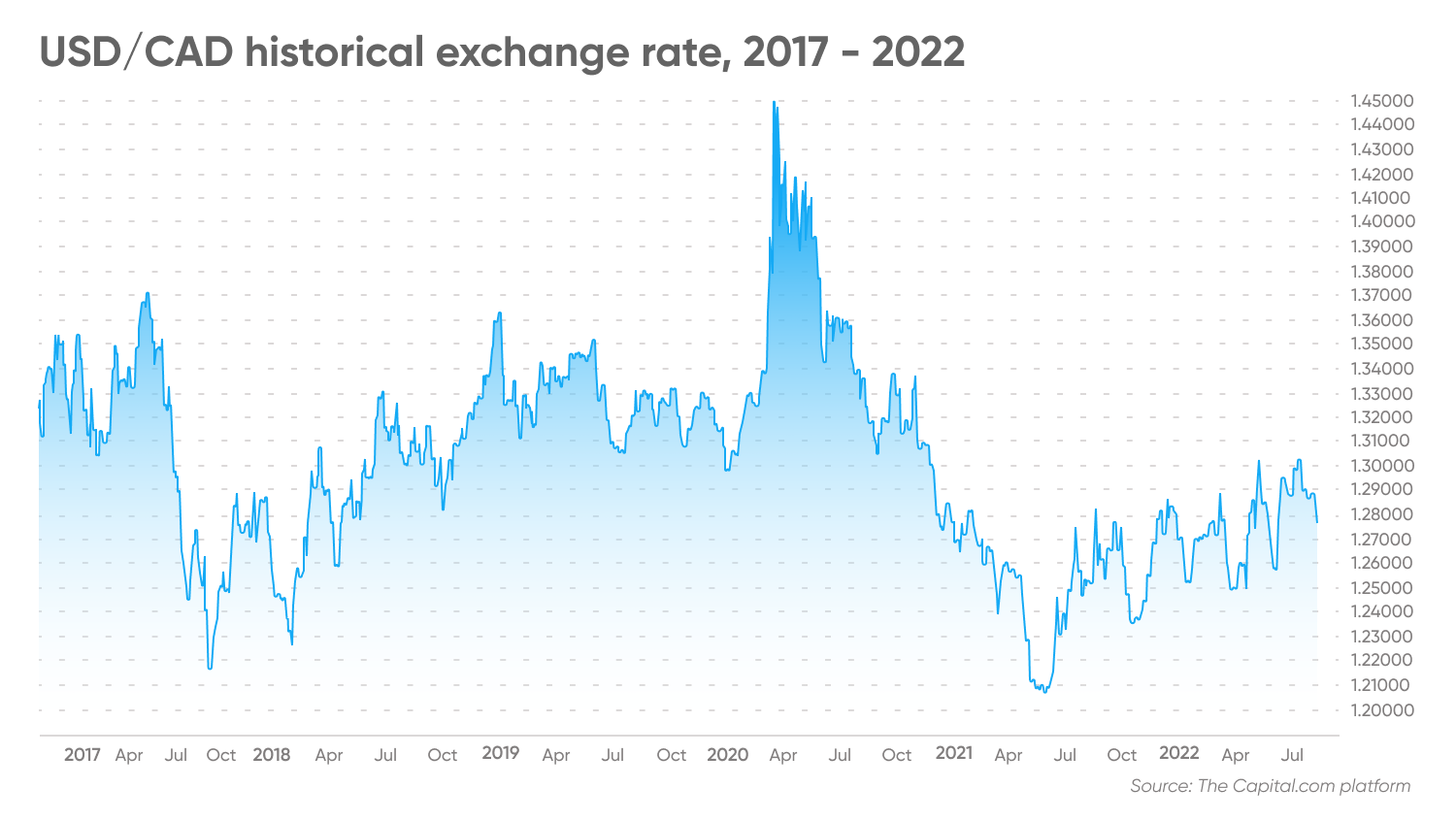
The Canadian dollar weakened considerably against the US dollar as the Covid-19 pandemic made a landfall in mid-March 2020. The loonie spiked to 1.43 per US dollar on 16 March as Bank of Canada made the second rate cut by 50 basis point (bp) in the month to help the economy during the Covid-19 restrictions.
In March 2020, the country’s central bank issued three interest rate cuts, which brought the key rate to 0.25%. Canada’s economy declined by 5.5%, and inflation was below the 2% target during 2020.
The currency pair steadily declined since then throughout the second half of 2021, trading at US$1.268 in early January 2021. Over the first half of 2021, the loonie continued to strengthen against the greenback, dropping to as low as $1.204 at the end of May, as shown on this chart (above).
The CAD's appreciation was primarily fuelled by rising oil prices. International benchmark Brent gained around 45% in the first half of 2021 as countries around the world accelerated their vaccination programs and pandemic restrictions loosened, which increased mobility and boosted fuel demand.
The Canadian dollar was also bolstered by the Bank of Canada's optimistic economic forecast for 2021. In April, the central bank projected 6.5% GDP growth for 2021 as it emerged from pandemic restrictions.
After bottoming in May 2021, the USD/CAD pair gradually climbed up, crossing US$1.28 per dollar several times in the second half as the US dollar strengthened against the weaker CAD. The CAD briefly strengthened against the USD in October at 1.23 per US dollar, before gradually spiking to hit 1.29 per dollar in December.
In the second half of 2021, the US Fed had indicated that it will start scaling back asset purchases and hiking interest rates. The Fed’s hawkish tone had boosted the greenback.
USD/CAD rate drivers in 2022
In October, the Bank of Canada said it would maintain the pandemic-induced lower interest rate until the 2% inflation target was achieved. The Bank projected it would hike its key rate in the middle quarters of 2022, which weakened CAD against the US dollar.
In the first quarter of 2022, the USD/CAD was steady, trading between 1.27 to 1.28 amid rising oil prices caused by Russian invasion of Ukraine and the start of monetary tightening, with the first rate hike since 2018 on 3 March.
Towards the end of March, the loonie continued to strengthen against the greenback, crossing 1.25 per dollar on 25 March. Fading risk-aversion reaction to the war in Ukraine, higher oil prices and Bank of Canada’s hawkish rate policy boosted the loonie, according to Interchange Financial’s daily note.
However, CAD gave up its gains against the US dollar in the following weeks. The currency pair hit an 18-month high on 12 May, crossing 1.30 per dollar. Underperforming equity market, cryptocurrencies, and other riskier assets, giving a boost to the US dollar as investors sought safe-haven assets.
The BoC’s more aggressive rate policy to cool four-decades high inflation helped CAD to recoup its losses against the US dollar and the USD/CAD fell to 1.25 per dollar on 8 June this year.
Yet the pair faced another volatile week in July, giving up most of its gains and soared to 1.31 on 14 July after the central bank made a surprise full percentage point rate increase.
Another factor that affects USD/CAD is CAD’s increasingly fading correlation from the oil price, according to Beata Caranci and James Orlando, economists at TD Economics.
Oil prices have been consistently elevated at $100 per barrel for several months amid the disruptions caused by the Russian invasion of Ukraine. As of 12 August, USD/CAD was trading at 1.275. The currency pair has gained 0.87% year-to-date in 2022 and 1.76% in the past year.
USD/CAD prediction: Analyst views
With the Fed and BoC expected to continue its rate hike policy to curb inflation and energy prices remain elevated, what is the US dollar to Canadian dollar forecast according to analysts?
Meanwhile, Cingari concluded that the “Fed is not happy with the inflation trend and hiking rates faster”. TD Economics’ also expected a stronger CAD in the coming months.
USD/CAD forecast: Price target for 2022-2025
Will the USD/CAD continue to have a roller-coaster ride in the coming months and next year?
In their USD/CAD forecast published on 2 August, analysts at The National Bank of Canada (NBC) predicted the loonie to trade at 1.30 per US dollar in the third quarter of this year, before dropping to 1.27 in the fourth quarter.
The currency pair was expected to fall to 1.25 per US dollar in the first quarter of 2023 and 1.22 in the second quarter.
Economic data provider Trading Economics gave a bullish USD/CAD prediction, suggesting that the pair could trade at 1.30852 by the end of this quarter and at 1.35623 in one year.
For its USD/CAD forecast for 2022, TD Economics estimated the currency pair to trade at 1.27 in the third quarter of this year, dropping 1.24 per dollar in the fourth quarter. USD/CAD was expected to rise to 1.26 in the first quarter 2023, 1.28 in the second quarter, and 1.30 in the third quarter before dropping slightly to 1.29 per dollar.
Dutch lender ING Group projected the currency pair to trade at 1.27 per dollar in the third quarter and 1.23 in the fourth quarter.
In its USD/CAD forecast for 2023, ING expected the currency pair to trade at 1.22 in the first quarter of 2023, steadying to 1.21 in the second and third quarter, before rising to 1.22 in the last quarter of 2023. In 2024, the USD/CAD was estimated to trade at 1.22 in the first quarter of 2024 and close the year at 1.25.
The analysts did not provide the long-term USD/CAD forecast beyond 2024.
Algorithm-based price prediction service Wallet Investor does provide long-term projections using USD/CAD historical price.
As of 12 August, the algorithm-based forecasting site was bearish on USD/CAD, suggesting that the currency pair is “a bad long-term investment.” The pair was forecast to trade at 1.295 in December 2022, according to Wallet Investor’s forecasting system.
In its USD/CAD forecast for 2025, the service projected the currency pair to drop to 1.198 a dollar in December 2025, falling to 1.131 in August 2027. Wallet Investor did not provide USD/CAD forecasts for 2030.
The bottom line
Analysts provided mixed USD/CAD forecasts due to a combination of factors affecting the rate, including BoC rate policy, concerns of a global economic slowdown and volatile oil prices.
Bear in mind that analysts and algorithm-based USD/CAD forecasts can be wrong. They shouldn’t be used as a substitute for your own research. Always conduct your own due diligence before trading, looking at the latest news, technical and fundamental analysis and analyst commentary.
Remember that past performance does not guarantee future returns. And never trade money that you cannot afford to lose.
FAQs
Why has USD/CAD been rising?
There are several factors, including Bank of Canada’s surprise 100bp rate hike in July, easing oil price, and faster than expected inflation rate in the US that may be driving USD/CAD higher.
Will USD/CAD go up or down?
Analysts mentioned in the article gave mixed forecasts on USD/CAD. However, remember that their projections can be wrong. Forecasts shouldn’t be used as a substitute for your own research. Always conduct your own research before trading. And never trade money you cannot afford to lose.
When is the best time to trade USD/CAD?
You can trade currencies around-the-clock. However, there are certain time slots when forex trading is most busy. This usually occurs between 19:00 and 04:00 GMT, when the middle of the Asia-Pacific trading session and the late US trading hours coincide. Macroeconomic data releases and central bank announcements may also contribute to the USD/CAD volatility.
USD/CAD a buy, sell or hold?
Analysts mentioned in this article did not provide ratings for USD/CAD. Remember that your decision to invest or not to invest in the USD/CAD pair should be based on your risk tolerance, investing goals, and portfolio composition. You should do your own research about the currency pair before trading. And never trade more money than you can afford to lose.