
Europe steps out of Wall Street's shadow
European indices take advantage of lower energy prices as the ECB stays ahead of the curve on inflation.
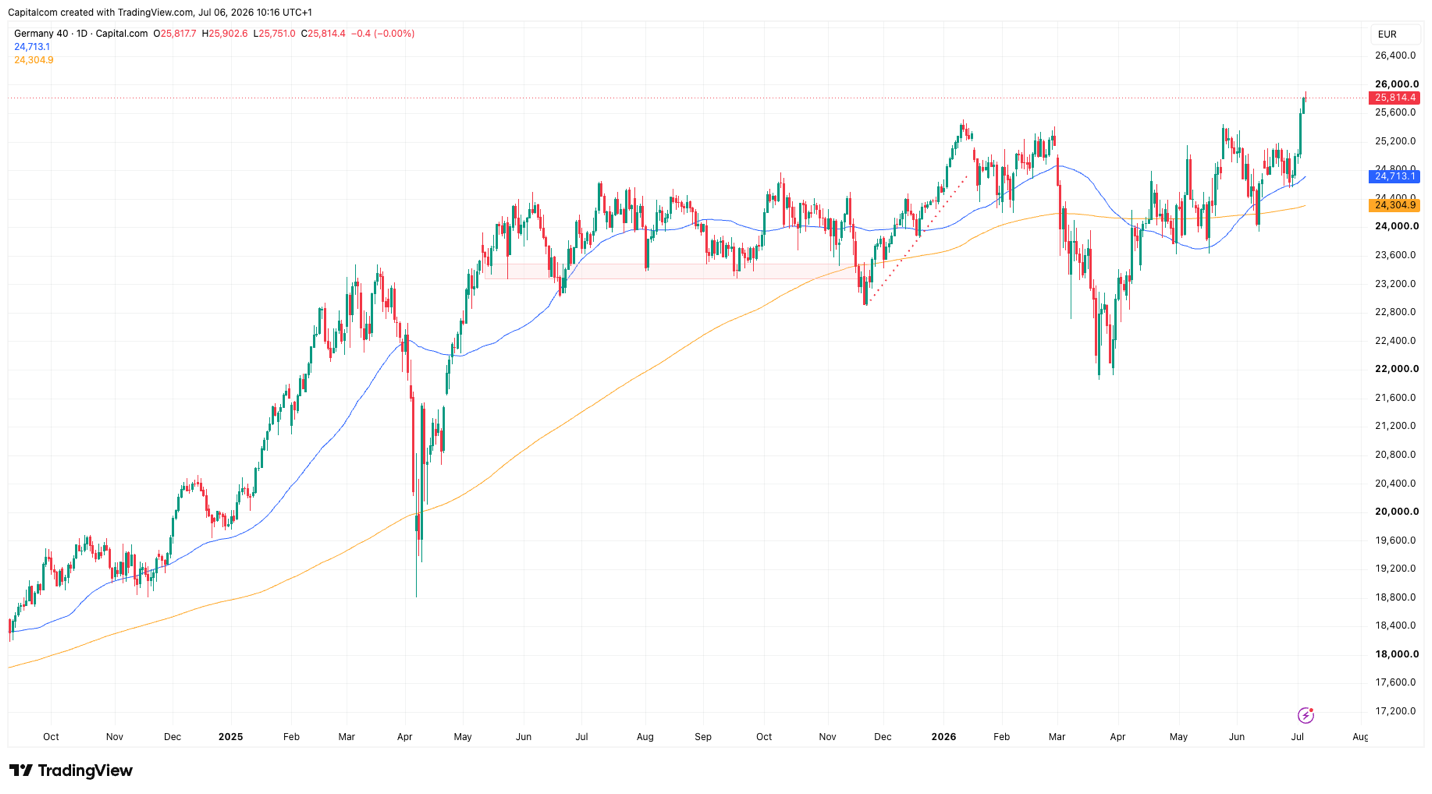
For much of the past decade, the investment conversation has revolved around one market: the United States. Every setback in Europe has reinforced the narrative that Wall Street is where investors should be, while European equities have been viewed as slower growing, more cyclical and ultimately less attractive than their US counterparts. Yet the DAX 40's push to fresh all-time highs suggests that narrative may be changing.
DAX 40 daily chart
Past performance is not a reliable indicator of future results.
The obvious explanation is that Europe has benefited from the sharp decline in energy prices following the easing of tensions in the Middle East. Cheaper oil has reduced inflationary pressure and improved the outlook for an economy that remains more dependent on imported energy than the United States. It has also eased concerns that higher energy costs would erode corporate margins and consumer spending.
But that alone does not explain why Germany's benchmark index has climbed to record territory. Perhaps the more important development is that markets have become increasingly comfortable with the European macro backdrop. Inflation remains above target, but it is no longer accelerating. The ECB has demonstrated its willingness to tighten policy where necessary, yet its communication has avoided creating unnecessary concern that rates will continue rising aggressively. That combination has allowed investors to shift their attention back toward earnings and economic resilience rather than simply worrying about inflation.
Contrast that with the United States. Wall Street still enjoys the stronger structural growth story, particularly through artificial intelligence, but investors are also grappling with a more complicated policy outlook. Kevin Warsh's arrival at the Federal Reserve has reinforced expectations that rates could remain restrictive for longer, supporting the dollar and Treasury yields while creating periodic headwinds for equity valuations. The AI narrative remains intact, but markets have become increasingly sensitive to every inflation print and labour market release.
The DAX also reflects something broader than Germany alone. Its heavyweight exposure to industrials, engineering and globally diversified exporters means it has benefited from resilient global demand while simultaneously enjoying the tailwind of lower energy costs. Meanwhile, valuation remains considerably less demanding than many parts of the US technology sector, leaving investors with less pressure to justify exceptionally optimistic growth assumptions.
Technically, the picture has also improved markedly. The DAX has broken convincingly to new highs while holding comfortably above both its 50-day and 200-day moving averages. Unlike some other major indices that have struggled to regain momentum after recent volatility, the German benchmark continues to produce a sequence of higher highs and higher lows, reinforcing the strength of the prevailing uptrend.