HomeSilver price forecast: Dollar weakness, supply deficit

Silver price forecast: Dollar weakness, supply deficit

Silver is a widely traded precious metal used in both investment and industry, with prices in April 2026 shaped by dollar weakness and a projected sixth consecutive annual supply deficit. Explore third-party Silver price targets. Past performance is not a reliable indicator of future results.
By Dan Mitchell
Silver Price Forecast | Dollar Weakness, Supply Deficit
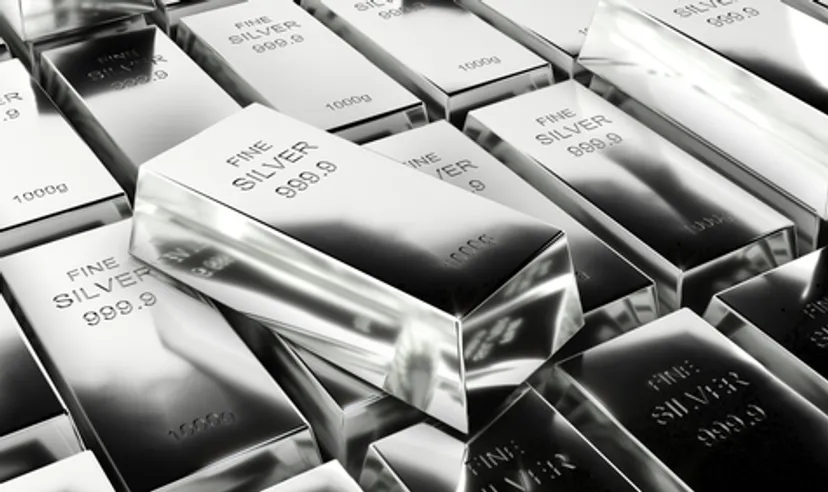
Source: Shutterstock

Silver (XAG) is trading at $78.87 as of 11:25am UTC on 21 April 2026, within an intraday range of $78.60–$80.39. Past performance is not a reliable indicator of future results.

Dollar weakness and persistent structural supply concerns continue to underpin the metal. The US dollar has remained broadly under pressure in mid-to-late April 2026, supporting demand for dollar-denominated commodities such as silver (Moneta Markets, 16 April 2026). The Silver Institute and Metals Focus confirmed in their World Silver Survey published on 15 April 2026 that the global silver market is projected to record a sixth consecutive annual supply deficit, with the 2026 shortfall estimated at 46.3 million troy ounces, up 15% from 40.3 million ounces in 2025 (Silver Institute / Metals Focus, 10 February 2026). Silver's dual role as both a safe-haven asset and an industrial metal, with industrial consumption from solar, EV, and semiconductor sectors cited as a structural demand floor, has kept investor interest elevated amid ongoing uncertainty over US trade policy (European Business Magazine, 25 February 2026).

Silver price forecast 2026-2030: Analyst price target view

As of 21 April 2026, third-party Silver predictions reflect sharply diverging views, shaped by a structural supply deficit now in its sixth consecutive year, elevated post-January volatility, and uncertainty over whether industrial demand destruction at high prices will cap further gains.

Bloomberg Intelligence (range-bound outlook)

Mike McGlone, senior commodity strategist at Bloomberg Intelligence, states in his April 2026 metals analysis that silver prices are likely to languish between $50 and $100 for years, arguing that the metal's January 2026 spike to $121.65/oz may represent a generational peak, with demand destruction from price-sensitive industrial users acting as a structural ceiling. McGlone notes that silver's September 2011 all-time high was not exceeded for more than a decade, cautioning that a repeat of protracted range-bound trading is a plausible outcome amid easing speculative positioning (Kitco News, 16 April 2026).

Silver Institute / Metals Focus (World Silver Survey 2026)

The World Silver Survey 2026 does not publish a formal spot price target but projects the global silver supply deficit will widen to 46.3 million ounces in 2026, a 15% increase from 40.3 million ounces in 2025, with continued drawdowns of above-ground COMEX and London vault stocks cited as a key price-support mechanism. The survey characterises the current environment as a price discovery phase, with the $70 – $80/oz band described as the area where strong physical support has been established following the January sell-off (Silver Institute / Metals Focus, 10 February 2026).

J.P. Morgan (annual average forecast)

J.P. Morgan maintains its 2026 annual average silver price forecast at $81/oz, with quarterly projections ranging from $84/oz in Q1 to $85/oz in Q4, citing tight physical supply and structural industrial demand as the key underpinnings, while noting that the metal can overshoot during periods of strong investor inflows. The bank acknowledges that these figures represent an annual average, not a year-end target, and that speculative positioning remains a key risk should fundamentals fail to catch up with price levels (TheStreet, 20 February 2026).

Goldman Sachs (green-transition thesis)

Goldman Sachs projects silver will average $85 – $100/oz in 2026, describing the metal as the primary strategic metal of the green transition amid rising demand from solar panels, AI-linked hardware, and electric vehicles, with thin vault inventories in London flagged as a potential amplifier of capital-flow-driven price spikes. The firm argues that the structural supply deficit makes sustained moves below $70/oz increasingly difficult, though it does not publish a single year-end price point (Finance Magnates, 7 April 2026).

Bank of America (ratio compression scenario)

Bank of America's head of metals research, Michael Widmer, maintains a year-end 2026 target range of $135 – $309/oz, derived from two gold-to-silver ratio compression scenarios: $135/oz applies the 2011 ratio low of 32:1 against gold near $5,000/oz, while $309/oz applies the 1980 Hunt Brothers extreme ratio of 14:1. Widmer acknowledges that both scenarios are historically grounded rather than base-case projections, with COMEX inventory drawdowns and physical tightness cited as the key preconditions for reaching either level (TheStreet, 16 April 2026).

Predictions and third-party forecasts are inherently uncertain, as they cannot fully account for unexpected market developments. Past performance is not a reliable indicator of future results.

Silver price: Technical overview

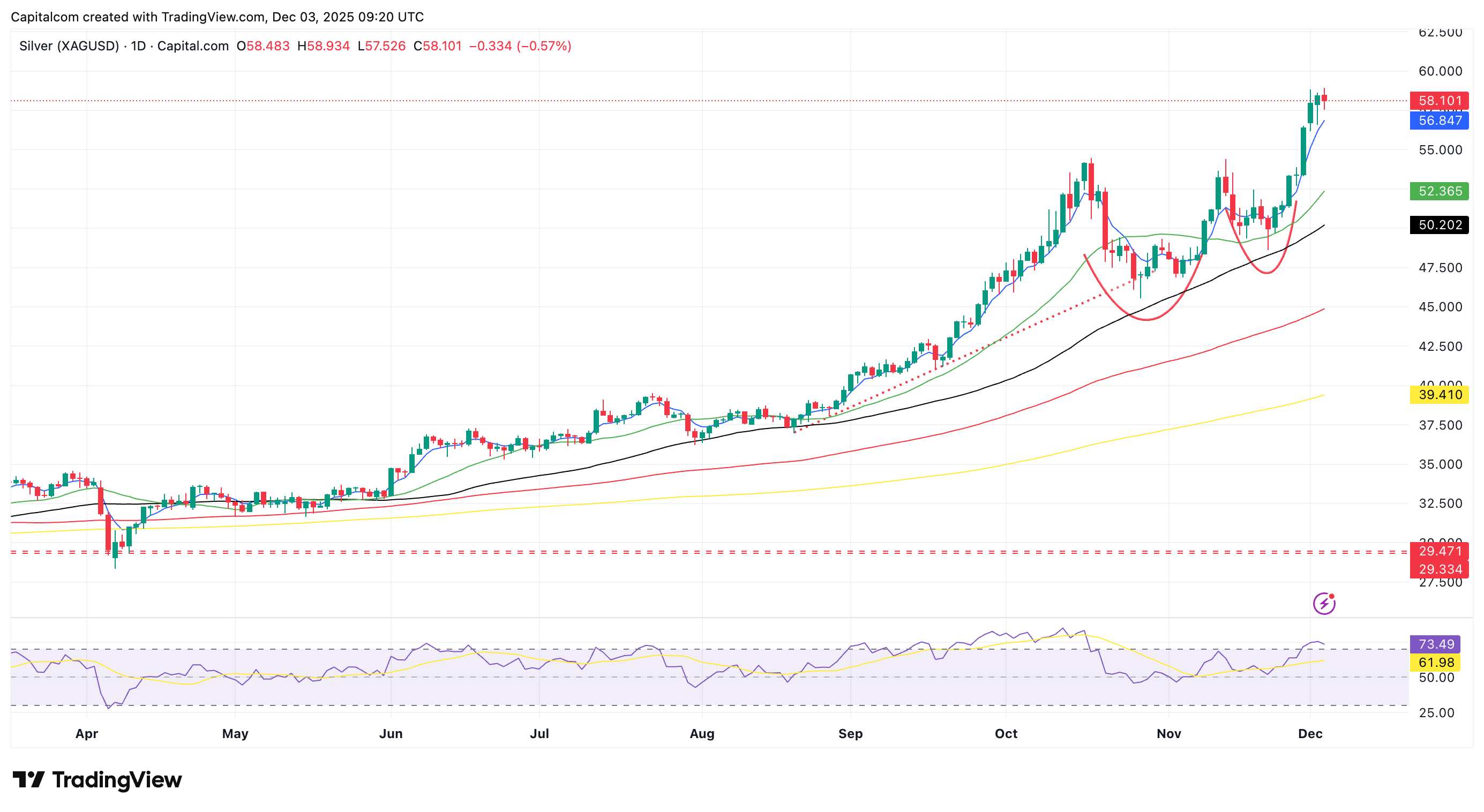
Silver spot trades at $78.87 as of 11:25am UTC on 21 April 2026, holding above its classic pivot point at $77.52 and within a broadly constructive moving-average setup.

On the daily chart, the Silver futures price sits above the 20/50/100-day SMAs at approximately $74.83 / $79 / $77.81, with the 200-day SMA well below, near $60.69. The 50-day SMA at $79 is the nearest overhead reference within the cluster, sitting fractionally above the last close. The Hull moving average (9) at $80.44 sits above the current price, suggesting near-term momentum has pulled back from its recent pace.

The 14-day relative strength index reads 53.74, placing it in upper-neutral territory and indicating that conditions are neither stretched nor showing signs of distribution, while the average directional index at 17.57 indicates a trend of moderate rather than established strength.

To the upside, the classic R1 at $94.02 represents the next pivot reference; a sustained daily close above $79 , which aligns with the 50-day SMA, would first need to be established before that level comes into view. On pullbacks, the classic pivot at $77.52 offers an initial reference point, with the 100-day SMA near $77.81 forming a nearby support area; a move beneath that area would bring S1 at $58.64 into the broader picture (TradingView, 21 April 2026).

This is technical analysis for informational purposes only and does not constitute financial advice or a recommendation to buy or sell any instrument.

Silver price history (2024–2026)

The Silver spot price closed 2024 at $28.91, having spent much of the year consolidating in the high-$20s to low-$30s range. The metal began to gain momentum into late 2024, and by the start of 2026, prices had already climbed to $72.70 on 1 January , almost doubling from the December 2024 close, driven by a combination of dollar weakness, safe-haven demand, and a widening physical supply deficit.

The most dramatic move came in late January 2026, when XAG surged to an intraday high of $121.69 on 29 January before retreating sharply. By 5 February, prices had pulled back to $67.27 as the initial spike unwound. Silver then staged a partial recovery, reaching $95.82 on 1 March 2026 before selling off again through late March, with the metal touching lows near $61.06 on 23 March amid renewed volatility.

Silver spot closed at $79.02 on 21 April 2026, which is approximately 8.7% up year to date and 141.2% higher year on year.

Past performance is not a reliable indicator of future results. Prices are indicative and may differ from live market prices.

Silver price outlook: Capital.com analysis

Silver's performance since the start of 2026 has been striking, with the metal surging from $72.70 in early January to an intraday high of $121.69 on 29 January before pulling back sharply. The structural backdrop remains broadly supportive: a sixth consecutive annual supply deficit, persistent dollar weakness, and growing industrial demand from solar, EV, and semiconductor sectors all underpin the longer-term case for interest in the metal. However, the violent round trip in late January and February illustrates the risks within that picture as silver's relatively thin market depth means speculative positioning can amplify moves in both directions, and price-sensitive industrial buyers may reduce consumption at elevated levels, which could limit further gains.

More recently, XAG has stabilised in the $67–$81 range, suggesting that participants are reassessing fair value after the spike. Macro tailwinds, including uncertainty around US trade policy and a softer dollar, continue to attract haven-oriented flows; yet any resolution of those tensions, or a shift in Federal Reserve policy expectations, could quickly reverse that dynamic. The physical deficit may provide support, but elevated prices can also incentivise new mine supply over time, potentially narrowing that gap.

CFDs are complex instruments and come with a high risk of losing money rapidly due to leverage. Past performance is not a reliable indicator of future results.

Capital.com’s client sentiment for Silver CFDs

As of 21 April 2026, Capital.com client positioning in Silver spot CFDs shows 82.2% buyers versus 17.8% sellers, putting buyers ahead by 64.4 percentage points and placing sentiment firmly in heavy-buy, one-sided-towards-longs territory. This snapshot reflects open positions on Capital.com at the time of capture and can change rapidly as market conditions shift.

Image

Summary – Silver price 2026

Past performance is not a reliable indicator of future results.

FAQ

What is the silver price forecast?

There is no single forecast for silver. In the article, third-party projections published in April 2026 range from a broad multi-year trading band of $50–$100 per ounce to higher average or scenario-based views above that level. The gap between those forecasts reflects uncertainty around key drivers, including the supply deficit, US dollar moves, industrial demand, and speculative positioning. Forecasts are external opinions rather than certainties, so they should be treated as one input among many.

Could silver’s price go up or down?

Yes. Silver can move in either direction, sometimes quickly. In the article, supportive factors include persistent supply constraints, dollar weakness, and demand linked to industrial uses such as solar, EVs, and semiconductors. At the same time, prices could come under pressure if the dollar strengthens, policy expectations change, or high prices reduce demand from price-sensitive buyers. Silver can also be volatile, which means short-term moves may be amplified by positioning and liquidity conditions.

Should I invest in silver?

Whether silver is suitable depends on your objectives, risk tolerance, time horizon, and understanding of the market. The article is informational and does not provide investment advice or a recommendation. Silver may attract attention because of its role as both an industrial metal and a store-of-value asset, but it can also experience sharp price swings. If you are considering exposure, it is important to understand both the potential opportunities and the risks before making any decision.

Can I trade silver CFDs on Capital.com?

Yes, you can trade Silver CFDs on Capital.com. Trading commodity CFDs lets you speculate on price movements without owning the underlying asset and to take long or short positions. However, contracts for difference (CFDs) are traded on margin, and leverage amplifies both profits and losses. You should ensure you understand how CFD trading works, assess your risk tolerance, and recognise that losses can occur quickly.

Capital.com is an execution-only brokerage platform and the content provided on the Capital.com website is intended for informational purposes only and should not be regarded as an offer to sell or a solicitation of an offer to buy the products or securities to which it applies. No representation or warranty is given as to the accuracy or completeness of the information provided.

The information provided does not constitute investment advice nor take into account the individual financial circumstances or objectives of any investor. Any information that may be provided relating to past performance is not a reliable indicator of future results or performance.

To the extent permitted by law, in no event shall Capital.com (or any affiliate or employee) have any liability for any loss arising from the use of the information provided. Any person acting on the information does so entirely at their own risk.

Any information which could be construed as “investment research” has not been prepared in accordance with legal requirements designed to promote the independence of investment research and as such is considered to be a marketing communication.