
Plug Power (PLUG) stock forecast: Is it time to buy the dip?
Plug Power is a US hydrogen technology company listed on Nasdaq. It reported Q2 2026 revenue of $178.3m, compared with analyst consensus of $169.11m. Explore third-party PLUG price targets and technical analysis. Past performance is not a reliable indicator of future results.
Plug Power (PLUG) traded at $2.10 at 1:35pm UTC on 16 September 2026, within an intraday range of $2.02–$2.10. Past performance is not a reliable indicator of future results.
Recent developments include second-quarter revenue of $178.3m, above the $169.11m analyst consensus, while equipment and electrolyser sales declined sharply year on year (Yahoo Finance, 11 August 2026). Management also continued investor meetings, with Craig-Hallum hosting roadshows in Minneapolis and Milwaukee/Chicago on 16 and 17 September (Ad Hoc News, 14 September 2026). Separately, an executive disclosed a Rule 10b5-1 share sale earlier in the week (StockTitan, 11 September 2026).
Third-party Plug Power outlook: Q2 beat and margin recovery
As of 16 September 2026, third-party Plug Power stock predictions reflect different assumptions around margin recovery, equipment demand and future growth.
Roth Capital (individual broker target)
Roth Capital raised its target to $5 from $3.50 while reiterating a Buy rating. The revision followed second-quarter results and reflected greater confidence in Plug Power’s growth and margin trajectory (Yahoo Finance, 11 September 2026).
Craig-Hallum (individual broker target)
Craig-Hallum reiterated a Buy rating and $5 target after Plug Power exceeded second-quarter expectations and raised its full-year revenue-growth outlook (Investing.com, 11 August 2026).
Canaccord Genuity (individual broker target)
Canaccord Genuity reiterated a Hold rating with a $4 target, maintaining a more cautious view despite improved second-quarter execution (Investing.com, 11 August 2026).
Susquehanna (individual broker target)
Susquehanna lowered its target to $2.50 from $3.75 while keeping a Neutral rating, citing a more conservative view of near-term equipment demand (StockAnalysis.com, 10 August 2026).
Morgan Stanley (individual broker target)
Morgan Stanley raised its target to $1.65 from $1.50 while maintaining an Underweight rating. Its revised target remained below the other broker estimates cited here (GuruFocus, 7 August 2026).
Predictions and third-party forecasts are inherently uncertain, as they cannot fully account for unexpected market developments. Past performance is not a reliable indicator of future results.
Plug Power earnings: latest results and next report
Plug Power’s latest results cover the second quarter ended 30 June 2026. Net revenue was approximately $178m, up around 9% from the first quarter, while GAAP loss per share narrowed to $0.14 from $0.20 a year earlier and adjusted loss per share narrowed to $0.07 from $0.18.
Consolidated gross margin was approximately break-even, compared with negative 13% in the first quarter and negative 31% a year earlier. Plug also reported net cash usage of around $61m and operating expenses of approximately $62m, down about 50% year on year.
The company raised full-year 2026 revenue-growth guidance to 15%–16% and reiterated its target for positive EBITDAS in the fourth quarter. Plug defines EBITDAS as earnings before interest, taxes, depreciation, amortisation and stock-based compensation (Plug Power, 10 August 2026).
Plug Power had not announced a formal date for its third-quarter results as of 16 September. MarketBeat estimates 9 November 2026 based on historical reporting schedules, so this remains an estimated date rather than a company-confirmed release (MarketBeat, accessed 16 September 2026).
PLUG stock price: technical overview
As of 1:35pm UTC on 16 September 2026, the PLUG stock price traded at $2.10, below its 20-, 50-, 100- and 200-day simple moving averages near $2.17, $2.18, $2.70 and $2.48 respectively. The 20-day SMA remained below the 50-day average, while the 50-day EMA stood near $2.27 and the 100- and 200-day EMAs near $2.42–$2.43.
The 14-day RSI stood at 41.9, below its neutral midpoint but above the conventional oversold threshold of 30. ADX at 11.7 was below the conventional 25 reference often associated with an established trend. ADX measures trend strength rather than direction.
Higher technical references included the central pivot at $2.23, R1 at $2.46 and R2 at $2.77. The 200-day SMA near $2.48 also sat within this higher area. Below the quoted price, S1 at $1.93 and S2 at $1.70 provided lower references (TradingView, 16 September 2026).
These indicators and levels provide technical reference points rather than indications of future price direction.
This is technical analysis for informational purposes only and does not constitute financial advice or a recommendation to buy or sell any instrument.
Plug Power share price history (2024–2026)
PLUG’s stock price traded at $2.16 on 17 September 2024. The stock moved lower through the autumn, trading largely between $1.90–$2.30 into November, before rising above $2.50 in December. The move continued into January 2025, when the shares reached $3.47 on 7 January before falling through February and March.
Further declines took the shares to a multi-year low of $0.72 on 26 June 2025. They recovered to around $1.80 by late July before rising sharply on 6 October, reaching an intraday high of $4.75 and closing at $4.23. The advance then faded into November.
A later rise through December 2025 and January 2026 took the shares to $3.47 on 7 January. They moved above $3.50 in late April and reached intraday highs of $4.33 on 11 May and $4.35 on 2 June before declining into early July.
Second-quarter results on 10 August showed revenue of around $178m, gross margin near break-even and full-year revenue-growth guidance of 15%–16%. The shares subsequently traded around $2.40 before moving lower through late August and early September.
As of 1:35pm UTC on 16 September 2026, Plug Power traded at $2.10. That was around 23.5% above the $1.70 level recorded a year earlier, but well below the October 2025 intraday high of $4.75.

Past performance is not a reliable indicator of future results. Share prices are indicative and may differ from live market prices.
Plug Power (PLUG): Capital.com analyst view
Plug Power’s second-quarter results showed some improvement in revenue, gross margin and quarterly cash usage, while the company also raised its full-year revenue-growth guidance to 15%–16% (SEC, 10 August 2026).
Further margin improvement, lower cash usage or revenue growth in line with guidance could support expectations around Plug’s operating performance. Continued losses, higher funding requirements or slower project execution could weigh on those expectations instead.
Equipment demand and the timing of customer projects also remain relevant. Stronger deliveries and successful conversion of the sales pipeline could support revenue and margins, while delays or weaker demand could make management’s targets harder to reach.
Capital.com’s client sentiment for Plug Power CFDs
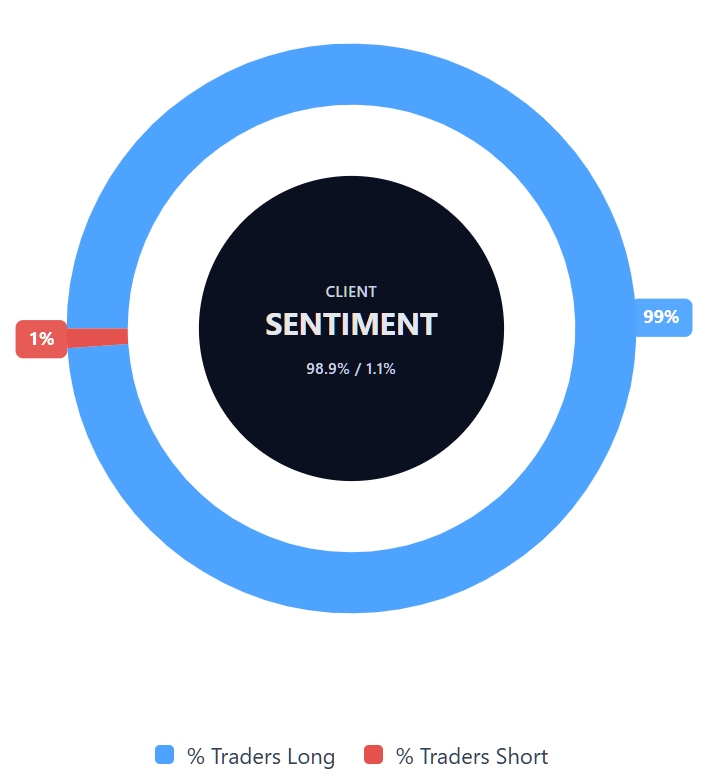
As of 16 September 2026, Capital.com client positioning in Plug Power CFDs shows 98.9% buyers and 1.1% sellers, a difference of 97.8 percentage points. This reflects open positions on the platform, can change and does not indicate future price direction.
Summary – Plug Power 2026
- As of 1:35pm UTC on 16 September 2026, Plug Power traded at $2.10 within an intraday range of $2.02–$2.10.
- According to TradingView data, technical readings placed the price below its 20-, 50-, 100- and 200-day SMAs, with RSI at 41.9 and ADX at 11.7.
- Key influences include margin recovery, revenue growth, equipment demand, cash usage and project execution.
- Further margin improvement, stronger deliveries or revenue growth could support expectations, while continued losses, higher cash use or weaker demand could weigh on them.
- Recent developments include Craig-Hallum investor roadshows, a Rule 10b5-1 executive share sale and mixed analyst target revisions since August 2026.
Past performance is not a reliable indicator of future results.
FAQ
Who owns the most Plug Power stock?
This article does not identify Plug Power’s largest shareholder, as its focus is on price performance, earnings, analyst forecasts and recent company developments. Investors looking for current ownership data should check Plug Power’s latest regulatory filings and shareholder disclosures, as institutional and insider holdings can change over time. Ownership information can provide context around voting influence and investor concentration, but it does not indicate how PLUG shares will perform.
What is the five-year Plug Power share price forecast?
The forecasts covered here do not provide a reliable five-year PLUG stock forecast. The cited broker targets are shorter-term estimates ranging from $1.65–$5. Longer-term performance could depend on revenue growth, margin recovery, cash usage, equipment demand and project execution. Funding needs and hydrogen-sector conditions may also matter. Forecast uncertainty generally increases over longer periods, so these targets should be treated as third-party valuation scenarios rather than expected future prices.
Is Plug Power a good stock to buy?
Whether Plug Power is suitable to buy depends on an individual’s objectives, financial circumstances and tolerance for risk. Improving margins, stronger revenue growth or lower cash usage could support expectations for the business. Continued losses, weaker equipment demand, project delays or higher funding requirements could weigh on them instead. The broker targets cited on this page range widely, reflecting different assumptions rather than a single market view or investment recommendation.
Could Plug Power stock go up or down?
Yes. Plug Power shares can move in either direction as company and sector conditions change. Stronger deliveries, further margin improvement, revenue growth in line with guidance or lower cash usage could support expectations. Conversely, continued losses, weaker equipment demand, project delays or greater funding needs could weigh on the share price. Broader sentiment towards hydrogen and clean-energy companies may also influence PLUG independently of individual company developments.
Should I invest in Plug Power stock?
Whether to invest in Plug Power depends on your personal circumstances, objectives and attitude to risk. Factors to consider include revenue growth, gross margins, cash usage, operating losses, equipment demand and the company’s ability to convert its sales pipeline into recognised revenue. The analyst targets cited here range from $1.65–$5, showing different valuation assumptions. Past performance and third-party forecasts are not reliable indicators of future returns.
Can I trade Plug Power CFDs on Capital.com?
Yes, you can trade Plug Power CFDs on Capital.com. Trading share CFDs lets you speculate on price movements without owning the underlying asset and to take long or short positions. However, contracts for difference (CFDs) are traded on margin, and leverage amplifies both profits and losses. You should ensure you understand how CFD trading works, assess your risk tolerance, and recognise that losses can occur quickly.