Germany 40 forecast: ECB hike and tariff pressure
Germany 40 is a German stock index whose price is being shaped by ECB rate expectations, weaker GDP forecasts and US tariff pressure. Explore third-party DE40 targets and technical analysis. Past performance is not a reliable indicator of future results.
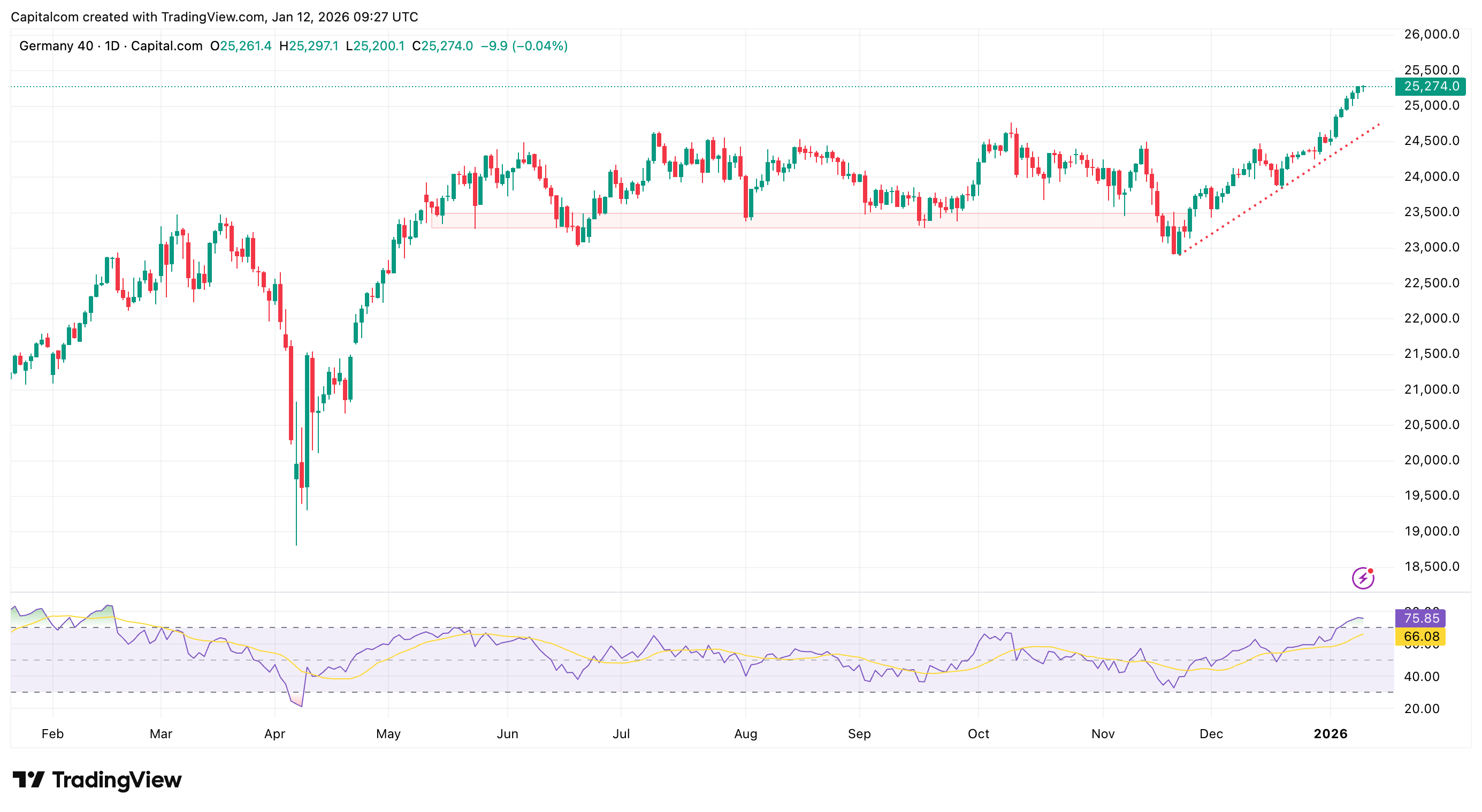
The DAX index – referred to as the Germany 40 (DE40) on CFD trading platforms such as Capital.com – is trading at 24,687.70 as of 12:20pm UTC on 8 June 2026, within an intraday range of 24,364.20–25,001.10 on Capital.com's quote feed. Past performance is not a reliable indicator of future results. Past performance is not a reliable indicator of future results.
Pressure on the DE40 reflects a combination of macro headwinds. The ECB is widely expected to raise its deposit rate by 25 basis points to 2.25% at its 11 June Governing Council meeting – the first hike in this cycle – after euro-area inflation rose to 3% in April, driven in part by elevated energy costs tied to the Iran conflict (Daily Sabah, 30 April 2026). Germany's GDP growth forecast has also been cut to +0.5% for 2026 from an earlier +1.0% projection, adding to concerns over the domestic outlook (Reuters, 22 April 2026). The backdrop is further complicated by US trade-tariff uncertainty, with Germany among the countries subject to escalating US import duties that rose to 25% from 1 June, weighing on the index's export-heavy composition (PwC, 19 January 2026).
Third-party Germany 40 outlook: ECB rate risk and tariffs
As of 8 June 2026, third-party Germany 40 predictions point to a wide range of near-term and year-end outcomes, shaped by ECB rate policy, US tariff exposure, domestic macro data, and energy inflation concerns.
RoboForex (near-term technical levels)
RoboForex identifies 25,145 as near-term resistance and 23,810 as key support for the DE40, with a bullish scenario pointing toward 25,475 on a break higher and a bearish scenario projecting a decline to 23,380 on a support breach. The publication notes Germany's Q1 2026 GDP growth of 0.3% quarter-on-quarter as a moderately positive backdrop, though it adds that the data matched forecasts and was therefore unlikely to trigger a strong surprise-driven move (RoboForex, 25 May 2026).
RoboForex (near-term technical levels)
RoboForex revises resistance higher to 25,455 and retains support at 23,810, with the nearest upside target at 25,940 on a breakout. The publication cites Germany's May unemployment rate falling to 6.3%, below both the forecast and April's 6.4% reading, as a moderately positive signal for the index, while noting that the ECB policy path, industrial exports, and corporate earnings remain the more decisive drivers (RoboForex, 1 June 2026).
DailyForex (technical level analysis)
DailyForex places the DE40 near the 25,000 level, describing that figure as a near-term price magnet, with 25,500 acting as the next ceiling on an upside break. Senior technical analyst Christopher Lewis flags rising interest rate expectations and energy inflation risks as the primary sources of headwinds for the index in the current session (DailyForex, 4 June 2026).
Coin Price Forecast (algorithm-based)
Coin Price Forecast carries a mid-2026 DE40 target of 25,894 and a year-end 2026 target of 26,469 in its current daily-updated algorithmic model, implying approximately 6% upside from the index's current level. The model has revised progressively upward since its 2 February 2026 capture, which held a more modest year-end target of 25,525 (Coin Price Forecast, 7 June 2026).
Trading Economics (macro-regression model)
Trading Economics projects the DE40 at approximately 22,228 on a 12-month horizon as of 8 June 2026, based on its macro-regression model applied to Germany's underlying economic indicators. The projection reflects headwinds including a 3.8% month-on-month decline in German factory orders in April 2026, alongside persistently elevated energy costs and slowing industrial demand (Trading Economics, 8 June 2026).
Predictions and third-party forecasts are inherently uncertain, as they cannot fully account for unexpected market developments. Past performance is not a reliable indicator of future results.
Germany 40 constituents: latest and upcoming earnings
Q1 2026 results for DE40 constituents showed a clear split between financial-sector strength and industrial pressure. According to an analysis by consulting firm EY, the 40 DAX-listed companies reported aggregate EBIT growth of 4.4% year-on-year in Q1 2026, even as revenues fell by an average of 3.7%; the financial sector led with record profit growth of 15.9%, while all car manufacturers reported falling profits. Deutsche Telekom posted the highest quarterly profit among DAX constituents at €5.8bn, followed by Allianz at €4.5bn and E.ON at €3.9bn, with Siemens Energy and Munich Re also cited among the strongest performers for the quarter (Deutschland.de, 17 May 2026).
Looking ahead, Volkswagen AG is scheduled to publish its H1 2026 results in July, following its Annual General Meeting on 18 June 2026 and an ESG Conference on 10 June 2026, according to the company's investor calendar (Volkswagen Group IR, 30 April 2026). Siemens Energy, which raised its fiscal year 2026 net income outlook to approximately €4bn and lifted its free cash flow pre-tax guidance to around €8bn, is one of the more closely watched constituents heading into the Q2 reporting window (Siemens Energy IR, 26 May 2026). The week of 8 June 2026 carries limited DAX-specific scheduled earnings releases, with the primary event risk centred on the ECB rate decision on 11 June, with markets pricing in a greater than 95% probability of a 25 basis point hike to 2.25% – a decision expected to influence the interest-rate-sensitive financials and utilities constituents that drove Q1 outperformance (Reuters, 5 June 2026).
DE40 index price: technical overview
The DE40 index trades at 24,687.70 as of 12:20pm UTC on 8 June 2026, below the 10- and 20-day simple moving averages at 24,986 and 24,734, and broadly within the longer-term moving average cluster. The 50/100/200-day SMAs at approximately 24,216 / 24,304 / 24,180 currently form a collective support shelf.
Momentum signals from TradingView are mixed. The 14-day relative strength index reads 50.17, placing it in neutral territory with no clear directional bias. The average directional index at 16.73 indicates a weak, non-trending environment, sitting within the 15–25 range that typically characterises consolidation phases.
On the upside, the classic pivot R1 at 25,763 represents the nearest reference above the current price. A daily close above that level would bring the R2 area near 26,421 back into view. The Hull moving average (9) at 24,720 sits just above the current print and may act as an immediate overhead reference.
To the downside, the classic pivot point at 24,780 sits fractionally above the last price. Below that, the 100-day SMA near 24,304 and the 200-day SMA near 24,180 form the next support shelf. A sustained move beneath that band would bring S1 at 24,122 into consideration.
This is technical analysis for informational purposes only and does not constitute financial advice or a recommendation to buy or sell any instrument (TradingView, 8 June 2026).
Germany 40 index history (2024–2026)
The Germany 40 index opened June 2024 around 18,490 and spent most of that summer consolidating in the 18,000–18,750 range, before a sharp sell-off in early August 2024 dragged the index to a low of 17,021 on 5 August. The move coincided with a global equity rout triggered by the Bank of Japan's surprise rate hike and an unwinding of yen carry trades.
The index recovered steadily through Q4 2024, ending the year at 19,832 – up roughly 7% from its August trough. 2025 opened with momentum building, and the DE40 pushed above 25,500 by mid-January 2026, its strongest level in the two-year window. However, the index reversed sharply in April 2025 when US President Trump announced sweeping reciprocal tariffs, sending the DE40 as low as 18,809 on 7 April 2025 – one of its sharpest single-day drops in the period.
A recovery followed through the remainder of 2025 and into 2026, with the index returning to the 25,000–25,400 range by late May 2026 before renewed pressure from ECB rate-hike expectations and trade uncertainty pulled it back to its current level.
Germany 40 closed at 24,687.50 on 8 June 2026, approximately 2.5% above its 8 June 2025 close of 24,300.40, and up roughly 0.7% year to date from the 1 January 2026 open of 24,521.20.
Past performance is not a reliable indicator of future results. Prices are indicative and may differ from live market prices.
Germany 40 (DE40): Capital.com analyst view
The Germany 40 (DE40) has navigated a volatile 2026, recovering from an April low near 21,504 – driven by the initial shock of US reciprocal tariff announcements – to trade around 24,688 as of 8 June 2026. That rebound reflects a resilient earnings picture, with aggregate EBIT across DAX constituents rising 4.4% year-on-year in Q1 2026 despite a 3.7% revenue decline, led by strong financial-sector results. Germany's fiscal spending plans, including defence and infrastructure investment, have also supported sentiment.
At the same time, the index remains sensitive to several headwinds. The ECB is widely expected to raise rates to 2.25% on 11 June 2026, which could weigh on interest-rate-sensitive constituents and compress valuations. German GDP growth has been revised down to 0.6% for 2026, while a 15% US baseline tariff on EU goods continues to pressure the index's export-heavy constituents, particularly in the automotive sector.
The DE40's composition – spanning industrials, financials, technology, and healthcare – gives traders exposure to a broad section of Germany's economic cycle. However, that same export-heavy weighting also increases sensitivity to global demand cycles, trade policy shifts, and energy cost volatility, meaning the index can move in either direction as macro conditions change.
Capital.com’s client sentiment for Germany 40 CFDs
As of 8 June 2026, Capital.com client positioning in Germany 40 CFDs stands at 67.3% buyers versus 32.7% sellers, putting buyers ahead by 34.6 percentage points and keeping sentiment in majority-buy territory. This snapshot reflects open positions on Capital.com and can change.

Summary – Germany 40 2026
- Germany 40 (DE40) trades at 24,687.70 as of 12:20pm UTC on 8 June 2026, down from a January 2026 high near 25,511 but well above the April 2025 tariff-shock low of 18,809.
- Key drivers include an expected ECB rate hike to 2.25% on 11 June, a revised German GDP growth forecast of 0.6% for 2026, and ongoing US tariff pressure on the index's export-heavy constituents.
- Q1 2026 earnings showed EBIT growth of 4.4% year-on-year across DAX constituents despite a 3.7% revenue decline, led by the financial sector. Automotive names reported falling profits amid tariff headwinds.
Past performance is not a reliable indicator of future results.
FAQ
What is the five-year Germany 40 forecast?
Five-year Germany 40 forecasts vary widely because the index is sensitive to domestic growth, ECB policy, global trade conditions, energy prices and corporate earnings. The article highlights near-term third-party projections ranging from support around 23,810 to year-end 2026 algorithmic targets above 26,000, while one macro-regression model points lower. Longer-range forecasts should be treated with caution, as they can change quickly and can’t account for unexpected market events.
Is Germany 40 a good CFD to trade?
Whether Germany 40 is suitable to trade as a CFD depends on your experience, strategy, risk tolerance and understanding of leverage. The index gives exposure to major German-listed companies across sectors including industrials, financials, technology and healthcare, which may appeal to traders looking at macro and earnings-driven moves. However, CFDs are high-risk instruments, and Germany 40 can move sharply in response to rates, tariffs, energy costs and global demand.
Could Germany 40 go up or down?
Germany 40 could move in either direction. A stronger earnings backdrop, supportive fiscal spending, easing tariff concerns or improving economic data could help the index rise. However, higher ECB rates, weaker German growth, energy inflation, softer industrial demand or further trade pressure could weigh on performance. Technical indicators in the article are mixed, with the index trading near key moving averages, which suggests traders may watch both support and resistance levels closely.
Should I invest in Germany 40?
This article doesn’t provide investment advice or a recommendation to buy, sell or hold Germany 40. Whether you choose to invest or trade depends on your goals, financial situation, time horizon and risk appetite. If you’re considering Germany 40 exposure through CFDs, it’s important to understand how leverage works, how quickly losses can build, and whether you can afford the risk. Past performance isn’t a reliable indicator of future results.
Can I trade Germany 40 CFDs on Capital.com?
Yes, you can trade Germany 40 CFDs on Capital.com. Trading index CFDs lets you speculate on price movements without owning the underlying asset and to take long or short positions. However, contracts for difference (CFDs) are traded on margin, and leverage amplifies both profits and losses. You should ensure you understand how CFD trading works, assess your risk tolerance, and recognise that losses can occur quickly.