
Dogecoin price prediction: Third-party outlook
Dogecoin became available on the Solana network through the Sunrise protocol on 7 September 2026, adding a new cross-chain development to recent DOGE market activity. Explore third-party DOGE price targets and technical analysis. Past performance is not a reliable indicator of future results.
Dogecoin (DOGE/USD) last traded at $0.090948, within an intraday range of $0.0886026–$0.0914202 as of 8:32am UTC on 9 September 2026. Past performance is not a reliable indicator of future results.
Price action over the prior week reflected a mix of macroeconomic and crypto-specific developments. The Bureau of Labor Statistics reported on 4 September 2026 that the US economy added 162,000 jobs in August, against a forecast of 53,000 (BLS, 4 September 2026). The stronger reading coincided with higher expectations for a Federal Reserve rate increase, which can weigh on risk-sensitive assets, although softer inflation or a less restrictive policy outlook could ease that pressure (Reuters, 4 September 2026). DOGE later recovered amid a short squeeze in derivatives markets and renewed spot exchange-traded fund inflows, while Dogecoin's integration with the Solana network through the Sunrise protocol added another development for traders to monitor (CoinGabbar, 8 September 2026).
Third-party Dogecoin outlook: Solana launch and Fed outlook
As of 9 September 2026, third-party DOGE price predictions include a range of Dogecoin price targets, using technical, statistical and fundamental methodologies. The figures below reflect each source's assumptions rather than fixed outcomes.
OpenPR (Changelly-sourced technical outlook)
OpenPR reports a September 2026 target range of $0.083–$0.093 for Dogecoin, citing a Changelly projection that places immediate resistance at the 200-day exponential moving average near $0.099. The outlook also identifies the 14 September 2026 DOGE-1 lunar mission, a SpaceX Falcon 9 launch funded in Dogecoin, as a potential catalyst to monitor (OpenPR, 3 September 2026).
MarketForecast (statistical model)
MarketForecast's calibrated model projects a 30-day median of $0.0916 through 21 September 2026, with an 80% confidence interval widening from $0.0802–$0.1048 at the eight-day mark to $0.0701–$0.1197 by day 30. The model assigns a 62% probability to a base case between $0.0691 support and $0.1024 resistance, citing 77% annualised volatility and a 60-day swing range (MarketForecast, 22 August 2026).
CoinGabbar (technical analyst outlook)
CoinGabbar's September 2026 outlook sets an upside range of $0.10128–$0.11861, conditional on a daily close above the $0.08879–$0.09015 retest zone. Its downside scenario points to $0.07902 and then $0.07138 if that area fails. The analysis links the higher-price scenario to a trendline breakout and stronger volume, while identifying Dogecoin's uncapped supply as a possible longer-term constraint (CoinGabbar, 25 August 2026).
OpenPR (Ali Charts whale-accumulation model)
OpenPR cites on-chain tracker Ali Charts in projecting a next target of $0.077 for Dogecoin, based on reported accumulation of more than 430 million tokens by large wallet addresses. The projection remains conditional on trading volume confirming the accumulation signal in subsequent sessions (OpenPR, 18 August 2026).
CBC Global (CoinGape-sourced conditional forecast)
CBC Global reports a CoinGape forecast linking Dogecoin's potential move towards $0.10 to Bitcoin holding above $80,000. It identifies $0.09–$0.093 as an initial target range, followed by $0.095–$0.10 if that area clears. A reversal in Bitcoin could instead weigh on DOGE and the wider crypto market (CBC Global, 23 August 2026).
Predictions and third-party forecasts are inherently uncertain, as they cannot fully account for unexpected market developments. Past performance is not a reliable indicator of future results.
Dogecoin: macro and sector context
Federal Reserve policy remained part of the wider backdrop for Dogecoin ahead of the Federal Open Market Committee meeting scheduled for 15–16 September 2026. The stronger-than-expected August US jobs report, released on 4 September, was followed by CME FedWatch pricing that put the probability of a 25-basis-point rate increase at around 58%–66% (Forbes, 31 August 2026). Higher rate expectations can weigh on risk assets, while softer inflation or a less restrictive policy outlook could have the opposite effect.
Fed Governor Christopher Waller had said in a 3 September 2026 Reuters NEXT interview that he could support holding rates steady if disinflation continued (Reuters, 3 September 2026). . The August consumer price index report, due on 11 September, was the next scheduled release likely to shape rate expectations (Toobit, 7 September 2026).
Dogecoin also became available on the Solana network on 7 September through Sunrise, a cross-chain gateway built by Wormhole Labs, generating a reported $19m in trading volume within its first 24 hours (AMBCrypto, 8 September 2026). Greater interoperability could support activity if adoption continues, although its longer-term price impact remains uncertain.
Separately, spot Dogecoin exchange-traded funds recorded a $419,000 net inflow on 3 September, marking their first three-day inflow run since May 2026. However, they remained $344,000 in net outflows for September at the time of reporting (CoinGabbar, 5 September 2026). Bitcoin also remained part of the wider market backdrop after closing the week above $80,000 for the first time since early May 2026 (Finanzen.net, 7 September 2026).
DOGE price: technical overview
As of 8:32am UTC on 9 September 2026, DOGE/USD was trading above its 20-, 50-, 100- and 200-day simple moving averages (SMAs), at roughly $0.088, $0.078, $0.078 and $0.088 respectively. The 20-day SMA also remained above the 50-day SMA, while the 200-day exponential moving average (EMA) stood near $0.094.
The 14-day relative strength index (RSI) was near 63.4, while the 14-day Average Directional Index (ADX) stood at 41.3, according to TradingView data. These indicators describe recent momentum and trend conditions but do not determine future direction.
The nearest classic pivot above the last traded price was R1 near $0.09993, followed by R2 near $0.11702. Below the market, the classic pivot stood near $0.08377, with the 50-day and 100-day SMAs clustered around $0.078. The S1 pivot sat further down near $0.06668.
The Hull moving average (9) stood near $0.09217, reflecting its faster response to recent price changes than longer-period averages.
A move above nearby resistance could bring higher technical levels into focus, while a move below support could shift attention towards lower ones (TradingView, 9 September 2026).
This is technical analysis for informational purposes only and does not constitute investment advice or a recommendation to buy or sell any instrument.
Dogecoin price history (2024–2026)
DOGE/USD’s price traded around $0.10 in September 2024 before rising sharply through November during a period of heightened pro-crypto sentiment surrounding the US presidential election. It reached close to $0.47 on 8 December 2024 before falling back in early 2025.
DOGE was around $0.29 by February and continued lower later in the year. A rise to $0.25 on 10 October 2025 was followed by a fall to $0.20 the next day, coinciding with a broader crypto-market flash crash.
Dogecoin ended 2025 at $0.1176 before moving lower through the first half of 2026. It reached a 2026 low near $0.0692 on 6 August before recovering.
DOGE closed at $0.0913679 on 9 September 2026, down approximately 22.3% year to date and 62.1% year on year.

Past performance is not a reliable indicator of future results. Prices are indicative and may differ from live market prices.
Capital.com analyst view: Dogecoin
Dogecoin traded well below its late-2024 and early-2025 highs during much of 2026. This coincided with a broader retracement in meme coins, with sector-wide market capitalisation down roughly 82% from its November 2024 peak (CryptoRank, 16 June 2026), uneven spot ETF flows and continued issuance of new Dogecoins.
Price action has not moved in one direction throughout the year. Periods of stabilisation and recovery have coincided with wider blockchain interoperability, changing ETF flows, including a return to net inflows following a 16-session drought in August (Dinar Detectives, 22 August 2026), and reported accumulation by larger wallet addresses. Sustained inflows or greater network activity could support demand, while renewed outflows, weaker adoption or broader crypto-market selling could weigh on price.
Some market participants point to Dogecoin's established liquidity and long trading history as supporting its continued prominence among widely traded cryptocurrencies, noting that it still represents more than half of the meme-coin category's total market value (Yellow.com, 16 June 2026). Others focus on its uncapped supply and comparatively limited utility as potential constraints. Neither view determines where DOGE will trade next.
Capital.com’s client sentiment for Dogecoin CFDs
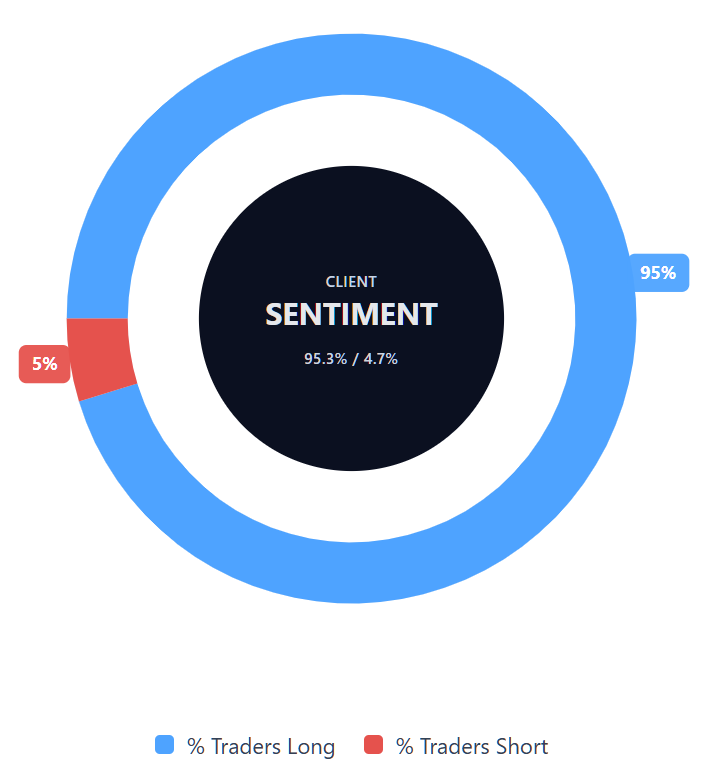
As of 9 September 2026, Capital.com client positioning in Dogecoin CFDs is weighted towards long positions, with 95.3% long and 4.7% short – a difference of 90.6 percentage points.
This snapshot reflects open positions on Capital.com and can change. Client sentiment shows positioning, not future price direction.
Summary – Dogecoin (2026)
- As of 8:32am UTC on 9 September 2026, Dogecoin was trading near $0.090948, within an intraday range of $0.0886026–$0.0914202.
- According to TradingView data, DOGE was above its 20-, 50-, 100- and 200-day SMAs, while its 14-day RSI stood near 63.4.
- Federal Reserve rate expectations, spot Dogecoin ETF flows and Dogecoin's expansion onto Solana remain among the factors in focus.
- Higher rate expectations could weigh on risk assets, while softer inflation or a less restrictive policy outlook could provide support.
Past performance is not a reliable indicator of future results.
FAQ
What is the latest Dogecoin crypto price prediction?
Third-party Dogecoin forecasts cited in this article span roughly $0.077–$0.12 for September 2026. The estimates vary because each source uses different technical, statistical or market assumptions. Some depend on DOGE holding specific support levels, while others look at Bitcoin's price, trading volume or on-chain activity. These forecasts are scenarios rather than fixed outcomes, and unforeseen market developments can make predictions inaccurate.
Who owns the most Dogecoin?
The sources covered in this article do not identify a single person or entity as the largest Dogecoin owner. They do, however, refer to reported accumulation by large wallet addresses, including purchases totalling more than 430 million DOGE before one August 2026 forecast. Large wallet balances can influence market attention, but they do not necessarily reveal who controls the addresses or indicate how Dogecoin's price will move.
How many Dogecoins are there?
This article does not provide a specific figure for Dogecoin's circulating supply. It does note that Dogecoin has an uncapped supply, meaning new DOGE can continue to enter circulation rather than being limited by a fixed maximum. Some analysts view this continued issuance as a potential constraint on price over longer periods, although supply is only one factor. Demand, market sentiment, adoption and wider crypto conditions can also affect DOGE's price.
Could Dogecoin's price go up or down?
Yes. Dogecoin's price can move in either direction, and the article highlights several factors that could influence it. Sustained ETF inflows, greater network activity or stronger wider crypto sentiment could support demand. Conversely, ETF outflows, weaker adoption, higher interest-rate expectations or broader crypto-market selling could weigh on price. Technical levels may also affect short-term trading activity, but none of these factors can reliably predict DOGE's next move.
Should I invest in Dogecoin?
Whether Dogecoin is appropriate for you depends on your circumstances, objectives and tolerance for risk, and this article does not provide investment advice or a personal recommendation. DOGE has experienced substantial price swings, while factors such as crypto-market sentiment, macroeconomic conditions, ETF flows and its uncapped supply can influence its price. If you are considering exposure to Dogecoin, it is important to understand the risks and how the chosen product works.
Can I trade Dogecoin CFDs on Capital.com?
Yes, you can trade Dogecoin CFDs on Capital.com. Trading crypto CFDs lets you speculate on price movements without owning the underlying asset and to take long or short positions. However, contracts for difference (CFDs) are traded on margin, and leverage amplifies both profits and losses. You should ensure you understand how CFD trading works, assess your risk tolerance, and recognise that losses can occur quickly.