
ASML Holding stock forecast: Third-party price targets
ASML Holding (ASML) trades at €828.55 as of 8:50am UTC on 14 October 2025, moving within an intraday range of €827.35–€842.85.
ASML remains near its session low after retreating from earlier highs, as markets react to heightened US–China trade tensions and ahead of tomorrow’s third-quarter earnings release (Nasdaq, 13 October 2025).
Shares came under pressure after China introduced tighter export controls on rare earth elements on 9 October, requiring licensing approval for any product containing over 0.1% of Chinese-origin materials (TrendForce, 7 October 2025). The restrictions focus on advanced semiconductor and AI technologies, coinciding with escalating trade tensions as President Trump proposed 100% tariffs on Chinese imports, while Beijing vowed to implement countermeasures (CNN, 13 October 2025).
ASML Holding stock forecast: Analyst price target view
Susquehanna (positive rating)
Susquehanna maintained its positive rating with a $1,150 target. Analyst Mehdi Hosseini raised the target from $965, citing expectations of sustained demand for extreme ultraviolet systems and steady order momentum ahead of third-quarter results (GuruFocus, 10 October 2025).
JPMorgan (overweight rating)
JPMorgan increased its target to $1,175 from $957, representing the highest forecast among major brokers. Analyst Sandeep Deshpande kept an overweight rating, noting anticipated AI-related semiconductor demand and improved spending outlooks across memory and leading-edge foundry segments (TradingView, 7 October 2025).
Goldman Sachs (buy rating)
Goldman Sachs reaffirmed its buy recommendation with a €935 target on 9 October 2025. The firm highlighted ASML as a key beneficiary of stronger demand for advanced logic and memory driven by AI, while observing potential for a valuation re-rating supported by market share growth into 2027–2028 (Investing.com UK, 9 October 2025).
Morgan Stanley (overweight rating)
Morgan Stanley upgraded from equal-weight to overweight with a €950 target on 22 September 2025. The firm forecast fiscal 2027 earnings per share of about €33, roughly 8% above consensus, citing early signs of cyclical recovery in memory markets and sustained AI-related demand (Yahoo Finance UK, 22 September 2025).
Predictions and third-party forecasts are inherently uncertain and may not reflect future outcomes. Past performance is not a reliable indicator of future results.
ASML stock price: Technical overview
ASML is trading at €828.55 as of 8:50am UTC on 14 October 2025, holding above its key moving-average cluster, with the 20-, 50-, 100- and 200-day SMAs positioned around €830, €722, €689 and €676 respectively. The 20-over-50 alignment remains in place, while price tests the 20-day level, with momentum steady as the 14-day RSI sits at a neutral 58.1.
The first area to watch on the upside is the 902 Classic Pivot (R1); a daily close above this level would place the 976 resistance area in focus and could reopen the path towards the 1,194 mark, representing the R3 level. The stock currently trades between key technical levels, with the Hull Moving Average near €821 acting as short-term dynamic support.
On pullbacks, initial support appears near the 757 Classic Pivot, followed by the 722 level, where the 50-day SMA provides a deeper base. A move below this area could expose the 689 zone, where the 100-day SMA converges. The longer-term moving averages continue to indicate an upward bias, while oscillators suggest a consolidative phase, with momentum indicators presenting mixed signals (TradingView, 14 October 2025).
This analysis is provided for informational purposes only and does not constitute financial advice or a recommendation to buy or sell any instrument.
ASML Holding share price history
ASML shares began trading near €570 in late 2023, marking the start of a significant period of growth for the Dutch semiconductor equipment company.
The stock advanced steadily through the first half of 2024, reaching a peak of €1,013 in July 2024, as demand for artificial intelligence applications lifted the broader chip sector. This represented an increase of nearly 80% from 2023 lows, with ASML supported by strong demand for its extreme ultraviolet (EUV) lithography systems, which are crucial for advanced chip production.
However, the momentum eased in the second half of the year. Third-quarter 2024 earnings results prompted a correction, with shares falling from €795 to €667 on 15 October 2024, amid concerns over China-related demand restrictions and softer order guidance. The stock ended 2024 at €678, reflecting a broader slowdown across the semiconductor sector following the AI-driven rally.
In 2025, ASML regained ground, rising to €747 by late January, before experiencing periods of volatility throughout the year. A decline to €735 in September was followed by a recovery to €897 in early October, although recent Chinese export controls on rare earth materials have since weighed on the share price.
ASML closed at €828.55 on 14 October 2025, up approximately 20.4% year to date and 4.8% over the past 12 months.

Past performance is not a reliable indicator of future results
Capital.com’s client sentiment for ASML Holding CFDs
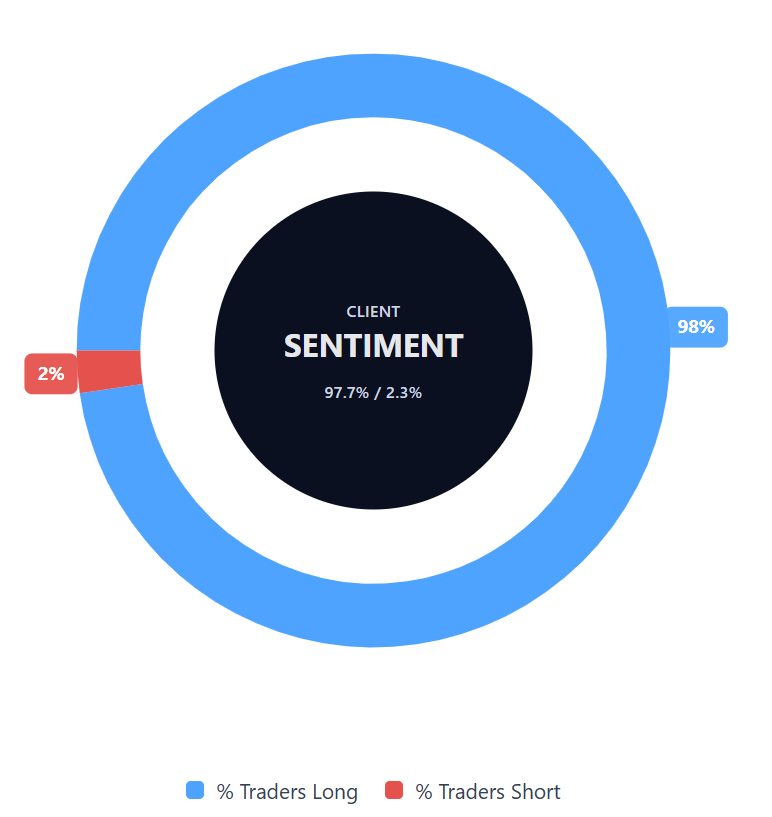
As of 14 October 2025, Client positioning in ASML share CFDs on Capital.com currently shows 97.7% of positions held by buyers and 2.3% by sellers, indicating a strong bias towards long positions, with buyers ahead by 95.4 percentage points.
This data represents open positions on Capital.com and is subject to change.
FAQ
Is ASML Holding a good stock to buy?
Capital.com does not provide investment advice. Whether ASML Holding is considered a good stock depends on individual financial objectives, risk tolerance, and overall market outlook. You may wish to track the company’s financial performance, sector trends, and wider market conditions before making any trading decisions.
Could ASML Holding stock go up or down?
ASML’s share price can move in either direction, depending on factors such as semiconductor demand, global trade developments, and quarterly results. Like all shares, ASML’s price is influenced by market volatility and external economic conditions. Past performance is not a reliable indicator of future results.
Should I invest in ASML Holding stock?
Trading or investing decisions should be based on independent research, personal circumstances and risk appetite. It’s important to note that all financial instruments involve risk, and past performance is not a reliable indicator of future results.
What factors influence ASML Holding’s share price?
ASML’s share price is affected by developments in the semiconductor industry, changes in global demand for chipmaking equipment and wider macroeconomic factors such as interest rates and trade policy. Company-specific events, including earnings updates and technology announcements, can also impact investor sentiment and price movements.