
Oil at $90, stocks at record highs — what are markets really saying?
US equities are storming higher despite oil still trading at elevated levels amidst the unresolved Middle East conflict. How is this possible?
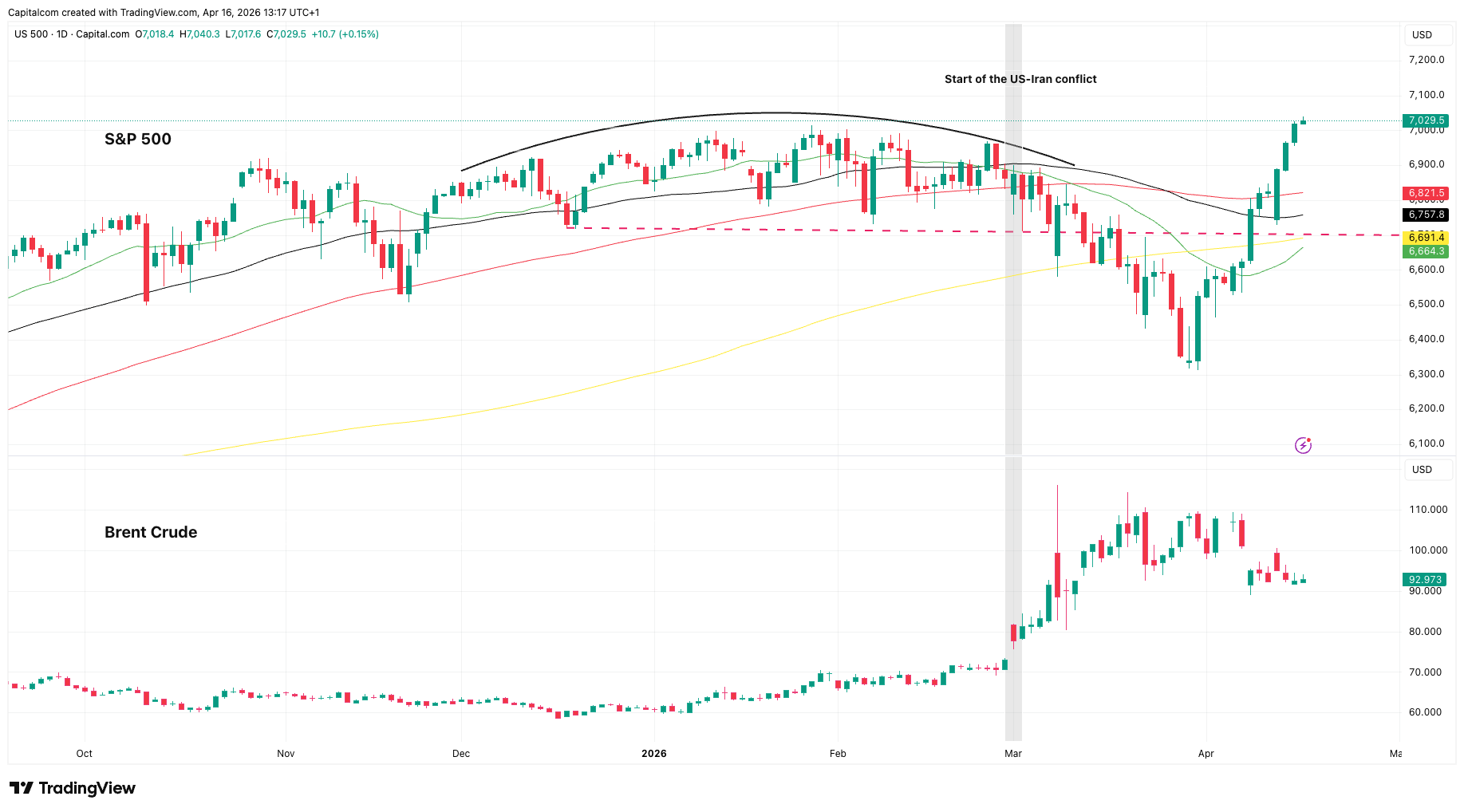
Brent crude is back trading around $90 a barrel, roughly where it was when the US–Iran conflict began to escalate in early March. Yet at the same time, the S&P 500 is pushing to fresh all-time highs, comfortably surpassing its pre-conflict levels. How can both be true? Are markets simply ignoring geopolitical risk? Or are investors now accepting that oil may remain higher but won’t derail the broader growth story?
S&P 500 and Brent Crude daily charts
Past performance is not a reliable indicator of future results.
The answer lies in how markets are interpreting the nature of the oil move, rather than the level itself. Earlier in the conflict, rising oil prices were seen as a signal of a potential supply shock, something that could tighten financial conditions, push inflation higher and weigh on growth. That’s why equities initially sold off. Today, however, oil at $90 is being viewed very differently. Having retreated from the more extreme levels seen during peak escalation, it is now seen as elevated but manageable, rather than a sign of systemic stress.
This shift reflects a broader repricing of risk. Markets appear to be increasingly confident that the worst-case scenarios, such as a prolonged closure of the Strait of Hormuz or widespread disruption to energy infrastructure, will be avoided. As a result, oil prices still carry a geopolitical premium, but equities are no longer reacting to that premium as if it will translate directly into economic damage. Instead, investors are focusing on the idea that supply disruptions, if they occur, will be temporary and contained.
There is also a structural element supporting equities. The US market, which dominates global indices, is less exposed to Middle Eastern energy than in previous cycles. Domestic production provides a buffer, and many large-cap companies have the pricing power to absorb or pass on higher input costs. As long as earnings expectations remain intact, and so far, they have, equities can continue to push higher even with oil elevated.
At the same time, this dynamic says as much about sentiment and positioning as it does about fundamentals. Markets have been conditioned to buy dips and quickly re-engage with risk at the first sign of stabilisation. The recent rally reflects a willingness to lean into a positive narrative, even if that narrative is not fully confirmed. In that sense, equities are not necessarily pricing perfection, but they are leaning toward a best-case path, one where the conflict does not materially damage growth or corporate profitability.
That leaves markets in a delicate equilibrium. The current pricing suggests that oil can stay higher without breaking the system, but only within a certain range. If prices remain around $80–90, they may act as a manageable headwind. But if oil pushes back toward $100 or remains elevated for an extended period, which would be evident in the futures price curve, the impact on margins, inflation and policy expectations becomes harder to ignore.
Ultimately, this divergence between oil and equities is less a contradiction and more a reflection of conditional optimism. Markets are not ignoring the risks, they are choosing, for now, to look through them. The question is how long that remains sustainable.