
Markets brace for a pivotal week: Fed, BoJ and Big Tech earnings take centre stage
Markets face key tests next week with several central banks reporting their latest monetary policy decisions alongside Big Tech earnings.
After another volatile week across global financial markets, investors are preparing for an exceptionally busy period that could determine the direction of equities, currencies and bonds heading into November. Central bank decisions, major technology earnings and key economic releases will all compete for attention. The challenge for investors is that the economic backdrop has become increasingly difficult to navigate. Inflationary pressures are resurfacing, geopolitical tensions are keeping energy prices elevated, and concerns about the sustainability of the AI-driven equity rally are becoming harder to ignore. While corporate earnings have generally remained resilient, markets are increasingly questioning whether valuations can withstand a prolonged period of higher interest rates.
This week in markets: Tech weakness and rising energy prices dominate
US equities have struggled to maintain their upward momentum, with technology stocks once again bearing the brunt of selling pressure. The Nasdaq fell 3% on Thursday, while the S&P 500 declined 1.2%, marking its sharpest daily fall since July. The selloff reflected renewed concerns about elevated technology valuations, particularly as higher borrowing costs challenge the economics of increasingly expensive AI infrastructure investments. However, the weakness was not uniform, with smaller-cap stocks showing greater resilience, suggesting investors may be rotating exposure rather than abandoning equities altogether.
Energy markets continue to provide uncertainty. Brent crude has climbed towards $114 per barrel, reaching its highest level since May as renewed tensions involving Iran and disruptions to regional energy infrastructure raise concerns about global supply. While higher prices have supported energy stocks, they are also threatening to complicate the inflation outlook just as central banks were hoping to see price pressures stabilise.
In Europe, the picture remains equally complicated. Political and fiscal uncertainty continues to weigh on sentiment, particularly in France, while elevated energy prices present another challenge for the region's already fragile growth outlook. The UK has faced its own difficulties after September inflation accelerated to 3.5%, above expectations, reinforcing the case for further Bank of England tightening. However, Friday's retail sales figures showed a 0.4% monthly contraction, highlighting the growing tension between persistent inflation and weakening household demand.
Looking ahead: A defining week for central banks and technology stocks
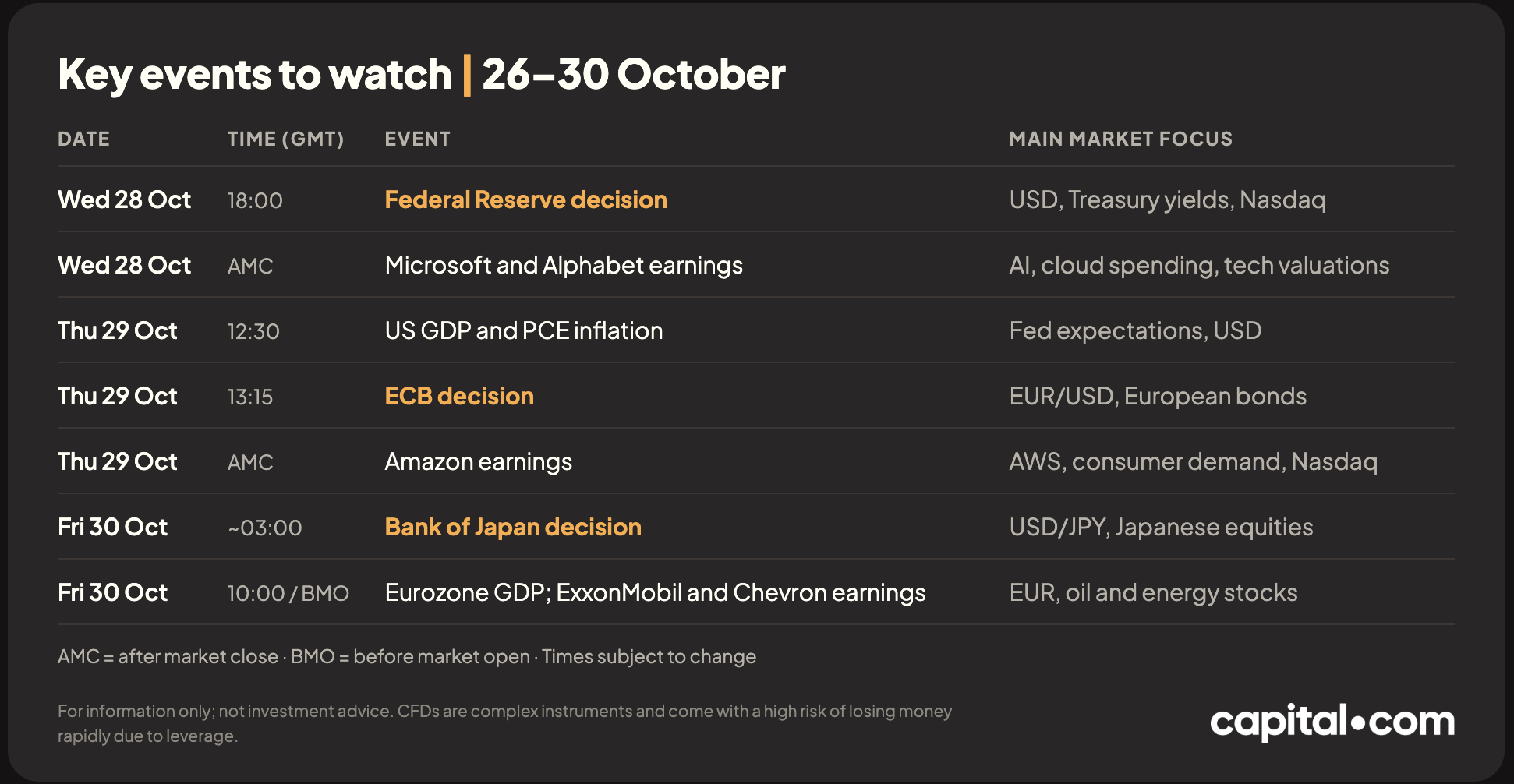
Federal Reserve: Can policymakers afford to remain patient?
The Federal Reserve's decision on Wednesday, 28 October, will be one of the most closely watched events of the week. Following September's interest rate increase, markets are broadly expecting policymakers to leave rates unchanged at 3.75%–4.00%. However, the focus will be on the accompanying guidance, particularly whether officials believe the recent acceleration in inflation warrants additional tightening before the end of the year.
The Fed is facing a difficult balancing act. Higher energy prices and persistent inflation argue for maintaining restrictive monetary policy, but signs of weaker consumption and renewed volatility in equities suggest the economy may be becoming increasingly sensitive to elevated borrowing costs. A more hawkish message could push Treasury yields and the dollar higher, placing additional pressure on growth stocks. Conversely, any indication that policymakers are becoming more concerned about economic activity could provide relief for equities and bonds, although investors may also interpret that as a warning about the strength of the US economy.
Bank of Japan: Will policymakers signal further tightening?
The Bank of Japan's meeting on 29–30 October will be another important catalyst, particularly for USD/JPY. Following September's rate increase to 1.25%, policymakers are expected to hold rates steady, but attention will turn to the updated economic outlook and any indications of further tightening before year-end.
The yen remains particularly sensitive to the divergence between Japanese and US monetary policy. Persistent inflation and currency weakness could encourage the BoJ to maintain a hawkish stance, especially if policymakers become concerned about rising import costs. However, weaker domestic demand and the risk of slowing global growth could justify a more gradual approach.
ECB: Fiscal concerns and growth risks remain in focus
The European Central Bank's meeting on Thursday, 29 October, will also be closely watched, although policymakers are widely expected to leave rates unchanged.
The eurozone faces a different set of challenges from the US, with relatively subdued growth and political uncertainty complicating the inflation outlook. France's fiscal difficulties and concerns about debt sustainability across parts of southern Europe have increased scrutiny of government borrowing costs. Meanwhile, elevated energy prices could simultaneously weaken economic activity and keep inflation above desired levels.
For EUR/USD, the relative tone of the Fed and ECB will be particularly important. A more hawkish Fed could reinforce dollar strength, while any indication that the ECB is becoming increasingly concerned about growth could weigh on the euro. However, if the Fed signals greater caution and European policymakers maintain a steady stance, the currency pair could find some support.
Big Tech earnings: Can AI spending continue to justify valuations?
Perhaps the biggest test for equity markets will come from corporate earnings, with Microsoft and Alphabet reporting on Wednesday, 28 October, followed by Amazon on Thursday. The results arrive at a particularly sensitive moment for technology stocks, following renewed selling pressure and growing concerns about the cost of financing the AI investment boom.
Investors are becoming increasingly demanding when it comes to AI-related spending. Strong revenue growth alone may no longer be sufficient to justify elevated valuations, particularly if companies continue to announce substantial increases in capital expenditure without demonstrating a corresponding improvement in profitability or cash flow.
Microsoft's results will provide an important indication of enterprise demand for AI services and the performance of its Azure cloud business. Investors will be watching whether growth in cloud revenues is keeping pace with the substantial investment required to expand computing capacity. Any signs of slowing demand or weaker margins could reinforce concerns that the returns on AI investment may take longer to materialise than previously anticipated.
Alphabet will face similar scrutiny, particularly around Google Cloud, advertising revenues and the company's ability to monetise AI products while managing rising infrastructure costs. Meanwhile, Amazon's results will provide insight into both consumer spending trends and demand for cloud computing through AWS, making its outlook particularly relevant for assessing the broader economic environment.
The challenge is that expectations remain elevated. Even companies delivering strong earnings could face selling pressure if forward guidance disappoints or spending plans exceed market assumptions. Conversely, evidence that AI investments are translating into stronger profitability could help restore confidence in the technology sector and support a broader market recovery.
With several major technology companies reporting within a short period, their combined performance could have a significant influence on the Nasdaq and S&P 500. The concentration of market capitalisation in these companies means that even relatively modest disappointments could have an outsized impact on the broader indices.