US Tech 100, US 500, US Wall Street 30 price forecast: AI earnings
The US Tech 100, US 500 and US Wall Street 30 track large-cap US equities, with June’s Nasdaq-100 rebalance adding CoreWeave and Astera Labs. Explore third-party US Tech 100, US 500, US Wall Street 30 price targets and technicals. Past performance is not a reliable indicator of future results.
- The Nasdaq 100 index – referred to as the US Tech 100 (US100) on CFD trading platforms such as Capital.com – is trading at $29,408.30, within an intraday range of $28,948.30–$29,568.90 as of 10:11am UTC on 29 June 2026.
- The S&P 500 index – referred to as the US 500 (US500) – stands at $7,393.50, near its intraday high of $7,394.70 – within a range of $7,301.60–$7,394.70
- The Dow Jones Industrial Average index – referred to as the US Wall Street 30 (US30) – is at $51,975.40, moving within a $51,678.50–$52,102 band.
Past performance is not a reliable indicator of future results.
Several factors are shaping the session. The Federal Reserve held its benchmark federal funds rate at 3.50%–3.75% at its June meeting, with the Federal Open Market Committee (FOMC) removing prior language signalling rate cuts and the median dot plot indicating a possible hike later in 2026 (CNBC, 17 June 2026). A Reuters poll of economists published on 26 June 2026 also noted expectations that rates would remain on hold through the year-end (Reuters, 26 June 2026). AI-related momentum has supported technology-heavy indices, while the Nasdaq-100's June rebalance – effective 22 June 2026 – added AI infrastructure names including CoreWeave (CRWV) and Astera Labs (ALAB), increasing the index's exposure to generative AI compute (Stock Titan, 24 June 2026). Quarter-end and half-year rebalancing flows are also relevant liquidity factors, coinciding with index fund positioning adjustments across all three benchmarks (CNBC, 26 June 2026).
Third-party US indices outlook: AI earnings shape H2 views
As of 29 June 2026, third-party US Tech 100, US 500, US Wall Street 30 predictions reflect a range of outlooks shaped by Federal Reserve policy, AI-driven earnings momentum, IPO market dynamics, and ongoing Middle East conflict as markets close out H1 2026.
Goldman Sachs (US 500 year-end target)
Goldman Sachs raised its 2026 year-end US 500 target to 8,000, from 7,600 previously. The bank projected earnings per share of $340 for 2026, a 24% increase year on year, and $385 for 2027. The revision was based on broad earnings outperformance, with roughly 85% of S&P 500 companies beating estimates in Q1 2026, alongside expectations that AI-related capital expenditure and the SpaceX IPO pipeline could support institutional inflows through year-end (MarketBeat, 16 June 2026).
Reuters (major brokerages consensus on US 500)
Reuters reports that top brokerages expect the US 500 to extend its rally through 2026, with AI momentum and strong corporate earnings cited as the primary drivers. The roundup notes that while the Middle East conflict has introduced volatility, the consensus among major sell-side houses remains positive on the index extending year-to-date gains into H2 (Reuters, 25 June 2026).
MarketBeat (US 500 and IPO pipeline outlook)
MarketBeat notes that Goldman Sachs' 8,000 year-end US 500 target implies roughly 6% upside from mid-June 2026 levels, amid broad earnings growth, AI capex, and renewed IPO activity, including SpaceX's 12 June debut at $135 per share and confidential S-1 filings from OpenAI and Anthropic. The piece also flags that while the CBOE VIX reached its highest level since early April and bearish retail sentiment remains elevated, the macro and earnings backdrop continues to support the structural bull case (MarketBeat, 16 June 2026).
Coin Price Forecast (US 500 algorithmic model)
Coin Price Forecast sets its year-end 2026 US 500 target at 7,563, with a mid-year estimate of 7,370. Its 15 June 2026 snapshot had carried a higher year-end marker of 7,672, with the subsequent revision to 7,563 reflecting the index's pullback from the 7,431 level recorded at that earlier date (Coin Price Forecast, 28 June 2026).
Investing.com (US Tech 100 technical view)
Investing.com notes that the US Tech 100 led US indices with an 8%-plus gain in May 2026, outpacing the US 500's approximately 5% monthly advance, as the Nasdaq entered June at record highs with distribution days running at just two. The analysis flags that while momentum remained supportive heading into H2, stretched valuations and the risk of AI earnings disappointments represented key tests for the index in the months ahead, with the US 500 and Dow Jones similarly at or near record territory as of early June 2026 (Investing.com, 1 June 2026).
Predictions and third-party forecasts are inherently uncertain, as they cannot fully account for unexpected market developments. Past performance is not a reliable indicator of future results.
US Tech 100, US 500, US Wall Street 30 prices: technical overview
The latest technical readings show mixed conditions across the three US indices, with US100 and US500 trading below short-term moving averages while US30 holds above key support levels.
US Tech 100
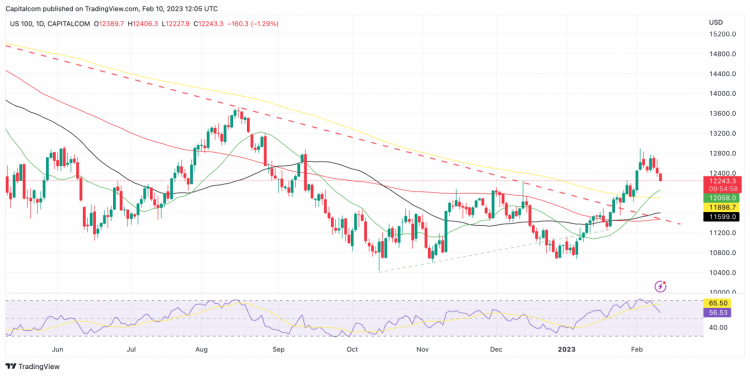
US100’s price trades at $29,408.30 as of 10:11am UTC on 29 June 2026, below its short-term moving-average cluster. The 20/50/100/200-day SMAs run at approximately 29,780 / 28,881 / 26,785 / 25,978, with price also beneath the 10- and 20-day SMAs. This leaves the immediate technical picture tilted to the downside. The 14-day RSI reads 47.15, a mid-range neutral print that reflects indecision rather than directional conviction, while the ADX at 21.29 points to limited trend momentum in either direction.
On the upside, the first reference to watch is the classic R1 at 29,571. A daily close above that level would bring the R2 area near 29,856 into view. Sustained trade above the 20-day SMA cluster around 29,780 would be needed to restore short-term positive conditions.
On pullbacks, the classic pivot at 29,073, derived from intraday data, serves as the initial support reference. Below there, the 50-day SMA near 28,881 represents the next meaningful MA shelf. A move below that level would risk a move toward the S1 area near 28,348 (TradingView, 29 June 2026).
This is technical analysis for informational purposes only and does not constitute financial advice or a recommendation to buy or sell any instrument.
US 500
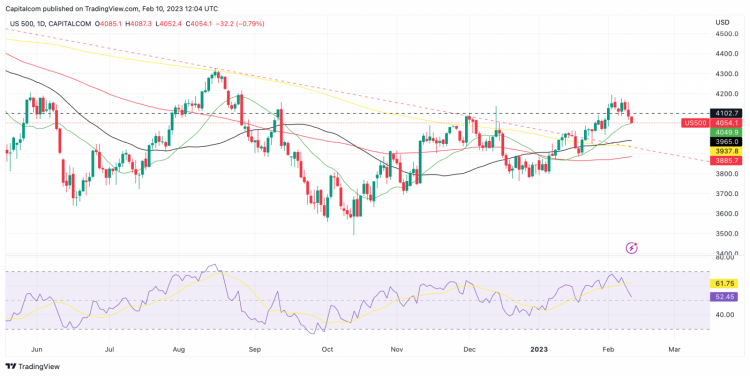
US500’s price trades at $7,393.50 as of 10:11am UTC on 29 June 2026, below its 10-, 20-, and 30-day SMAs, at approximately 7,433 / 7,455 / 7,457, while holding above the 50-day SMA near 7,363. This leaves the index in a congestion band between near-term MA resistance and medium-term MA support. The 14-day RSI reads 46.07, a lower-neutral reading that suggests the recent pullback has absorbed some momentum without yet establishing bearish conviction. The ADX at 22.41 indicates a trend of moderate rather than established strength.
On the upside, the classic R1 at 7,728 is the first level to watch. A convincing daily close through the 20-day SMA cluster around 7,455 would be the preliminary requirement, after which R1 and then R2 near 7,876 come into view. The Ichimoku base line at 7,429 sits just above the current last price and may act as near-term resistance.
On pullbacks, the classic pivot at 7,451 and the Ichimoku base line at 7,429 together form the initial support band. Below there, the 50-day SMA near 7,363 is the key MA shelf. A close below 7,363 would risk a move toward S1 at 7,303 (TradingView, 29 June 2026).
This is technical analysis for informational purposes only and does not constitute financial advice or a recommendation to buy or sell any instrument.
US Wall Street 30
US30’s price trades at $51,975.40 as of 10:11am UTC on 29 June 2026, above its short- and medium-term moving-average stack. The 20/50/100/200-day SMAs sit at approximately 51,301 / 50,298 / 49,127 / 48,312, with the 20-over-50 alignment intact and price trading above all four levels. This keeps the near-term technical picture positive. The 14-day RSI reads 61.12, an upper-neutral print consistent with positive momentum, while the ADX at 23.24 reflects a trend building toward established strength without reaching an extreme reading. Bull Bear Power at 712.38 also supports the positive technical picture in current conditions.
On the upside, the classic R1 at 51,786 has effectively been cleared, with price trading above it. The next reference is the R2 area near 52,536. A daily close through there would put the R3 zone at 54,722 back in longer-term focus. The Hull moving average at 51,917 sits just below the last price and offers a dynamic near-term support reference.
On pullbacks, the classic pivot at 50,350 represents the first meaningful support to monitor. Below there, the 50-day SMA near 50,298 forms a closely aligned MA shelf. A sustained move below that zone would risk a move toward S1 at 49,600 and, deeper, toward the 100-day SMA near 49,127 (TradingView, 29 June 2026).
This is technical analysis for informational purposes only and does not constitute financial advice or a recommendation to buy or sell any instrument.
US Tech 100, US 500, US Wall Street 30 price history (2025–2026)
The US Tech 100 (US100) and US 500 (US500) delivered strong gains over the past two years, though both indices also navigated sharp volatility driven by trade policy shocks, shifting Fed expectations, and geopolitical pressure before recovering to near record territory.
US Tech 100
The US100 price opened 2025 at around $21,048.40. Early gains faded as tariff escalation weighed on markets, dragging the index to a session low of $16,343 on 7 April 2025, its weakest level of the year. A swift reversal followed: the index climbed back above $19,000 by 9 April 2025 and sustained the recovery, closing 2025 at approximately $25,222.80 – roughly 19.8% above where it started the year.
The advance continued into 2026. The index opened the year near $25,287.10 and pushed steadily higher, reaching an intraday record of $30,760.10 on 3 June 2026 – up around 21.6% from the January open. A sharp reversal followed on 5 June 2026, with the close dropping to $28,736.90, a pullback of approximately 6.6% from the high in two sessions. The index has since partially recovered; US Tech 100 closed at $29,412.60 on 29 June 2026, approximately 16.3% up year to date and 30.1% up year on year.
Past performance is not a reliable indicator of future results. Prices are indicative and may differ from live market prices.
US 500
The US500 price opened 2025 at around $21,048.40. Early gains faded as tariff escalation weighed on markets, dragging the index to a session low of $16,343 on 7 April 2025, its weakest level of the year. A swift reversal followed: the index climbed back above $19,000 by 9 April 2025 and sustained the recovery, closing 2025 at approximately $25,222.80 – roughly 19.8% above where it started the year.
The advance continued into 2026. The index opened the year near $25,287.10 and pushed steadily higher, reaching an intraday record of $30,760.10 on 3 June 2026 – up around 21.6% from the January open. A sharp reversal followed on 5 June 2026, with the close dropping to $28,736.90, a pullback of approximately 6.6% from the high in two sessions. The index has since partially recovered; US Tech 100 closed at $29,412.60 on 29 June 2026, approximately 16.3% up year to date and 30.1% up year on year.
US Wall Street 30
The US30 price opened 2025 near $5,884.20 and spent much of the first quarter consolidating, before the April 2025 tariff shock dragged the broader market lower alongside technology peers. The index recovered through H2 2025, closing the year near $6,813 – an approximate annual return of 15.8%.
The move accelerated in 2026. The US 500 climbed through the $7,000 level in April 2026, pushed as high as $7,621 on 2 June 2026 and held elevated through mid-June. The Fed’s June meeting – in which rates were held at 3.50%–3.75% and the dot plot signalled a possible hike later in 2026 – then triggered a multi-day pullback. The index slipped to a close of $7,333.30 on 26 June before recovering. US 500 closed at $7,394.90 on 29 June 2026, approximately 8.5% up year to date.
Past performance is not a reliable indicator of future results. Prices are indicative and may differ from live market prices.
US100 vs US500 vs US30: Capital.com analyst view
The US Tech 100 and US 500 have posted notable gains through the first half of 2026, with AI-driven earnings momentum and broad corporate earnings outperformance providing a supportive backdrop. The Nasdaq-100’s June 2026 rebalance – which added AI infrastructure names including CoreWeave and Astera Labs – reflects how deeply the generative AI theme has become embedded in large-cap index composition. That exposure could continue to attract institutional inflows, but it also introduces concentration risk. Heavy reliance on a smaller group of high-multiple technology companies means that any disappointment in AI earnings delivery or capital expenditure guidance could weigh disproportionately on both indices.
The Federal Reserve’s decision to hold rates at 3.50%–3.75% in June 2026, while signalling a possible hike later in the year, adds another layer of complexity. A higher-for-longer rate environment could compress valuations for growth-heavy indices like the US Tech 100, though sustained earnings growth may offset some of that pressure for the broader US 500. Quarter-end and half-year rebalancing flows, alongside an active IPO pipeline, add short-term variables that could amplify moves in either direction.
Capital.com’s client sentiment for US100 CFDs
As of 29 June 2026, Capital.com client positioning in US100 CFDs shows 67.8% buyers vs 32.2% sellers, keeping it in majority-buy territory but below extreme levels, with buyers ahead by 35.6 percentage points. This snapshot reflects open positions on Capital.com and can change.
Capital.com’s client sentiment for US500 CFDs
As of 29 June 2026, Capital.com client positioning in US500 CFDs shows 70.4% buyers vs 29.6% sellers, placing it in majority-buy territory, with buyers ahead by 40.8 percentage points. This snapshot reflects open positions on Capital.com and can change.
Capital.com’s client sentiment for US30 CFDs
As of 29 June 2026, Capital.com client positioning in US30 CFDs shows 61.4% buyers vs 38.6% sellers, keeping it in majority-buy territory but below extreme levels, with buyers ahead by 22.8 percentage points. This snapshot reflects open positions on Capital.com and can change.
Summary – US Tech 100, US 500, and US Wall Street 30 (2026)
- As of 10:11am UTC on 29 June 2026, US100 trades at $29,408.30, US500 at $7,393.50, and US30 at $51,975.40, with all three indices positive year to date.
- AI-driven earnings momentum remains a shared driver across the three indices, with S&P 500 earnings growing approximately 24% year on year in Q1 2026 and the Nasdaq-100’s June rebalance adding AI infrastructure constituents.
- The Federal Reserve held rates at 3.50%–3.75% at its June 2026 meeting while signalling a possible hike later in the year, introducing a higher-for-longer risk that could weigh on growth-heavy indices.
- Quarter-end and H1 rebalancing flows, the SpaceX IPO pipeline, and Middle East geopolitical uncertainty are adding short-term positioning variables across all three benchmarks.
Past performance is not a reliable indicator of future results.
FAQ
What is the US Tech 100, US 500 and US Wall Street 30 price forecast?
Third-party forecasts for the US 500 point to a broad 7,563–8,000 range for 2026, based on estimates from algorithmic models and institutional analysts. Outlooks for the US Tech 100 and US Wall Street 30 remain linked to many of the same drivers, including AI-related earnings, Federal Reserve policy, IPO activity and geopolitical risks. Forecasts can change quickly and shouldn’t be treated as reliable indicators of future performance.
Could US Tech 100, US 500 and US Wall Street 30 go up or down?
Yes. The US Tech 100, US 500 and US Wall Street 30 could move in either direction, depending on earnings, interest-rate expectations, AI investment trends, liquidity flows and wider risk sentiment. A stronger earnings backdrop or renewed technology momentum could support prices, while higher-for-longer rates, stretched valuations or geopolitical disruption could weigh on the indices. Technical levels may offer reference points, but they don’t predict future market direction.
Should I invest in US Tech 100, US 500 and US Wall Street 30?
Whether these indices are suitable depends on your financial goals, risk tolerance, market knowledge and trading timeframe. This article is for informational purposes only and doesn’t constitute investment advice or a recommendation to buy, sell or hold any market. Before making any decision, consider doing your own research, understanding the risks of leveraged products, and seeking independent professional advice if needed.
Can I trade US Tech 100, US 500 and US Wall Street 30 CFDs on Capital.com?
Yes, you can trade US100 CFDs, US500 CFDs and US30 CFDs on Capital.com. Trading commodity CFDs lets you speculate on price movements without owning the underlying asset and to take long or short positions. However, contracts for difference (CFDs) are traded on margin, and leverage amplifies both profits and losses. You should ensure you understand how CFD trading works, assess your risk tolerance, and recognise that losses can occur quickly.