
Most traded currencies 2025: US dollar leads as yuan climbs

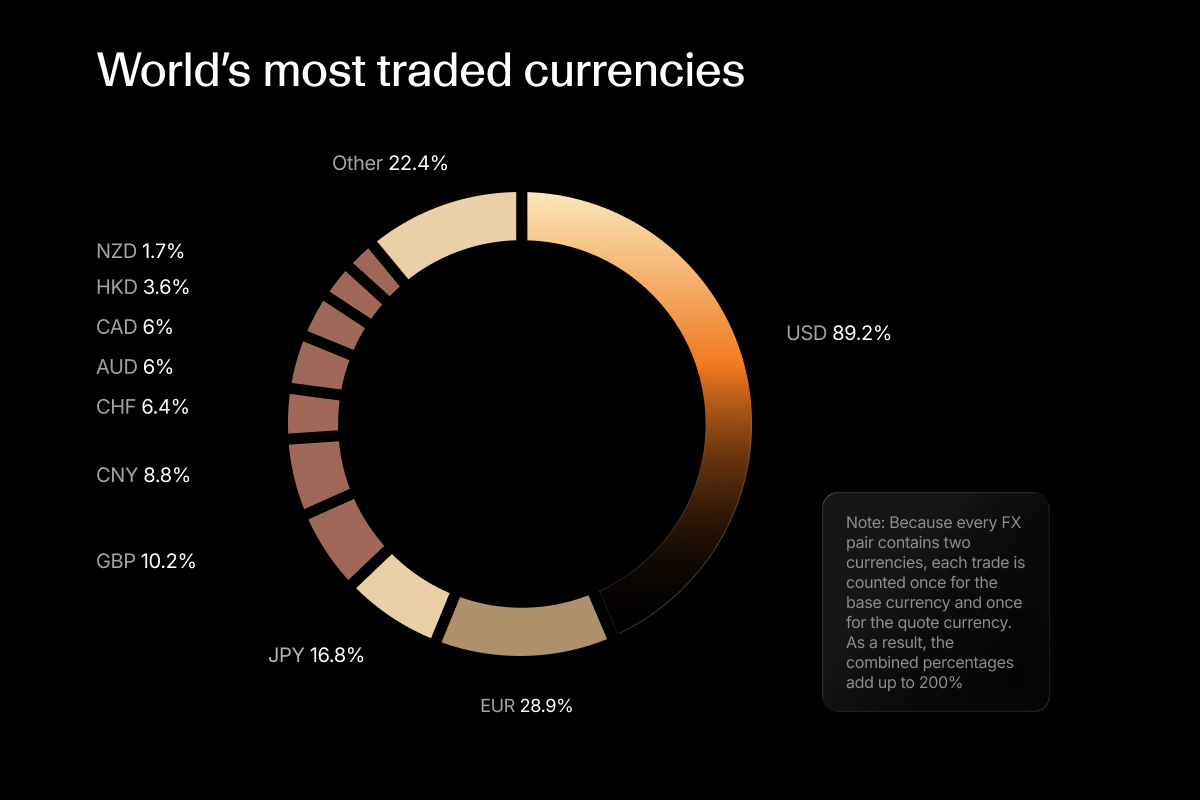
Global FX turnover reached $9.60tn a day in 2025, led by the US dollar as China’s yuan climbed into the top five most traded currencies.
Forex trading is built around currency pairs, but some currencies appear far more often than others. Here’s how the world’s most traded currencies rank in 2025.
What are the 10 most traded currencies?
The most traded currencies in the world are the US dollar (USD), euro (EUR), Japanese yen (JPY), British pound (GBP), Chinese yuan (CNY), Swiss franc (CHF), Australian dollar (AUD), Canadian dollar (CAD), Hong Kong dollar (HKD) and New Zealand dollar (NZD).
Together, they account for a large share of global foreign exchange, or forex, activity. Their rankings reflect several factors, including international trade, central bank policy, interest rates, financial market depth, commodity exposure and demand for liquid markets.
According to the 2025 Bank for International Settlements (BIS) Triennial Central Bank Survey, average daily turnover in global foreign exchange markets reached $9.60tn in April 2025, up 28% from $7.50tn in 2022. The BIS survey is widely used as the primary global source for forex turnover data, with the 2025 survey covering more than 1,100 banks and other dealers across 52 jurisdictions. (bis.org)
| Rank | Currency | Share of global FX turnover, April 2025 |
|---|---|---|
| 1 | US dollar (USD) | 89.2% |
| 2 | Euro (EUR) | 28.9% |
| 3 | Japanese yen (JPY) | 16.8% |
| 4 | British pound (GBP) | 10.2% |
| 5 | Chinese yuan (CNY) | 8.8% |
| 6 | Swiss franc (CHF) | 6.4% |
| 7 | Australian dollar (AUD) | 6% |
| 8 | Canadian dollar (CAD) | 6% |
| 9 | Hong Kong dollar (HKD) | 3.6% |
| 10 | New Zealand dollar (NZD) | 1.7% |
The percentages above add up to around 200%, rather than 100%, because every forex trade involves two currencies. For example, a EUR/USD trade is counted once for the euro and once for the US dollar. This follows the methodology used by the BIS. (bis.org)
1. US dollar (USD)
The US dollar is the world’s most traded currency. USD was on one side of 89.2% of all forex transactions in April 2025, with an estimated average daily turnover of around $8.56tn, based on the BIS global total of $9.60tn (bis.org, 30 September 2025).
Its position reflects the dollar’s role in international trade, finance and reserves. Many major commodities, including oil and gold, are also priced in USD, which adds to its importance across global markets.
The most active US dollar pairs include EUR/USD, USD/JPY, USD/CNY, GBP/USD, USD/CHF, AUD/USD and USD/CAD. EUR/USD remained the most traded currency pair in the world in 2025, accounting for 21.2% of global daily turnover, or around $2.04tn (bis.org, accessed 27 May 2026).
US dollar movements are commonly linked to US economic data, Federal Reserve policy, interest rate expectations and broader changes in market sentiment. Because the dollar is so widely used, its movements can affect a wide range of forex pairs, including those that don’t directly include USD.
2. Euro (EUR)
The euro is the second most traded currency in the world. It accounted for 28.9% of global forex turnover in April 2025, equivalent to around $2.77tn in average daily volume (bis.org, 30 September 2025).
The euro is used by 20 countries in the eurozone, giving it a central role in international trade, investment and reserves. Its value is shaped by European Central Bank (ECB) policy, inflation data, eurozone growth, political developments and the region’s trade relationships.
EUR/USD is the euro’s most important pair and remains the largest currency pair globally. Other widely followed euro pairs include EUR/GBP, EUR/JPY, EUR/CHF and EUR/AUD.
For traders, the euro can provide exposure to the eurozone economy as a whole rather than to a single national market. This means euro movements may reflect both country-level data and wider regional trends.
3. Japanese yen (JPY)
The Japanese yen ranked third in the 2025 BIS survey, accounting for 16.8% of global forex turnover, or around $1.61tn in estimated average daily volume (bis.org, 30 September 2025).
The yen is the most traded currency in Asia and is closely watched because of Japan’s role in global trade and finance. It is also linked to interest rate differentials, particularly when Japanese rates differ significantly from those in other major economies.
USD/JPY is the yen’s main currency pair. Average daily turnover in USD/JPY rose to around $1.37tn in 2025, reflecting the pair’s continued importance in global forex markets (bis.org, accessed 27 May 2026).
The yen is influenced by Bank of Japan (BoJ) policy, Japanese inflation and wage data, trade flows, bond yields and global market conditions. It can also be sensitive to changes in US rate expectations, given the scale of activity in USD/JPY.
4. British pound (GBP)
The British pound was the fourth most traded currency in 2025, with a 10.2% share of global forex turnover. That equates to around $979.20bn in estimated average daily volume (bis.org, 30 September 2025).
Also known as sterling, the pound remains one of the world’s major currencies. Its share of global turnover declined from 2022, when it represented around 12.9% of forex activity, but it continues to play a significant role in major currency pairs.
GBP/USD, often known as Cable, is the pound’s main pair. In 2025, GBP/USD accounted for 7.6% of global forex turnover, down from 9.5% in 2022 (bis.org, accessed 27 May 2026).
The pound is affected by Bank of England (BoE) policy, UK inflation and labour market data, government fiscal policy and political developments. As with other major currencies, its movements can also reflect changes in the US dollar, particularly in GBP/USD.
5. Chinese yuan (CNY)
The Chinese yuan moved up the rankings in 2025, becoming the fifth most traded currency in the world. It accounted for 8.8% of global forex turnover, equivalent to around $844.80bn in estimated average daily volume (bis.org, 30 September 2025).
The yuan’s rise reflects China’s role in global trade and the increasing use of its currency in cross-border transactions. While the yuan is not fully freely floating in the same way as some major currencies, it is actively traded in both onshore and offshore markets.
USD/CNY became one of the most important currency pairs globally in 2025, moving ahead of GBP/USD to rank among the top three pairs by turnover (bis.org, accessed 27 May 2026).
The yuan is influenced by People’s Bank of China (PBoC) policy, China’s trade balance, economic growth data, capital flow measures and global demand for Chinese goods. It can also respond to changes in US-China trade policy and wider emerging-market sentiment.
6. Swiss franc (CHF)
The Swiss franc ranked sixth in 2025, with a 6.4% share of global forex turnover. That equates to around $614.40bn in estimated average daily volume (bis.org, accessed 27 May 2026).
The franc is often described as a safe-haven currency because it has historically attracted demand during periods of market uncertainty. This is linked to Switzerland’s political stability, current account strength and role as a major financial centre.
The main franc pairs include USD/CHF and EUR/CHF. EUR/CHF is particularly important because of Switzerland’s close economic relationship with the eurozone.
The Swiss National Bank (SNB) plays a central role in shaping expectations for the franc. Interest rate policy, inflation trends, market volatility and demand for defensive assets can all affect CHF pairs.
7. Australian dollar (AUD)
The Australian dollar ranked seventh in 2025, with a share of around 6% of global forex turnover. That is equivalent to approximately $576.00bn in estimated average daily volume (bis.org, accessed 27 May 2026).
The Australian dollar is often viewed as a commodity-linked currency because Australia is a major exporter of natural resources, including iron ore, coal and natural gas. It is also closely connected to trade conditions in the Asia-Pacific region, particularly demand from China.
AUD/USD is the Australian dollar’s main currency pair. It is widely followed by traders monitoring commodity prices, Chinese economic data, US dollar movements and Reserve Bank of Australia (RBA) policy.
For Australian traders, AUD/USD is also important because it links global forex conditions with the local currency. Movements in this pair can affect the Australian dollar value of international exposures and may provide a useful reference point when analysing broader market conditions.
8. Canadian dollar (CAD)
The Canadian dollar ranked eighth in 2025, with a share of around 6% of global forex turnover. That is equivalent to approximately $576.00bn in estimated average daily volume (bis.org, accessed 27 May 2026).
The Canadian dollar, often called the loonie, is closely linked to Canada’s economy and its trade relationship with the US. It is also influenced by commodity markets, particularly oil, because Canada is a major energy exporter.
USD/CAD is the Canadian dollar’s main pair. It reflects the close economic ties between Canada and the US, as well as differences in monetary policy between the Bank of Canada (BoC) and the Federal Reserve.
CAD movements may be affected by oil prices, Canadian employment and inflation data, BoC policy decisions, US economic conditions and broader changes in the US dollar.
9. Hong Kong dollar (HKD)
The Hong Kong dollar ranked ninth in 2025, with a share of around 3.6% of global forex turnover, equal to around $345.60bn in estimated average daily volume. BIS data also showed a sharp increase in HKD activity between the 2022 and 2025 surveys (bis.org, accessed 27 May 2026).
The Hong Kong dollar’s importance reflects Hong Kong’s role as a major financial centre and its close links with mainland China. It is also supported by a long-standing linked exchange rate system, under which the HKD is maintained within a band against the US dollar.
USD/HKD is the main Hong Kong dollar pair. Because the HKD is managed within a narrow range against the US dollar, trading activity can be shaped by interest rate differentials, liquidity conditions and expectations around the currency band.
The HKD can be relevant for traders monitoring Asian financial markets, Chinese capital flows and regional funding conditions.
10. New Zealand dollar (NZD)
The New Zealand dollar ranked tenth in 2025, with a share of around 1.7% of global forex turnover, or approximately $163.20bn in estimated average daily volume (bis.org, accessed 27 May 2026).
The NZD is a commodity-linked currency, with New Zealand’s economy closely connected to agricultural exports such as dairy, meat and forestry products. It is also influenced by Asia-Pacific trade conditions and global risk sentiment.
NZD/USD is the main New Zealand dollar pair. Other commonly followed pairs include AUD/NZD, EUR/NZD and GBP/NZD.
The Reserve Bank of New Zealand (RBNZ), domestic inflation, commodity prices, trade data and global demand conditions can all influence NZD movements. Because New Zealand is a smaller economy than the US, eurozone, Japan or China, NZD pairs can be more sensitive to changes in liquidity and global market sentiment.
How do I find out more about the most traded currencies?
You can find more information on the world’s most traded currencies by following official data releases, central bank updates and market analysis.
The BIS Triennial Central Bank Survey is the main primary source for global forex turnover data. The latest survey covers trading activity in April 2025 and includes breakdowns by currency, instrument, counterparty and jurisdiction (bis.org, 30 September 2025).
Central bank websites can also help you track policy decisions and economic commentary. The Federal Reserve, ECB, BoJ, BoE, PBoC, SNB, RBA, BoC and RBNZ all publish updates that can affect their respective currencies.
For broader learning, you can read Capital.com’s forex trading guide and follow the latest forex market news for market commentary and analysis.
How to trade the most traded currencies with CFDs
Trading forex with contracts for difference (CFDs) allows you to speculate on the price movement of a currency pair without owning either currency.
With forex CFDs, you can go long if you think a pair’s price may rise, or short if you think it may fall. For example, when you trade EUR/USD, you’re speculating on the euro’s movement against the US dollar.
Major currency pairs are often highly liquid, which can mean tighter spreads than less traded pairs. However, liquidity doesn’t remove risk. Prices can move quickly around central bank decisions, inflation reports, employment data, geopolitical events and changes in market sentiment.
A trading plan may include position sizing, stop-losses, take-profits and clear rules for entering and exiting trades. Stop-losses can help manage risk, but they don’t guarantee protection in all market conditions.
Create an account Open a demo account
FAQ
Why does it matter that a currency is highly traded?
A highly traded currency usually has deeper liquidity, meaning there are more buyers and sellers active in the market. This can make it easier to enter and exit positions and may support tighter spreads than less traded currencies. However, high liquidity doesn’t remove risk. Major currencies can still move quickly, especially around central bank decisions, economic data releases and unexpected market events.
What is the world’s most traded currency?
The US dollar is the world’s most traded currency. It was on one side of 89.2% of all forex transactions in April 2025, according to the BIS Triennial Central Bank Survey. Its dominance reflects its role in international trade, finance, reserves and commodity pricing. (bis.org)
What is the highest-value currency?
The Kuwaiti dinar is generally regarded as the highest-value currency by exchange rate against the US dollar. This means one Kuwaiti dinar is typically worth more than one US dollar. A high exchange rate doesn’t necessarily mean a currency is more widely traded or more important in global markets. Forex turnover is measured by trading activity, where the US dollar remains the most traded currency.
What is the world’s least traded currency?
The least traded currencies are usually those from smaller economies, countries with limited convertibility, or markets with low international financial activity. Examples can include currencies that are not widely available through global forex venues. These currencies may have lower liquidity, wider spreads and fewer available trading pairs than major currencies such as the US dollar, euro or yen.
Visit our other complete guides

How to trade the US Dollar Index

What is GBP/USD (Pound-Dollar pair)?

