
Gold rebounds as Fed rate hike fears fade
The latest data from the US takes away the urgency for the Fed to hike rates, giving gold a boost higher.
It felt like markets were holding their breath at the start of this week, eagerly awaiting what the July CPI data would say about the disinflation process. Last week's softer jobs data suggested that the US economy may not be as robust as previously thought, but with the Fed focused on its dual mandate, markets were still concerned that persistent price pressures could force the central bank into further tightening.
On Wednesday, the data delivered some relief. Inflation softened across the board and broadly matched expectations, suggesting the trend continues to move in the right direction despite the recent energy shock. That allowed risk appetite to consolidate during the session. However, headline inflation at 3.4% remains far above target, meaning the Fed is unlikely to declare victory yet. Kevin Warsh has repeatedly stressed the importance of preventing elevated inflation from becoming entrenched, and the absence of a meaningful downside surprise probably explains why markets did not react more enthusiastically.
Falling yields give gold room to recover
For gold, the important consequence has been what the combination of softer employment and cooling inflation means for interest rates. The metal has rebounded from the $4,000 area as markets have become less convinced that another Fed hike is imminent. Lower expectations for policy tightening have taken some pressure off Treasury yields, reducing the opportunity cost of holding a non-yielding asset such as gold. A softer dollar reinforces the effect because gold becomes cheaper for buyers using other currencies.
The latest CPI report therefore supports the recovery without necessarily providing the catalyst for an immediate breakout. The Fed has been given more room to wait, but not yet a convincing reason to turn dovish. If subsequent inflation readings continue to cool while employment weakens, expectations for further tightening could fade more decisively, providing a more durable tailwind for gold.
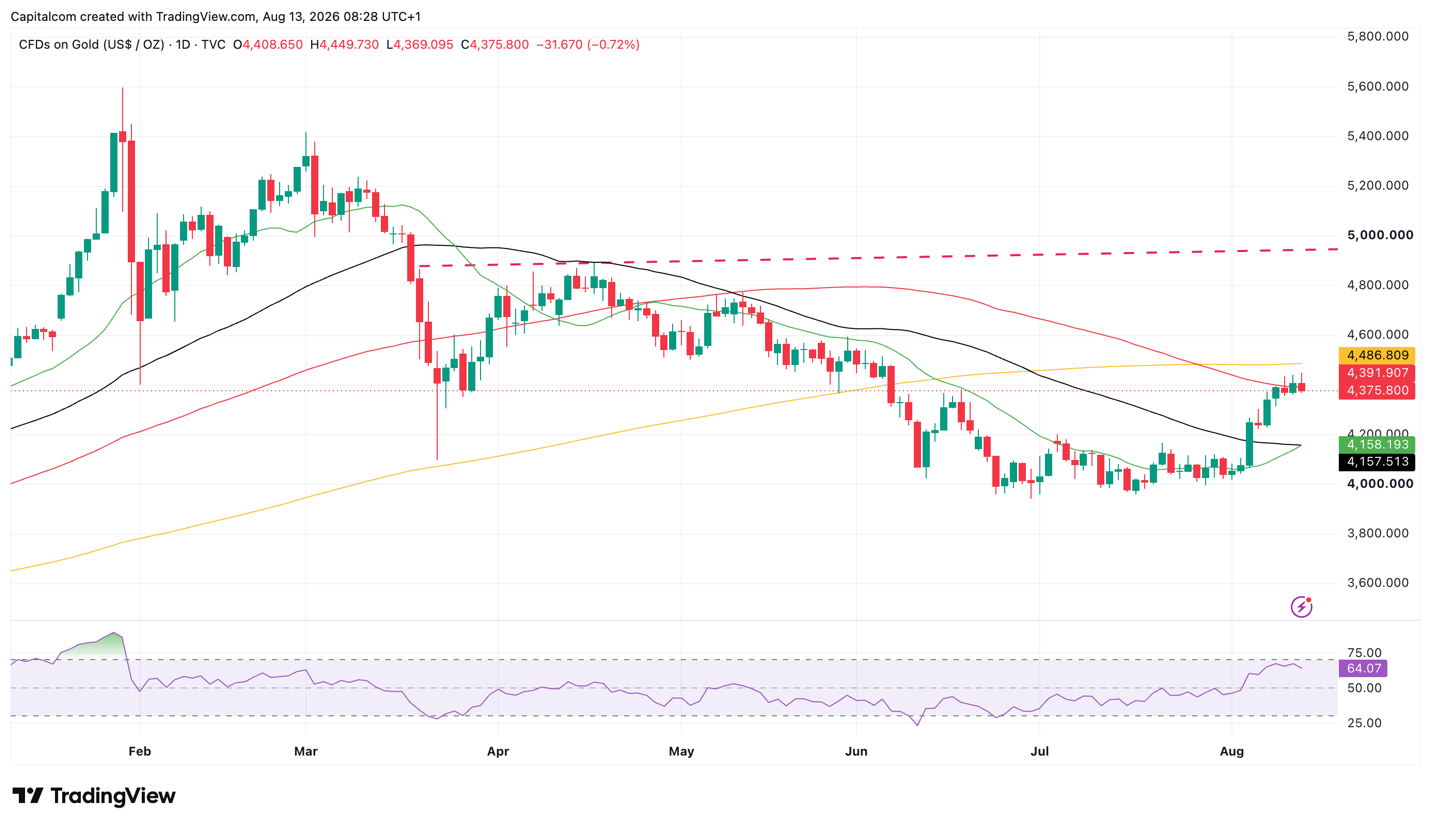
Technically, gold has made considerable progress after establishing a base around $4,000. Prices have recovered towards $4,400 but are now encountering an important cluster of resistance around $4,390-$4,490, where longer-term moving averages converge. The RSI shows momentum has improved without yet becoming excessively stretched. A sustained break through that resistance zone would strengthen the recovery and bring $4,500 and potentially higher levels back into focus. Failure to clear it could encourage consolidation, with $4,300 the first area to watch before stronger support around $4,150-$4,200.
Gold (XAU/USD) daily chart
Past performance is not a reliable indicator of future results.
The Fed is only one part of the gold story
Monetary policy remains the immediate driver, but gold's outlook is broader than the next Fed decision. Geopolitics continues to provide underlying support. Although progress towards reopening the Strait of Hormuz has reduced some of the acute risk premium across markets, the Middle East remains unstable and disruption around key energy and shipping routes has not disappeared.
The dollar will also be important. Gold's rebound has coincided with reduced expectations for additional Fed tightening, but a renewed period of US exceptionalism or stronger economic data could push yields and the dollar higher again. That would create a more difficult backdrop for bullion even if geopolitical demand remained supportive.
There is also a longer-term tension developing. Gold tends to benefit from falling real yields, yet large fiscal deficits and extraordinary levels of AI-related investment are increasing competition for capital. Technology companies, utilities, semiconductor manufacturers and governments are all competing for financing at the same time. If that keeps longer-term real yields structurally elevated even as the Fed eventually lowers short-term rates, gold may face a higher opportunity cost than in previous easing cycles.
For now, the immediate narrative has become more supportive. The labour market is cooling, inflation is gradually easing and the Fed appears to have more scope to remain patient. That combination has helped gold recover from its recent lows. The next challenge is turning that relief rally into something more durable, and for that, investors may need further evidence that inflation is genuinely converging towards target rather than merely stabilising above it.