
CAC 40 forecast: Is the French index poised to outperform its peers?
The CAC 40 is France’s benchmark stock index, with recent trading affected by higher bond yields and oil prices as L’Oréal overtook LVMH by market value. Explore third-party CAC40 price targets and technical analysis. Past performance is not a reliable indicator of future results.
The CAC 40 index – referred to as the France 40 (FR40) on CFD trading platforms such as Capital.com – traded near 8,105.6 at 9:03am UTC on 16 September 2026, within an intraday range of 8,033–8,140.1. Past performance is not a reliable indicator of future results.
French equities faced higher global bond yields and oil prices, with Brent crude moving above $107 per barrel after attacks on Saudi energy infrastructure (Yahoo Finance, 10 September 2026). Investors were also positioning ahead of the US Federal Reserve's policy decision (Yahoo Finance, 14 September 2026). Index moves were mixed: Capgemini, Dassault Systèmes and Publicis were among recent gainers, while Legrand, Schneider Electric and STMicroelectronics declined (Trading Economics, 14 September 2026). L'Oréal also overtook LVMH by market value amid weakness in parts of the luxury sector (Reuters, 15 September 2026).
Third-party CAC 40 outlook: oil, bond yields, luxury pressure
As of 16 September 2026, third-party CAC 40 predictions across different time horizons using quantitative and technical methodologies. These forecasts are estimates rather than indications of future price direction.
Sigmanomics (short-term expected-range model)
Sigmanomics projects a 14-day expected move of ±1.7%, implying a range of 8,136.52–8,421.02 points by 20 September 2026 from a base close of 8,283.16 on 4 September. The model cites an RSI reading of 35.5 and a level around 2.30% below the 20-day moving average (Sigmanomics, 6 September 2026).
Financial Forecast Center (monthly average model)
Financial Forecast Center projects an average of 8,698 points for September 2026, with an error margin of ±120 points, rising to 8,870 by December. Its time-series model uses historical index data, with wider error bands at longer horizons (Financial Forecast Center, 11 September 2026).
Long Forecast (monthly technical model)
Long Forecast projects a September 2026 close of 7,929 points within a monthly range of 7,354–8,820, representing a projected monthly decline of around 3.1%. It also projects 9,157 points by September 2027 (Long Forecast, 12 September 2026).
Coin Price Forecast (long-term trend model)
Coin Price Forecast projects a year-end 2026 level of 8,425 points, around 2% above the index level cited at publication. Its forecast reaches 9,042 points by the end of 2027 (Coin Price Forecast, 12 September 2026).
Financial Forecast Center (extended horizon model)
Financial Forecast Center separately projects monthly averages of 9,002 points in January 2027 and 9,221 by April, using the same time-series approach and a widening error band (Financial Forecast Center, 11 September 2026).
Predictions and third-party forecasts are inherently uncertain, as they cannot fully account for unexpected market developments. Past performance is not a reliable indicator of future results.
Macro and sector backdrop
The European Central Bank (ECB) raised its three key interest rates by 25 basis points on 10 September 2026. The deposit facility rate increased to 2.50%, the main refinancing rate to 2.65% and the marginal lending facility rate to 2.90%, effective from 16 September (ECB, 10 September 2026).
ECB President Christine Lagarde said inflation was set to remain above target for an extended period, citing the Middle East conflict as a source of price pressure (CNBC, 10 September 2026). France’s harmonised inflation rate was confirmed at 2.6% year on year for August (Trading Economics, 15 September 2026).
Luxury shares have also influenced the index. LVMH fell 2.64% to €406.45 on 15 September after Bernstein cut its price target to €520 from €570 (Ad-Hoc News, 15 September 2026). L’Oréal subsequently overtook LVMH as France’s largest listed company by market capitalisation (Reuters, 15 September 2026).
Higher oil prices and bond yields have added to the broader European equity backdrop (Yahoo Finance, 10 September 2026).
CAC40 index price: technical overview
As of 9:03am UTC on 16 September 2026, the CAC40 index traded near 8,105.6, below its 20-, 50-, 100- and 200-day simple moving averages (SMAs) at around 8,294, 8,416, 8,325 and 8,240 respectively. The 20-day average also remained below the 50-day average.
The 14-day relative strength index stood at 32.02, above the conventional 30 oversold threshold but towards the lower end of its range. The average directional index was 41.51, consistent with an established trend, although the indicator does not show direction.
Higher technical references included the 100-day SMA near 8,325, the central pivot at 8,465.88 and R1 at 8,623.65. Below the quoted level, S2 stood at 8,018.95. These are technical reference points rather than indications of where the index will move next (TradingView, 16 September 2026).
This is technical analysis for informational purposes only and does not constitute financial advice or a recommendation to buy or sell any instrument.
CAC 40 index history (2024–2026)
The CAC 40 index closed at 7,483.20 points on 17 September 2024 before ending that year at 7,378.40. Tariff-related uncertainty later contributed to a two-year low of 6,887.60 on 8 April 2025.
The index recovered through the rest of 2025, closing at 8,140.40, around 10.3% higher year on year. It then reached 8,640.70 on 26 February 2026 before falling to 7,613.70 on 20 March amid geopolitical uncertainty and higher bond yields. A subsequent recovery took it to 8,457.80 on 20 August.
The CAC 40 traded at 8,106.30 points on 16 September 2026, around 3.6% below its level at the start of the year but roughly 3.5% above its level a year earlier.

Past performance is not a reliable indicator of future results. Prices are indicative and may differ from live market prices.
CAC 40 (CAC40): Capital.com analyst view
The CAC 40 moved through several distinct phases during 2025 and 2026, falling to a two-year low near 6,887.60 in April 2025 before recovering above 8,640 in February 2026.
Several factors could influence the index in either direction. Resilient corporate earnings, easing inflation or lower borrowing-cost expectations could support valuations, while persistent inflation or tighter monetary policy could weigh on them. The ECB’s September rate increase illustrates how changing policy expectations can affect financing conditions and equity valuations.
Sector performance matters too. Improving luxury demand or stronger technology earnings could support the CAC 40, while weaker consumer demand, higher oil prices or rising bond yields could weigh on constituents and the broader benchmark. Geopolitical developments and shifts in global risk sentiment may also affect the index independently of French corporate performance.
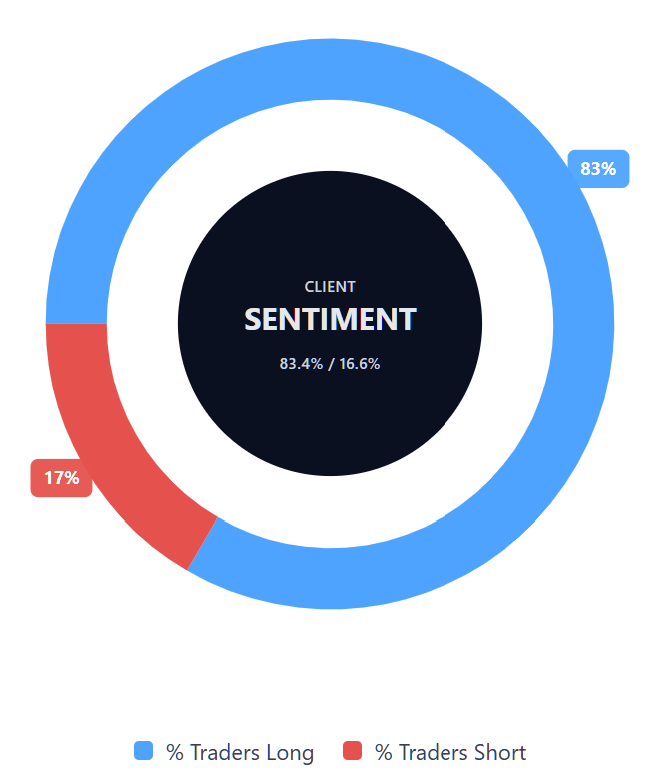
Capital.com’s client sentiment for France 40 CFDs
As of 16 September 2026, Capital.com client positioning in France 40 CFDs shows 83.4% buyers and 16.6% sellers, a difference of 66.8 percentage points. This reflects open positions on Capital.com at the time captured and can change.
Summary – CAC 40 2026
- As of 9:03am UTC on 16 September 2026, the CAC 40 traded near 8,105.6 points, within an intraday range of 8,033–8,140.1.
- On TradingView, technical data placed the index below its 20-, 50-, 100- and 200-day simple moving averages, while the 14-day RSI stood at 32.02.
- Potential influences include ECB policy, inflation, oil prices, bond yields and changing conditions across luxury and technology shares.
- Easing inflation, stronger earnings or lower borrowing-cost expectations could support valuations, while persistent inflation, tighter policy or weaker sector demand could weigh on them.
- Recent developments include L’Oréal overtaking LVMH by market capitalisation, Bernstein’s LVMH target cut and the CAC 40’s recent move to a four-month low.
Past performance is not a reliable indicator of future results.
FAQ
What is the five-year CAC 40 forecast?
The third-party forecasts covered here do not provide a reliable five-year CAC 40 outlook. Their projections extend mainly through 2026 and 2027, with cited 2027 levels ranging from 9,002–9,221 points for the specified periods. Forecast uncertainty generally increases over longer horizons because monetary policy, inflation, corporate earnings, sector performance and geopolitical conditions can change substantially. These model-based projections are estimates, not indications of future index levels.
Is the CAC 40 a good CFD to trade?
Whether the CAC 40 is suitable to trade as a CFD depends on a trader’s objectives, experience and tolerance for risk. The index provides exposure to major French companies across sectors including luxury, technology and industrials, while factors such as ECB policy, bond yields, oil prices and corporate earnings can create price movement in either direction. CFDs also use leverage, which magnifies both gains and losses and increases risk.
Could the CAC 40 go up or down?
Yes. The CAC 40 can move in either direction as economic, corporate and market conditions change. Stronger earnings, easing inflation, lower borrowing-cost expectations or improving luxury and technology demand could support the index. Persistent inflation, tighter monetary policy, weaker corporate results, higher oil prices or rising bond yields could weigh on it instead. Geopolitical developments and changes in global risk sentiment may also influence French equities independently of domestic conditions.
Should I invest in the CAC 40?
Whether to gain exposure to the CAC 40 depends on your financial circumstances, objectives and tolerance for risk. Factors to consider include French corporate earnings, ECB policy, inflation, sector composition and wider market conditions. The forecasts discussed here use different methodologies and shouldn’t be treated as expected outcomes. CFDs provide one way to trade CAC 40 price movements, but they involve leverage and don’t give ownership of the underlying index constituents.
Can I trade CAC 40 CFDs on Capital.com?
Trading France 40 CFDs on Capital.com lets you speculate on movements without owning the underlying asset and to take long or short positions. However, contracts for difference (CFDs) are traded on margin, and leverage amplifies both profits and losses. You should ensure you understand how CFD trading works, assess your risk tolerance, and recognise that losses can occur quickly.