

Gold stabilises after selloff, but risks remain
Rising yields and expectations of less rate cuts from the Federal Reserve continue to limit the upside in gold despite the risk-on mood.
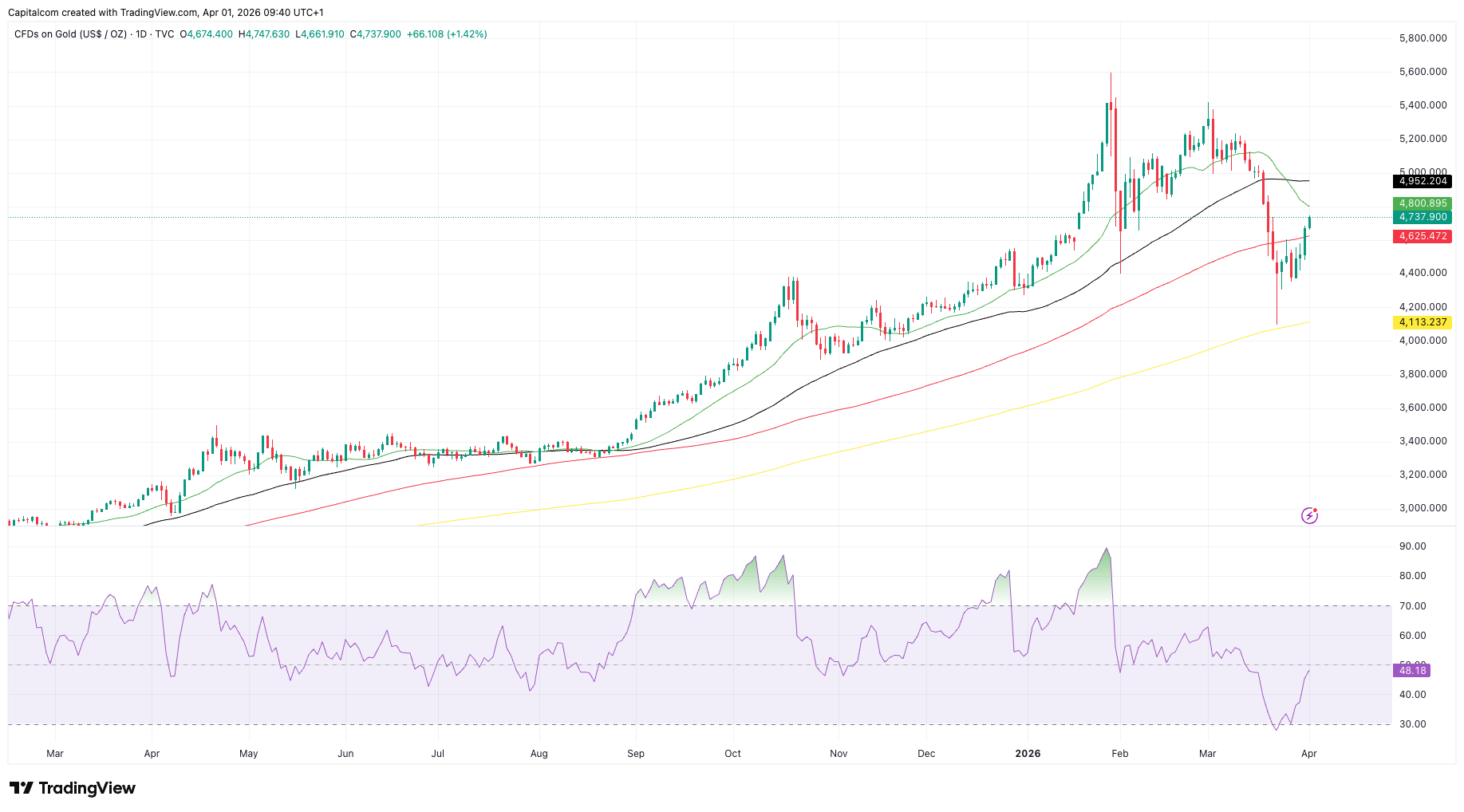
Gold has begun to stabilise after its sharp selloff, with the chart showing a tentative rebound toward the $4,700–$4,800 area. Technically, this looks like a corrective bounce rather than a full reversal. Price remains below key resistance levels around $4,900–$5,000 and is still trading under its shorter-term moving averages, suggesting the broader loss of momentum from the February highs remains intact. The RSI has recovered from oversold territory but is only back to neutral levels, reinforcing the idea that this is a rebalancing move rather than a renewed bullish trend. For a more constructive outlook, gold would need to reclaim the $4,900 region and hold above it; otherwise, the risk remains for further consolidation or downside.
Gold (XAU/USD) daily chart
Past performance is not a reliable indicator of future results.
The narrative and what it means for gold
From a fundamental perspective, the recent rebound highlights how narrative has followed price rather than led it. Headlines suggesting a potential de-escalation in the Middle East, including reports of the Trump administration being open to ending the war and comments from Iranian leadership, helped spark a rally in risk assets. However, positioning was a dominant factor heading into the quarter-end rebalancing of portfolios after a volatile quarter and one of the worst monthly performances for equities in years.
Importantly, the underlying fundamentals for gold have not materially improved. If anything, the conditions that drove the initial selloff (higher real yields, a stronger dollar and reduced expectations for rate cuts) remain largely in place. The geopolitical backdrop also remains unresolved. While headlines point to a willingness to negotiate, there is little evidence that the structural drivers of the conflict, particularly control of the Strait of Hormuz and the disruption to energy markets, have changed. As a result, the recent move higher in gold may prove fragile if those macro headwinds reassert themselves.
Ultimately, gold is caught between competing forces. On one hand, geopolitical uncertainty and financial instability would typically support safe-haven demand. On the other, tighter financial conditions and a dominant US dollar continue to act as a headwind. Until there is clearer evidence of either sustained de-escalation or a shift in monetary policy expectations, gold is likely to remain in a choppy, range-bound environment, with price action driven as much by positioning and flows as by fundamentals.