
Michael Kramer: What Is the Price-to-Earnings Ratio and Why Does It Matter?
Assessing a stock’s valuation is not as simple as assuming that a low P/E ratio means it is cheap or that a high P/E ratio means it is expensive.
The price-to-earnings (P/E) ratio is one of the most commonly used valuation metrics. Assessing a stock’s valuation is not as simple as assuming that a low P/E ratio means it is cheap or that a high P/E ratio means it is expensive. Interpreting the ratio requires considering the context in which it is used.
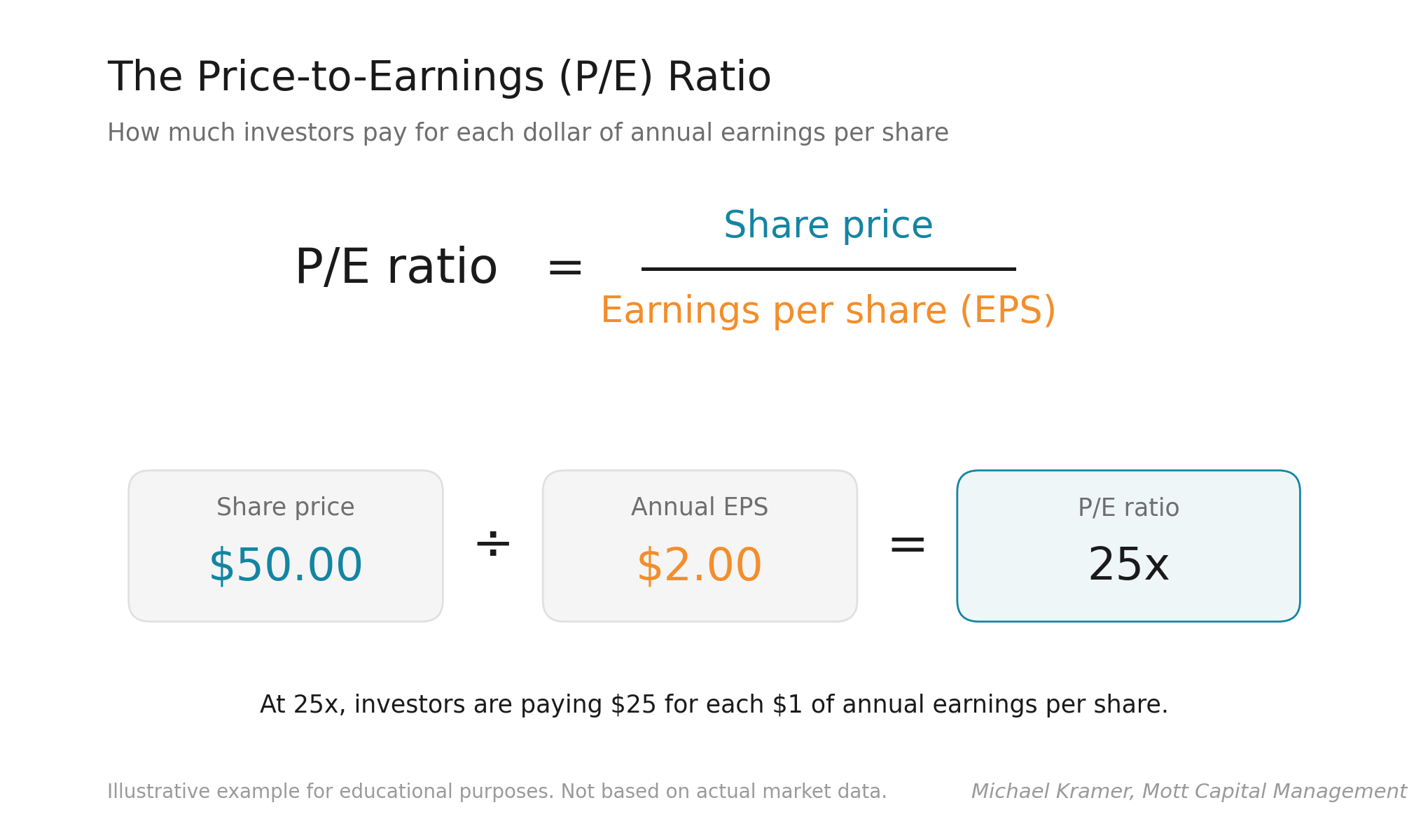
The ratio is calculated by dividing a company’s share price by its earnings per share (EPS). It measures how much an investor is paying for each dollar of annual earnings per share. For example, if a company’s share price is $50 and its annual earnings per share are $2, its P/E ratio is 25. This means investors are paying $25 for each $1 of annual earnings per share. Higher ratios are often described as more expensive and lower ratios as cheaper, although that interpretation depends on context. The reality is far more nuanced.
Different Ways to Calculate the P/E Ratio
The P/E ratio can be calculated in several ways, each potentially producing a different result and interpretation. A trailing P/E ratio uses a company’s earnings from its most recent fiscal year or the trailing 12 months. A forward P/E ratio uses analysts’ earnings estimates for the coming fiscal year or the next 12 months.
A trailing P/E ratio compares the current share price with the company’s reported earnings, while a forward P/E ratio compares it with expected earnings. Forward P/E ratios involve more uncertainty because analysts’ estimates may prove too high or too low.
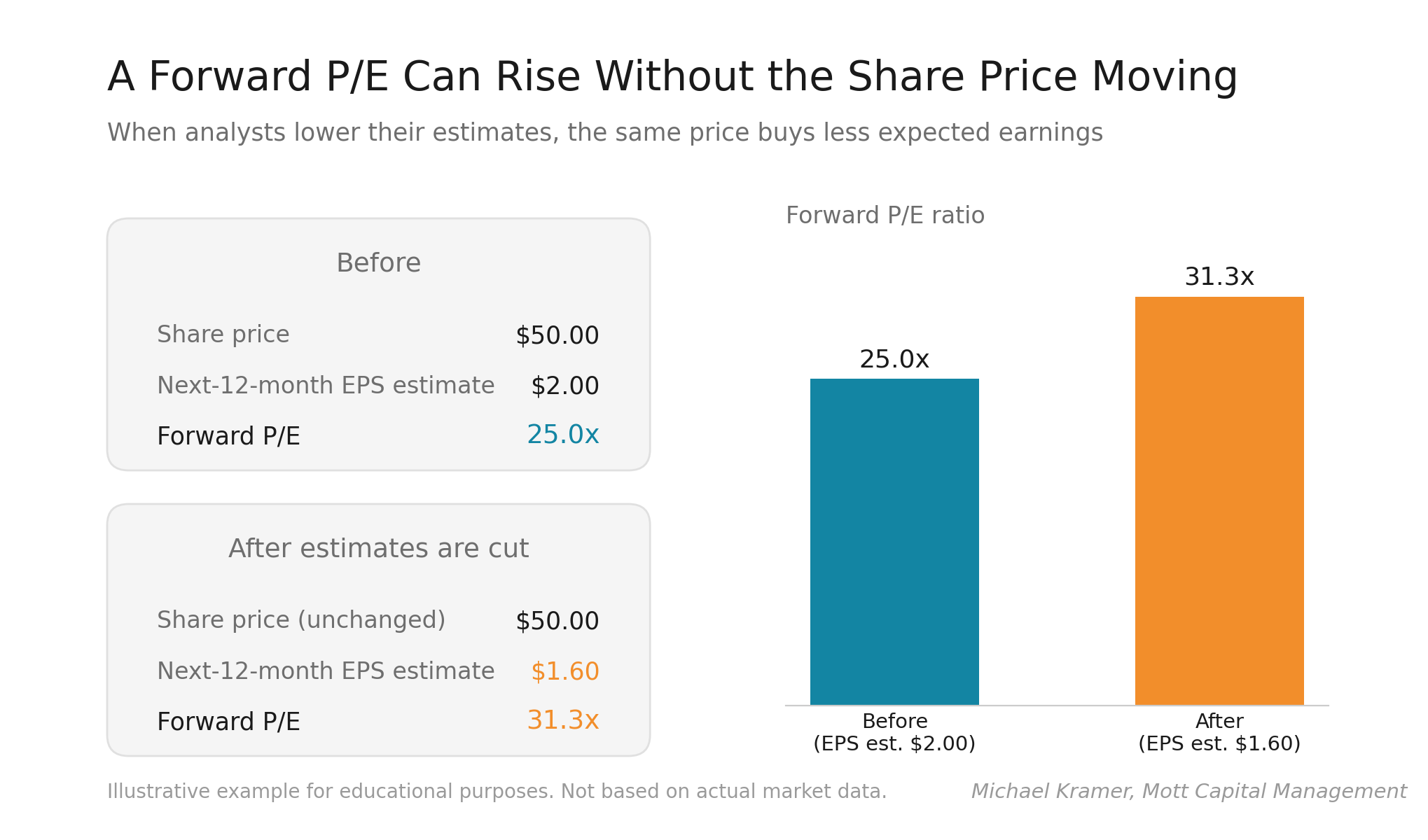
Analysts’ estimates can change after a company reports earnings and provides new guidance. If a company reports poor results and provides weak guidance, analysts may reduce their earnings forecasts. If the share price remains unchanged and the EPS estimate remains positive, a lower earnings estimate corresponds to a higher forward P/E ratio.
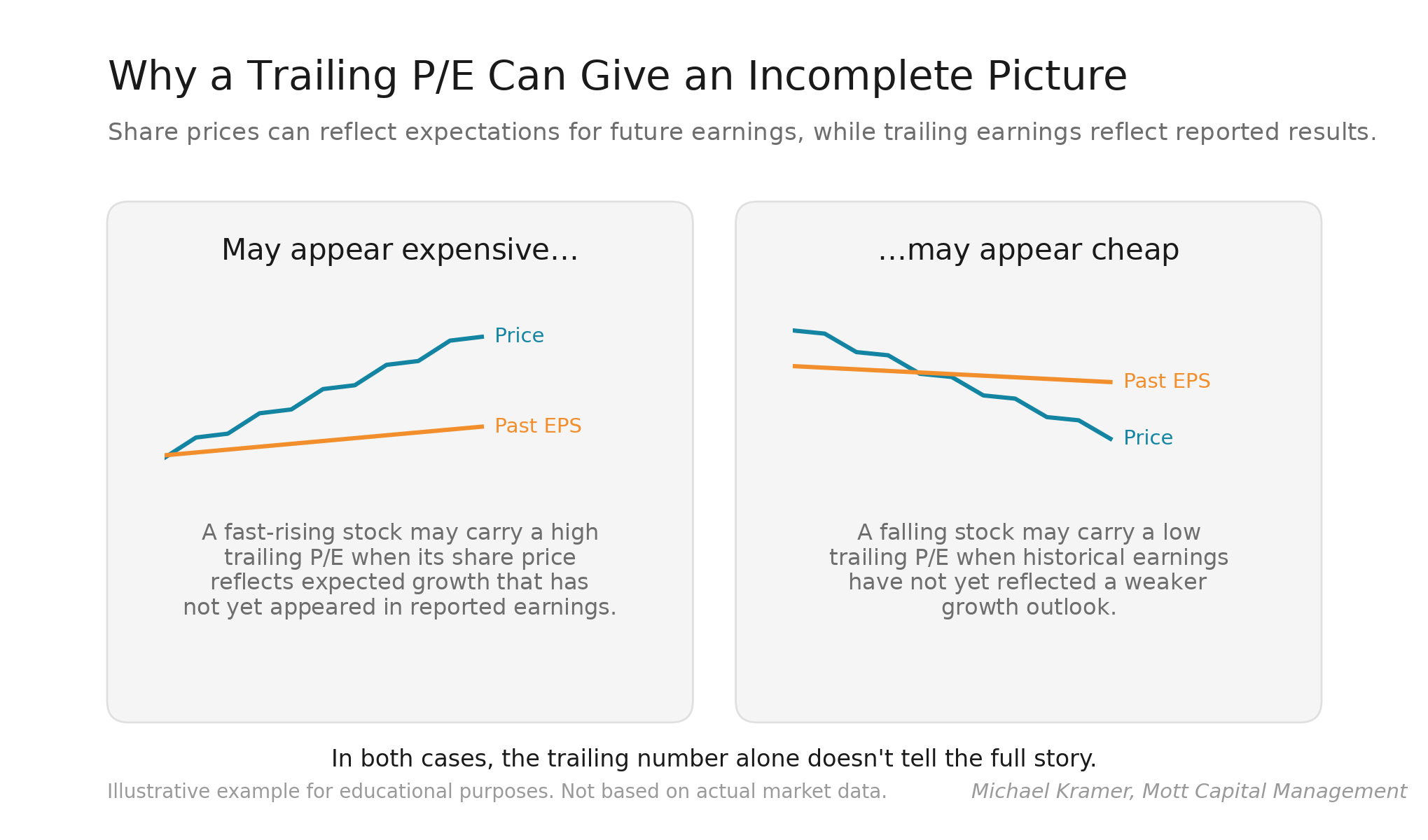
A trailing P/E ratio has disadvantages as well. A stock may have a high trailing P/E ratio when its share price has increased more quickly than its reported earnings. Conversely, a stock may have a low trailing P/E ratio when its share price has declined more quickly than its reported earnings. There is no single “correct” P/E ratio. Trailing and forward P/E ratios can be considered together when assessing a stock’s valuation.
Behind the Number
The P/E ratio provides limited information on its own because companies with different business models, margin profiles, and revenue characteristics can trade at different valuation multiples. As a result, sector context and company-specific characteristics are important when comparing P/E ratios.
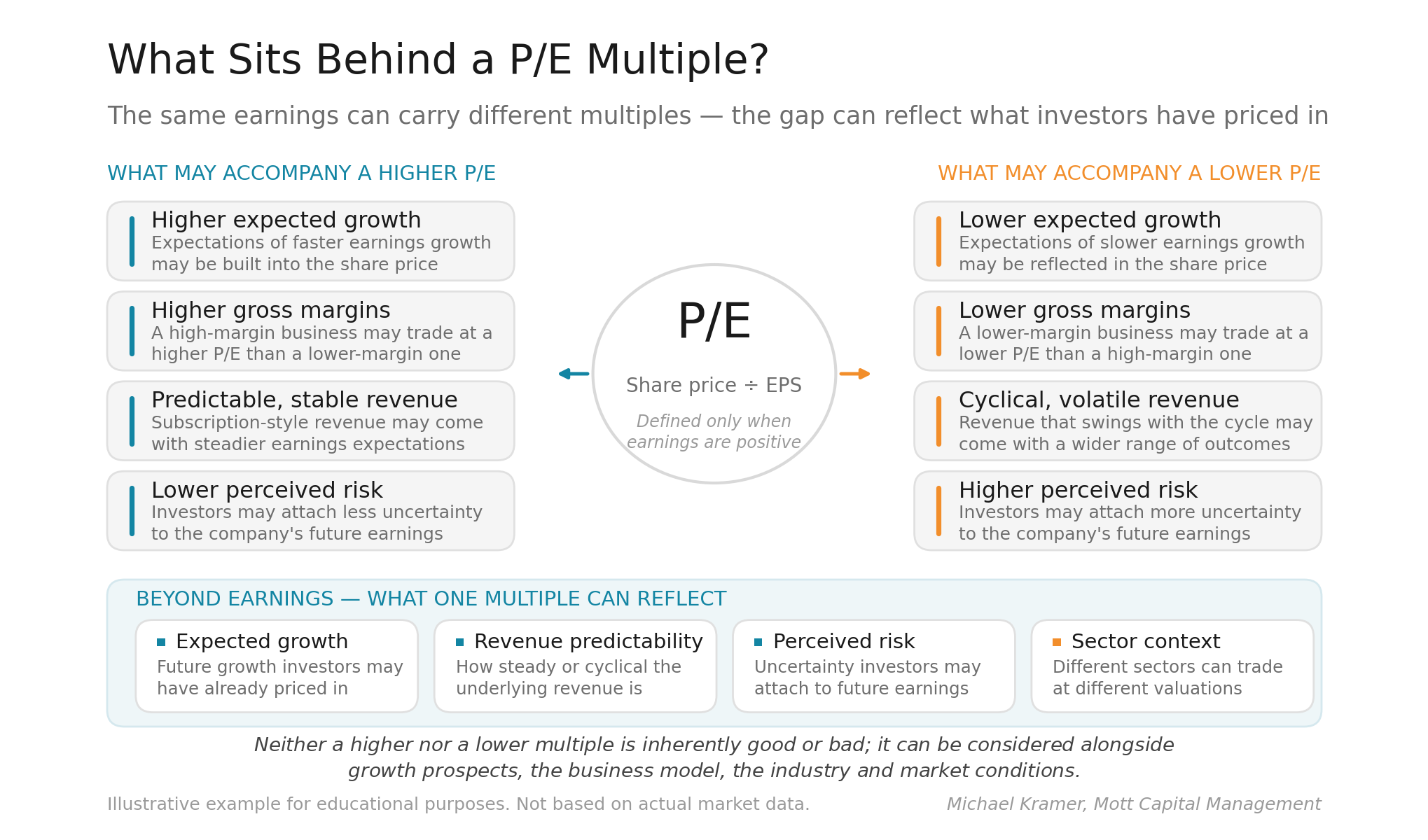
When a P/E ratio appears unusually high or low, it can prompt further analysis of what may underlie the valuation. A stock is not necessarily cheap or expensive based on the ratio alone; growth expectations, risk, profitability, and market conditions are among the factors commonly considered alongside the P/E ratio.
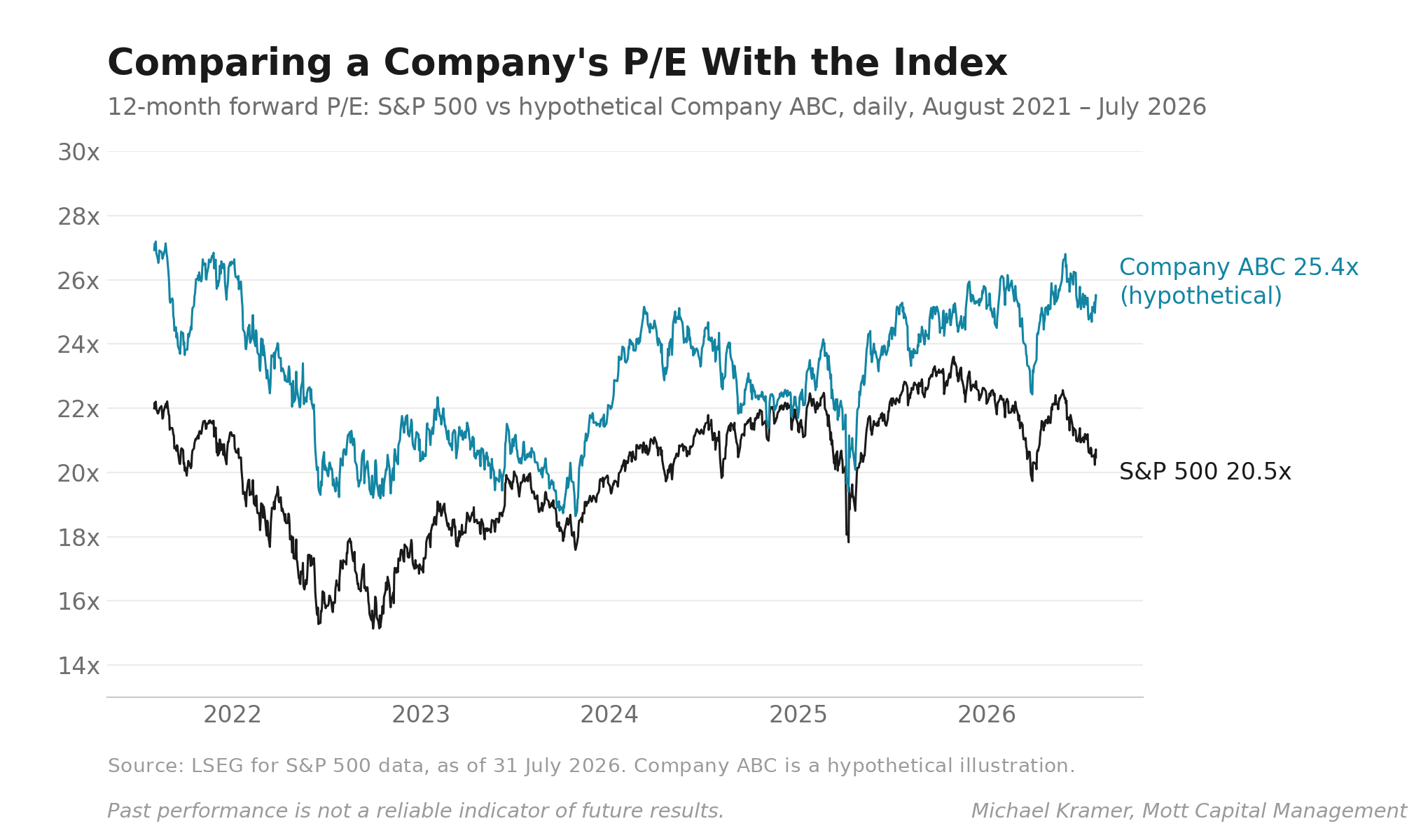
Historical comparisons can show how shares have been valued across past market cycles, but those valuation levels may not recur. Historical P/E ranges can provide useful context, but they do not indicate where a stock’s valuation will peak or trough in the future.
Macro Factors
P/E ratios can also vary with interest rates and other macro factors. All else being equal, lower rates are often associated with higher P/E ratios, while higher rates are often associated with lower valuations.
Valuations can also vary alongside credit spreads and market volatility. Wider credit spreads and higher volatility have often coincided with lower P/E ratios, while tighter spreads and lower volatility have often coincided with higher multiples. These relationships can vary across different market environments.
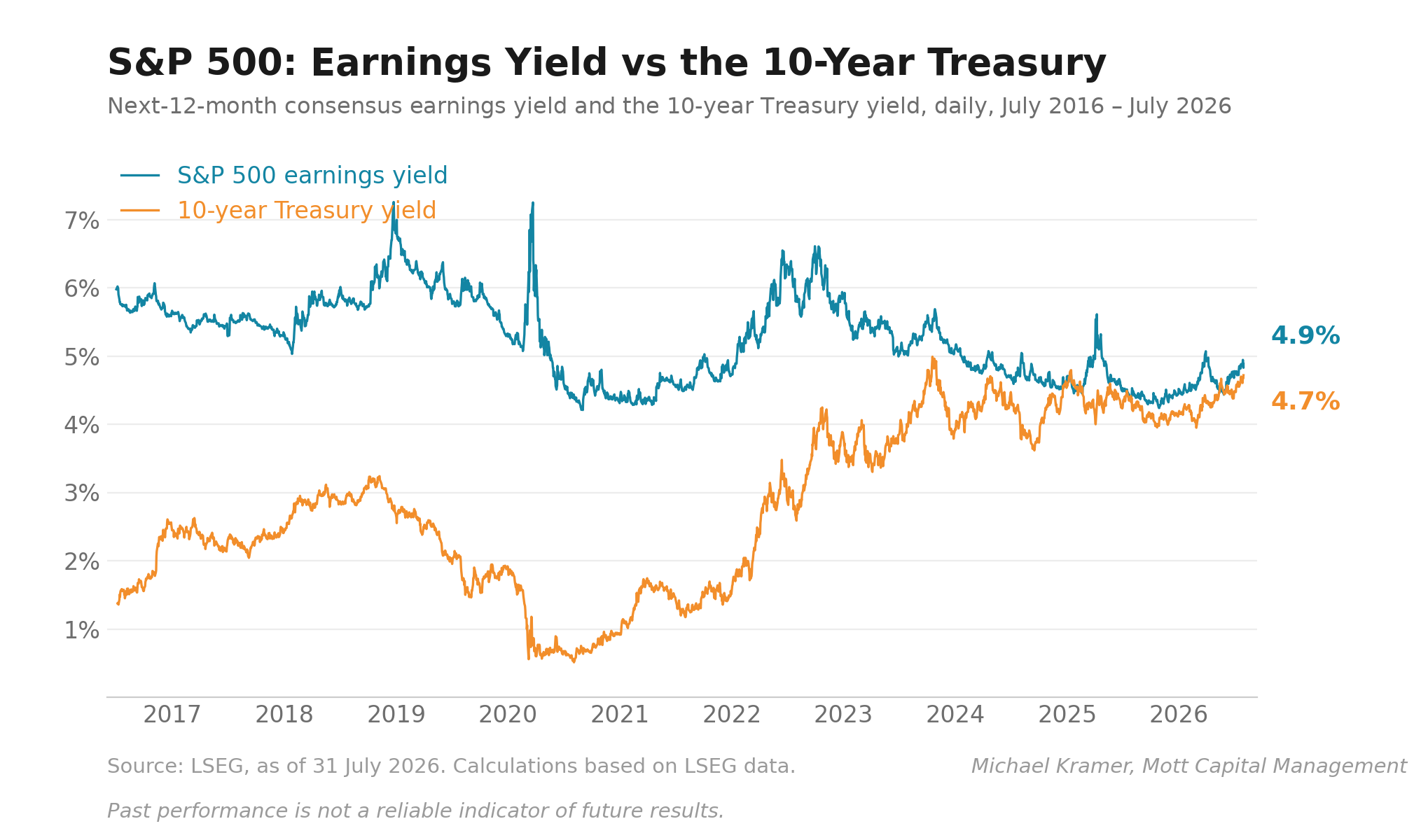
The inverse of the P/E ratio is called the earnings yield, and it is calculated by dividing earnings per share by the share price. The earnings yield can be compared with a Treasury yield, such as the 10-year Treasury yield, to provide context for the relative valuation of stocks and bonds. It is not a like-for-like comparison because corporate earnings are uncertain and can rise or fall.
Limitations
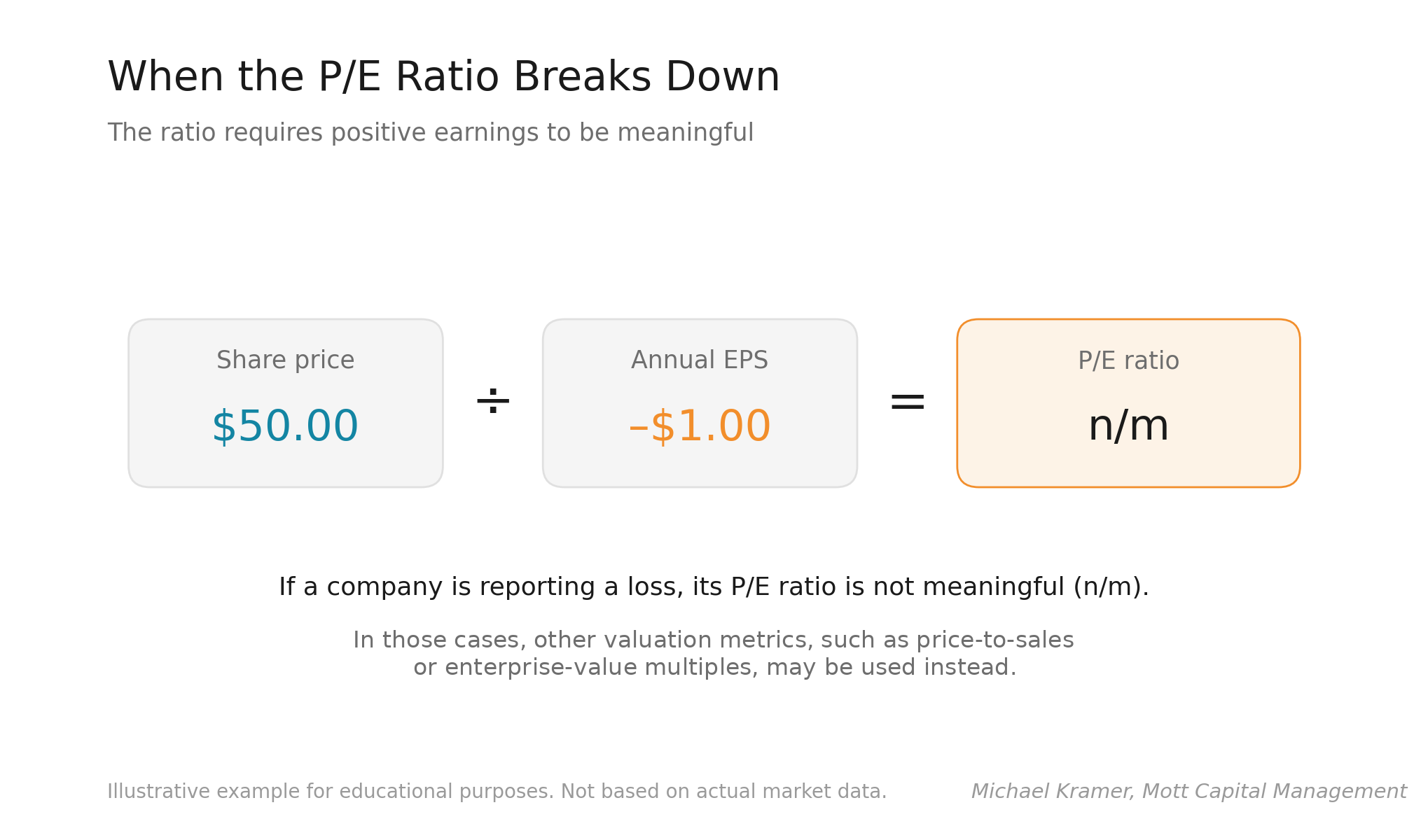
The P/E ratio also has important limitations. One important limitation is that a company must have positive earnings for the P/E ratio to be meaningful. If a company is reporting a loss, its earnings are negative, and the P/E ratio is not applicable. In those cases, other valuation metrics are generally used instead.
Ultimately, the P/E ratio alone cannot determine whether a stock is overvalued or undervalued. It is generally interpreted alongside a company’s growth prospects, business model, industry and broader market conditions. In that context, it can provide useful information about valuation.