
US Midterm Elections: what does the Democrats’ victory mean for oil, energy and AI?
What could be the consequences for energy markets and AI of the US Midterm elections?
The Democrats have taken control of both chambers of Congress, but the consequences for broad energy markets are not straightforward. Greater pressure to end the war with Iran could help bring oil prices down, but the new balance of power could also make it harder to ease sanctions on Russia and change the conditions for investment in oil and gas production, pipelines and data centres.
Iran and Ukraine: different implications
The new majority in Congress could make it harder to finance further stages of the war with Iran and increase pressure on the administration to present conditions for ending the conflict. But at the same time, the elections also remove an important political deadline - before the vote, another increase in fuel prices could have hurt Republican candidates. Some escalation actions may therefore have been postponed until after the election, regardless of its outcome. If that was the case, this particular incentive to avoid escalation is now weaker.
The implications for Russian fuel supplies are different. If stronger support for Kyiv in Congress leads to greater opposition to concessions to Moscow, agreements on easing sanctions could become harder to reach or maintain. We have already seen a signal of this in recent days. On 2 November, New Jersey Governor Mikie Sherrill warned port operators against accepting Russian diesel, arguing that the licence issued by the Trump administration conflicts with the 2022 statutory ban on imports of Russian petroleum products.
It that case, it is worth noting two things:
1) that sanctions decisions still depend on existing laws and the powers held by the administration,
2) the new Congress will not take office until 3 January 2027, while the G20 summit in Miami is scheduled for 14-15 December. Trump has expressed optimism about reaching an agreement to end the war in Ukraine, although a potential meeting with Vladimir Putin has not yet been confirmed.
Is “Drill, Baby, Drill” under threat again?
The Republicans’ loss of control over Congress could make it harder to implement the administration’s energy policy if companies become less confident that favourable regulations will remain in place, particularly with the next presidential election approaching in 2028.
The history of Keystone XL shows how much regulatory stability matters for major energy investments. The project received approval during Donald Trump’s first term but was abandoned in 2021 after Joe Biden revoked its permit.
Another example is South Bow’s expansion plans. In its second-quarter update, the company announced binding 20-year commitments from nine customers to transport 465,000 barrels per day from Canada to delivery points in the US. Its development plans include the Prairie Connector and the proposed Liberty Bridge pipeline, being developed together with Bridger. Despite this commercial support, South Bow continued to stress the need for long-term permit certainty and regulatory predictability ahead of a final investment decision, planned for mid-2027.
Could the Change Slow AI Development?
The election results could also affect electricity and natural gas demand through their impact on data centre development - at the opening of ADIPEC on 2 November, Sam Altman identified energy availability as one of the main challenges for AI development.
The Democrats’ proposals focus mainly on financing infrastructure and protecting local resources - for example, senator Martin Heinrich wants large energy consumers to cover the costs of the infrastructure needed to connect them to the grid. At the same time, Senator Mark Warner has proposed linking federal tax incentives to standards covering energy, water consumption, environmental impact and local communities.
These requirements could increase upfront costs and delay some projects. For companies financing construction through debt, delays could also extend the period between spending money and starting to generate revenue.
However, some Democratic proposals aim to speed up approvals for energy infrastructure. For instance Heinrich’s initiative aims to connect new energy projects to the grid more quickly.
Either way, commenting on the election result, Elon Musk wrote on X: “Data centers in space looking pretty appealing right now”.
Texas Will Be an Important Test
Texas, which accounts for around 27% of planned US data centre capacity, is the state where the impact of the “Blue Wave” on energy markets could be particularly visible, following Democrat Gina Hinojosa’s victory in the gubernatorial election.
Hinojosa supports a moratorium on new data centres until stronger protections for the power grid, water resources and local communities are introduced. Restrictions were already introduced under Republican Governor Greg Abbott, but during the campaign Hinojosa argued that temporary restrictions were not enough and that permanent regulations were needed.
Oil Prices: Here and Now
At 12:45 CET, Brent is trading at around 101.5 USD/b, down approximately 2% today.
It is difficult to attribute this decline directly to the election results. Oil prices remain exposed to sharp moves in either direction, driven mainly by political and military developments that are difficult to capture in traditional forecasting models.
For now, sentiment appears to reflect Qatar’s mediation efforts alongside continuing military risks. US officials described the latest strikes on Iran’s Qeshm Island as limited and defensive, stressing that they did not mark a return to large-scale military operations. Iranian officials have been more cautious about US statements suggesting that an agreement is close. According to Reuters, a senior Iranian official said on Tuesday that the two sides were still far from reaching a deal and that Tehran was demanding that its conditions be met, including the lifting of the US blockade and oil sanctions.
So despite signs of diplomatic progress, it is too early to conclude that geopolitical risks have eased on a lasting basis.
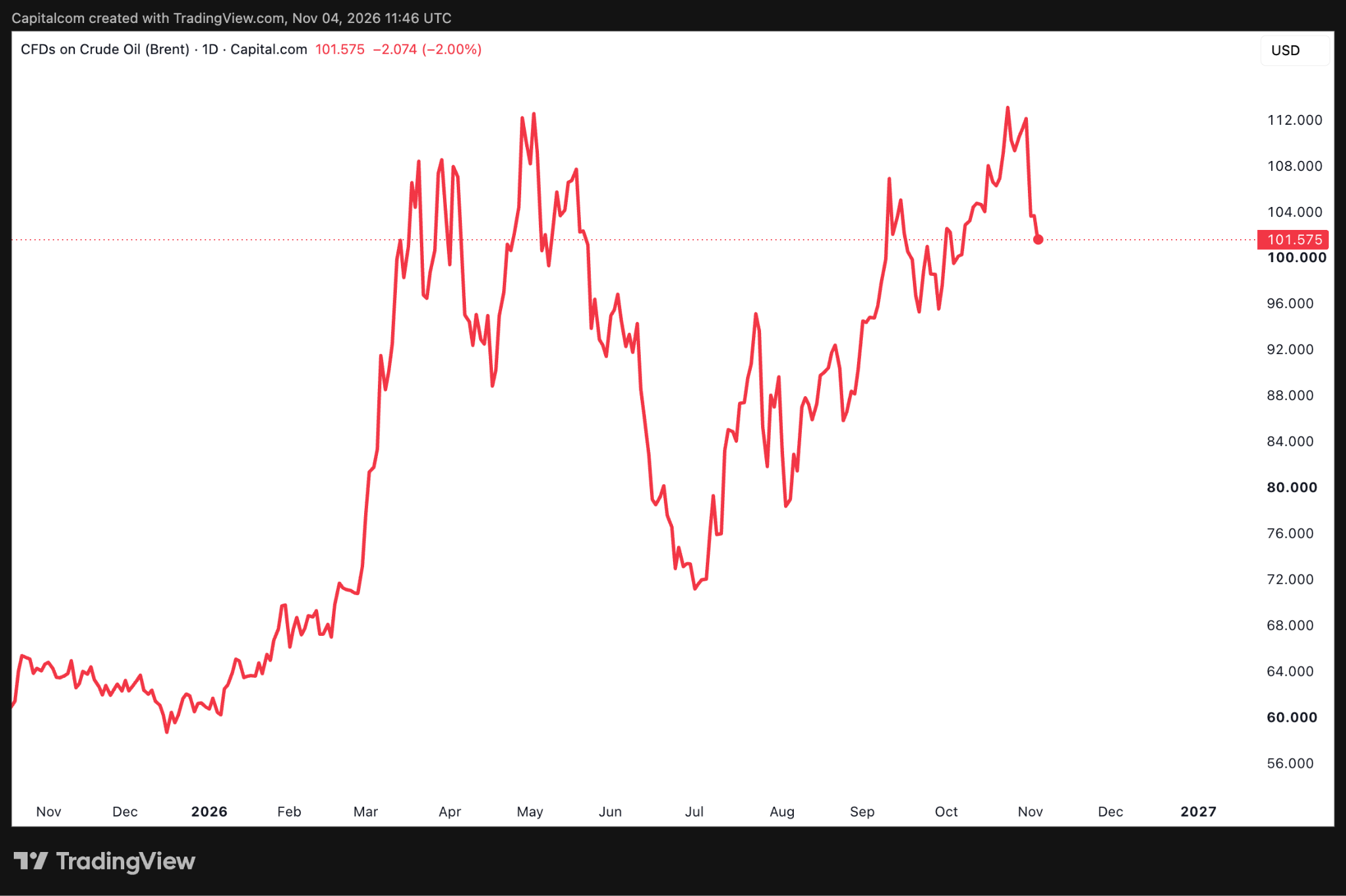
UKOIL (Brent), 1D timeframe. Past performance is no guarantee of future results.