
Market Mondays: Focus shifts from geopolitics to earnings and central banks
Focus shifts on the Magnificent 7 earnings season and key central bank meetings as US equities cotninue to power higher.
Markets are entering a pivotal week, with the focus beginning to shift away from pure geopolitical headlines toward a broader convergence of drivers — earnings, central bank policy and the still-uncertain trajectory of the US–Iran conflict. While headlines from the Middle East continue to generate short-term volatility, their grip on markets has noticeably weakened compared to previous weeks.
Over the past 48 hours, the geopolitical narrative has once again flipped. Reports over the weekend suggested that ceasefire talks were deteriorating, raising concerns about prolonged disruption to energy flows and renewed tension around the Strait of Hormuz. Yet, almost immediately, fresh headlines emerged indicating that Iran may be willing to re-engage and potentially reopen the Strait. This back-and-forth dynamic has become a familiar pattern — one that continues to drive headline-driven volatility, but with diminishing impact on broader risk sentiment.
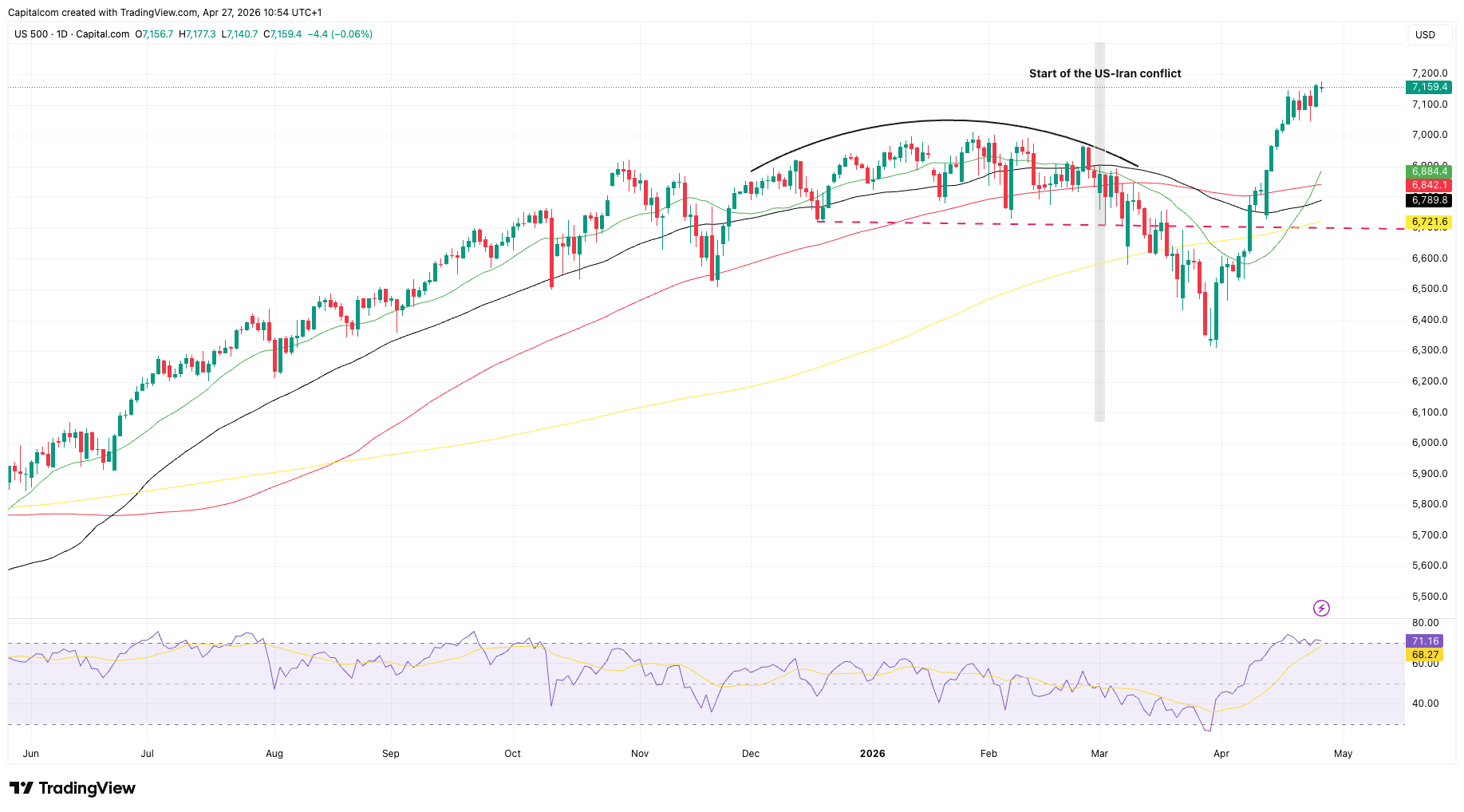
S&P 500 daily chart
Past performance is not a reliable indicator of future results.
That shift is particularly evident in cross-asset behaviour. Earlier in the conflict, markets moved almost mechanically: higher oil meant weaker equities, a stronger dollar and softer gold. That relationship has now largely broken down. Oil remains elevated, but equities — particularly in the US — have surged to new highs, suggesting that investors are increasingly looking through the geopolitical noise and focusing on underlying fundamentals.
Those fundamentals, for now, remain supportive. Earnings season has started strongly, with expectations for double-digit growth not only holding but, in some cases, being revised higher. The outlook for the second quarter remains particularly robust, with forecasts pointing to continued expansion in corporate profits. This has provided a powerful anchor for equity markets, helping to justify valuations even as macro risks persist.
At the same time, the composition of the rally has shifted. Earlier in the year, markets were rotating toward cyclicals in anticipation of stronger global growth and lower interest rates. That narrative has faded. Instead, leadership has returned to large-cap technology, driven by strong profitability, resilient demand and continued investment in AI. The question now is whether that story can hold up as capital expenditure rises and investors once again scrutinise the return on those investments.
Central banks are the other key piece of the puzzle. Expectations have stabilised significantly in recent weeks, with markets moving away from pricing aggressive rate cuts — or hikes — toward a more neutral stance. The Federal Reserve, in particular, is now expected to remain on hold, monitoring the impact of higher energy prices rather than reacting aggressively. This reduction in policy uncertainty has been an important factor in supporting risk assets, helping to compress volatility and encourage flows back into equities.
However, this equilibrium remains fragile. The market is effectively pricing a scenario where geopolitical risks do not escalate, earnings remain strong and central banks stay predictable. Any deviation from that — whether through renewed conflict, weaker corporate guidance or a shift in policy expectations — could quickly reintroduce volatility. For now, markets appear comfortable operating under a framework of conditional optimism. As long as the situation in the Middle East does not materially worsen, and as long as earnings and policy remain supportive, risk assets can continue to grind higher. But with multiple key catalysts converging in the days ahead, the margin for error is narrowing — and the potential for sharp moves in either direction is increasing.