
Japanese yen rallies as Takata puts BOJ tightening back in focus
The Japanese Yen continues to strengthen as BoJ officials hint at further tightening.
The Japanese yen has staged a sharp recovery, with USD/JPY falling back towards 157 and GBP/JPY retreating towards 212, as investors reassess the likelihood that the Bank of Japan is prepared to respond more forcefully to persistent inflation and renewed weakness in the currency. The latest catalyst has been commentary from BOJ board member Hajime Takata, who argued that Japan has entered a new phase in which rate increases should be conducted in a more “nimble and data-dependent” manner rather than following a predetermined timetable. Takata has also left the door open to larger or consecutive moves, helping markets bring forward expectations for further tightening.
That has been enough to generate a significant repricing. Markets are now assigning a very high probability to another rate increase at the BOJ's September 17-18 meeting, while expectations have also shifted towards greater tightening by year-end.
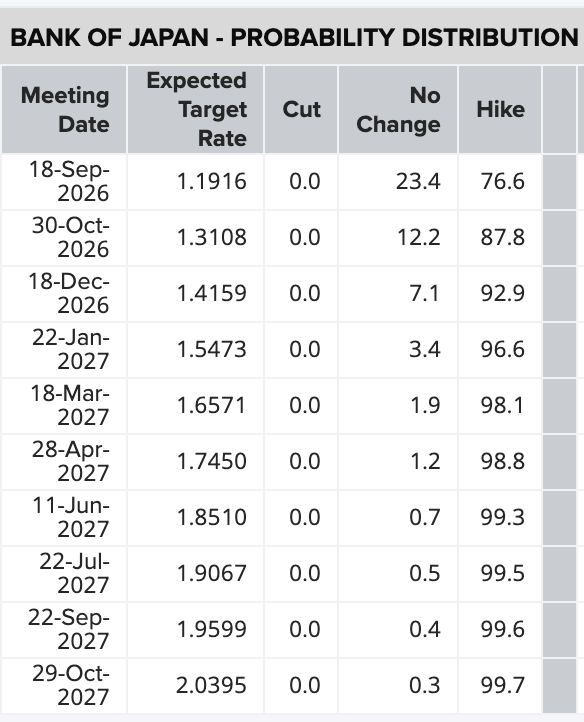
Source: refinitiv
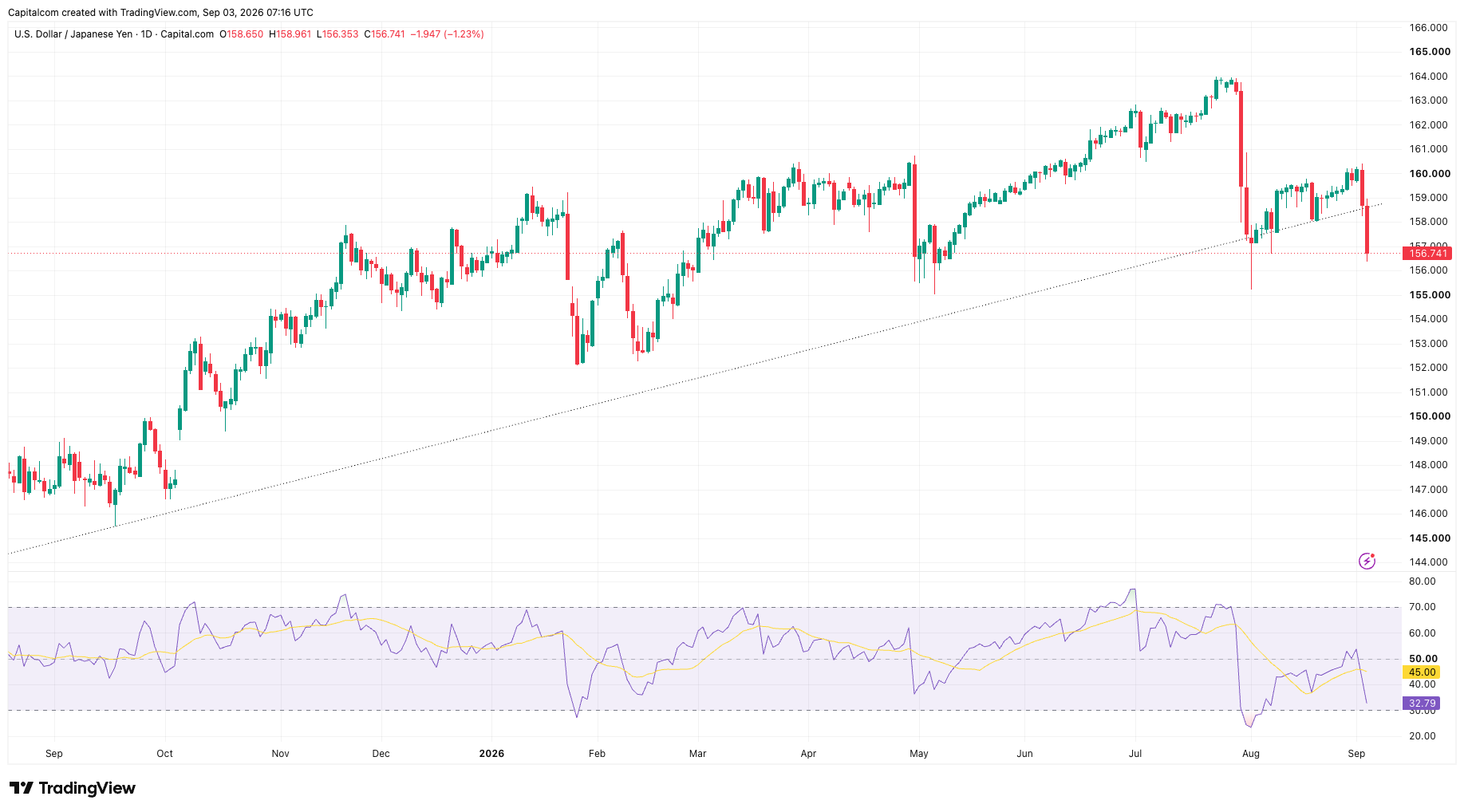
The latest move has caused some meaningful technical damage to USD/JPY. The pair had recovered towards 160 after its sharp late-July decline from around 164, but that rebound has now reversed. The pullback has taken USD/JPY back below 157, testing both the August lows and the rising trendline that has supported the broader advance since early 2025.
USD/JPY daily chart
Past performance is not a reliable indicator of future results.
Importantly, the hawkish rhetoric isn't occurring in isolation as Japan's inflation backdrop has become more uncomfortable for policymakers, suggesting that underlying inflationary pressures are broadening beyond the direct impact of energy. The BOJ itself has acknowledged that underlying inflation is approaching its 2% objective, while highlighting the weaker yen, Middle East tensions and rising domestic costs as upside risks to prices.
As a result, the yen has been caught in an uncomfortable feedback loop. Currency depreciation raises the cost of imports, particularly energy, adding to inflation and squeezing household purchasing power. If the BOJ is becoming less willing to tolerate that dynamic, monetary policy could increasingly be used to help prevent further deterioration in the currency.
How much weight should markets give Takata?
There is an important counterargument to his comments. Takata is among the most hawkish members of the Policy Board, meaning his comments should not necessarily be interpreted as representative of the BOJ's centre of gravity. The same applies to fellow hawk Naoki Tamura, who has previously argued that rates should rise by 25 basis points every few months towards an estimated 2% neutral level.
Both Takata and Tamura's current terms expire in mid-2027, potentially reducing the significance of their longer-term policy prescriptions. Their comments can therefore be viewed partly as ideological arguments about where Japanese monetary policy should be heading rather than definitive signals about where Governor Kazuo Ueda and the majority of the board intend to take it.
There is also the possibility that the increasingly hawkish language serves another purpose: verbal intervention. Japanese policymakers have spent considerable time trying to slow excessive yen depreciation through warnings to currency markets. Hawkish BOJ rhetoric can achieve some of the same effect. If traders believe policymakers are prepared to accelerate tightening, speculative short-yen positions become more expensive and less attractive, potentially strengthening the currency without requiring either an immediate rate increase or direct FX intervention.
That makes the follow-through crucial. The yen has experienced several sharp rallies over the past year only for depreciation to resume once markets concluded that rhetoric would not translate into sufficiently aggressive policy action.
September's BOJ meeting just became much more interesting
The September meeting may therefore carry considerably more event risk than appeared likely only a few weeks ago. Recent inflation data gives policymakers a stronger economic justification for tightening. Yen depreciation provides an additional incentive, while Takata's comments have demonstrated that at least part of the Policy Board believes the BOJ should be prepared to move faster. Governor Ueda has also indicated that rate adjustments can be discussed at every meeting, adding credibility to the market's repricing.
If the BOJ follows the recent rhetoric with another rate increase — and particularly if it signals that subsequent hikes could arrive more quickly — the yen could have scope to extend its recovery as investors reassess Japan's still-wide interest-rate differential with other major economies.