
Gold eyes $5,000 as Warsh takes centre stage
Gold continues to move higher as dollar weakness and easing expectations of Fed hikes keep the precious metal supported.
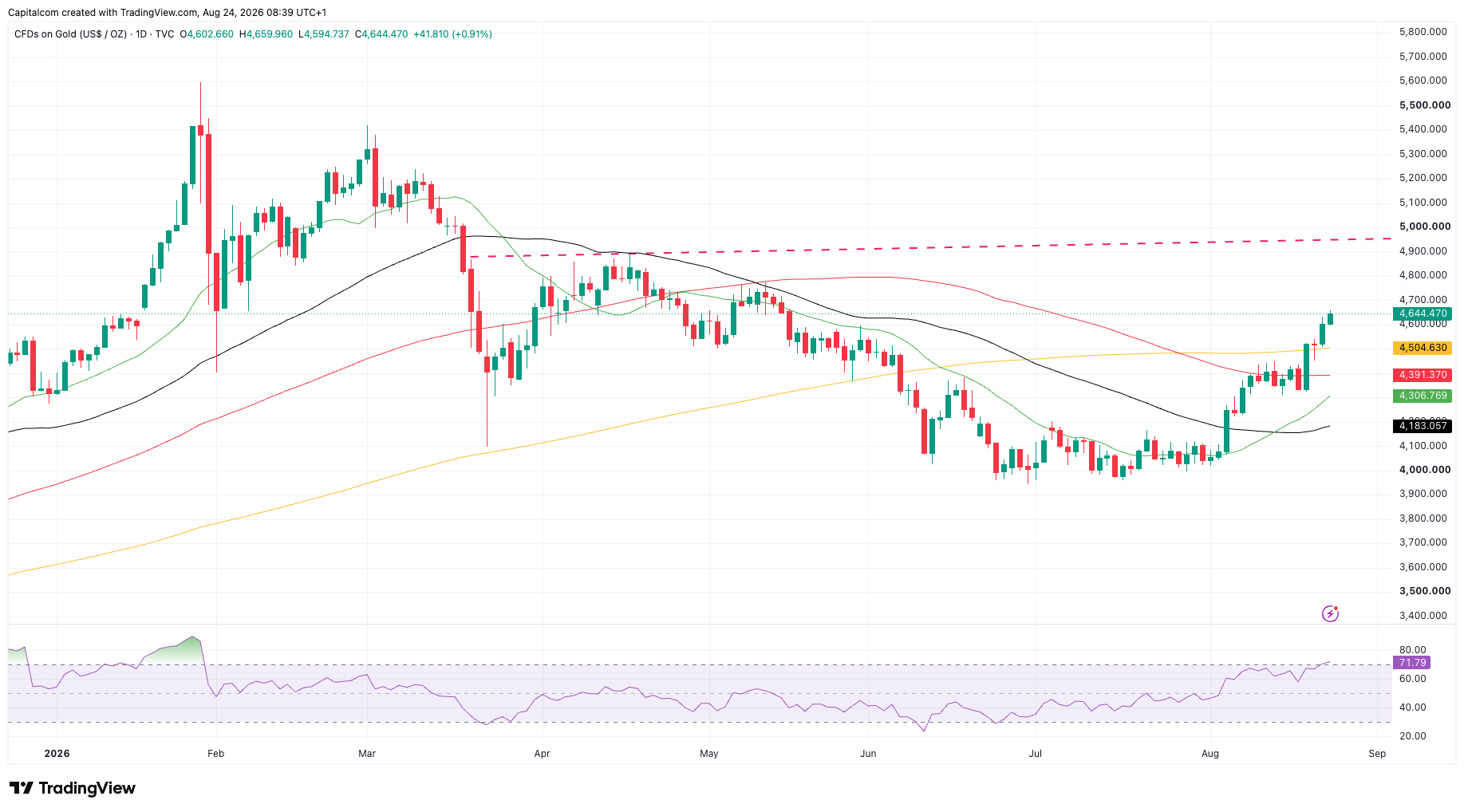
Gold has started the week on strong footing as the precious metal breaks above $4,600, extending an impressive August recovery and pushing to its highest level in more than three months. The move follows a gain of more than 5% last week and reflects a combination of a weaker US dollar, some relief in Treasury yields and fading expectations that the Federal Reserve needs to raise rates immediately.
Gold (XAU/USD) daily chart
Past performance is not a reliable indicator of future results.
Gold's recovery has taken place with a backdrop of turbulence in the US bond market. Long-term Treasury yields remain historically elevated, with the 10-year around 4.7% and the 30-year above 5.2%, but they have eased from their recent peaks following the Treasury's decision to expand liquidity-support buybacks. At the same time, the dollar weakened sharply last week. Both developments have provided breathing room for bullion: lower yields reduce the opportunity cost of holding a non-yielding asset, while a weaker dollar makes gold relatively more attractive to international buyers.
The shift in Fed expectations has also been important. Recent employment and inflation data have weakened the case for an immediate rate increase, even though inflation remains sufficiently elevated to keep further tightening on the table. That distinction matters for gold. The market does not necessarily need to price aggressive Fed easing for bullion to perform; simply removing the threat of imminent tightening can reduce upward pressure on real yields and the dollar.
Jackson Hole becomes the next major test
That puts Kevin Warsh's first Jackson Hole speech as Fed Chair firmly at the centre of this week's outlook. Warsh is scheduled to deliver keynote remarks on Friday, and markets will be looking for greater clarity on both his assessment of inflation and the broader "regime change" he has advocated at the Fed. He has been reluctant to provide conventional forward guidance, meaning the speech may focus more heavily on the Fed's reaction function and longer-term philosophy than explicitly signalling what policymakers will do in September.
For gold, what matters is how the bond and currency markets interpret his message. A relatively balanced Warsh who acknowledges the recent moderation in economic data and keeps the prospect of another rate increase at arm's length could allow yields and the dollar to remain contained, potentially extending gold's recovery. A stronger emphasis on persistent inflation and the possibility that policy still needs to tighten would present a more difficult backdrop, particularly after such a rapid rise in bullion.
Warsh also faces a difficult bond-market environment. Long-term yields have remained elevated despite the Treasury increasing its buyback programme, suggesting investors are demanding greater compensation for holding duration amid heavy government borrowing, fiscal uncertainty and lingering inflation risks.
Before Jackson Hole, investors will receive another important piece of the puzzle. July PCE inflation is due on Wednesday, alongside the second estimate of second-quarter GDP. PCE is particularly important because it is the Fed's preferred inflation gauge, and the latest available reading showed headline PCE running at 3.7% year-on-year in June.
Meanwhile, geopolitical uncertainty continues to provide an underlying layer of support. Tensions surrounding Iran and the Strait of Hormuz remain unresolved, while Washington is preparing additional sanctions against Tehran. Iran has warned that further economic pressure could provoke additional disruption to Gulf energy exports, keeping both the oil and safe-haven risk premiums alive.
Gold technical outlook
The technical picture has improved considerably during August as gold has moved decisively away from the $4,000 area, which provided a base through much of July and early August, and has now reclaimed its major moving averages. The latest move has carried the metal above the $4,500 region and its 200-day moving average, strengthening the argument that the recovery is becoming more than a short-lived relief rally. Prices are now approaching $4,650-$4,700, which represents the first significant upside test. A sustained break through that region could bring the $4,900-$5,000 area back into focus.
There is reason for some caution, however. The RSI has moved above 70, suggesting momentum is becoming overbought after the rapid advance. That does not necessarily imply an imminent reversal, but it increases the likelihood of consolidation or profit-taking if this week's catalysts fail to deliver further support. On the downside, $4,500 is now an important first test. Holding above that former resistance area would preserve the constructive breakout structure. A move back below it could suggest the rally has run ahead of the macro story, with the $4,400 region becoming the next area of interest.
The question this week is whether PCE and Jackson Hole can provide the fundamental confirmation needed to turn the breakout into a sustained move towards $5,000.