

Bitcoin price prediction: Fed meeting and ETF flow reversal
Bitcoin traded near $65,569 in late July as markets assessed possible Federal Reserve easing and shifting spot ETF flows after renewed outflows. Explore third-party BTC price targets and technical analysis. Past performance is not a reliable indicator of future results.
Bitcoin (BTC/USD) is trading near $65,569 at 1.44pm UTC on Monday, within an intraday range of $64,250.75–$65,641.55 and close to its upper end. Past performance is not a reliable indicator of future results.
Expectations that the Federal Reserve could move towards policy easing have supported sentiment ahead of its 28–29 July 2026 meeting (CBS News, 24 July 2026). The federal funds rate currently stands at 3.5%–3.75% (Federal Reserve, 17 June 2026). This backdrop has also coincided with a partial recovery in spot Bitcoin exchange-traded fund (ETF) flows after an earlier multi-week outflow streak (Investing.com, 24 July 2026). Net ETF inflows of roughly $510m were recorded over three days in early July (LiveVolatile.com, 15 July 2026). However, flows turned negative again by 23 July, with about $225m in single-day outflows (KuCoin, 23 July 2026). Price movements during the month broadly reflected changing market expectations for rate cuts following weaker US labour-market data, with nonfarm payrolls rising just 57,000 in June against a consensus forecast of 113,000 (TD Economics, 2 July 2026).
Third-party Bitcoin outlook: Fed meeting and ETF flow reversal
As of 27 July 2026, third-party BTC price predictions point to a wide range of potential outcomes for the remainder of the year, shaped largely by the timing of Federal Reserve policy changes and shifting ETF demand. The following summaries highlight selected forecasts from this period and present them as indicative scenarios rather than guarantees.
CoinCodex (short-term model)
CoinCodex's algorithmic model projects that Bitcoin will reach $65,959 within days before climbing to $79,543 by the end of 2026, representing a 27% gain from its reference price. The model attributes the projected move to continued short-term technical momentum (CoinCodex, 27 July 2026).
Yahoo Finance (AI model consensus)
Yahoo Finance reports that three of four artificial intelligence (AI) forecasting models expect Bitcoin to end July 2026 above the reference price used by the models, with targets generally clustering in the $60,000–$68,000 range. The outlook is tied to expectations for the Federal Reserve's month-end policy decision and its potential influence on risk appetite (Yahoo Finance, 5 July 2026).
CoinGecko (analyst range overview)
CoinGecko notes that the Bitcoin forecasts it tracks for 2026 differ considerably, spanning lower-end estimates of $38,000–$39,000 and an upper-end projection of $200,000. It attributes the spread to differing assumptions about institutional adoption, regulatory clarity and macroeconomic conditions (CoinGecko, 23 July 2026).
Predictions and third-party forecasts are inherently uncertain, as they cannot fully account for unexpected market developments. Past performance is not a reliable indicator of future results.
Bitcoin: macro backdrop and upcoming catalysts
Bitcoin enters the week of 27 July 2026 trading within a range of approximately $63,700–$65,400, after rebounding by more than 13% from a local cycle low of $57,750 recorded on 1 July 2026. Total crypto market capitalisation is around $2.28tn, while Bitcoin's dominance is approximately 56.4%. The Fear and Greed Index stands at 27, within its 'fear' category, compared with 'extreme fear' one month earlier (Sergey Tereshkin, 26 July 2026).
One closely watched near-term event is the Federal Reserve's two-day Federal Open Market Committee (FOMC) meeting, which begins on 28 July 2026 (Federal Reserve, 17 June 2026). The rate decision is due at 2pm New York time on 29 July, followed by a press conference with Federal Reserve chair Kevin Warsh (Sergey Tereshkin, 26 July 2026). Market consensus indicates that the Federal Reserve could leave the target range unchanged at 3.5%–3.75% (CBS News, 24 July 2026).
Later in the week, market participants will also monitor the first estimate of US second-quarter gross domestic product (GDP) and the June personal consumption expenditures (PCE) inflation data, both due on 30 July 2026, alongside quarterly earnings from Coinbase and Strategy. US spot Bitcoin ETFs recorded a net outflow of about $225m on 24 July 2026, ending a seven-day inflow streak that had totalled nearly $1bn (Sergey Tereshkin, 26 July 2026).
Regulatory developments have also drawn attention during July 2026. The EU's Markets in Crypto-Assets Regulation (MiCA) transition period closed on 1 July (AMF, 23 June 2026), Japan reclassified crypto assets in mid-July (CoinDesk, 15 July 2026), and 18 July marked a US statutory deadline to finalise stablecoin rules under the GENIUS Act, which regulators missed (GN Crypto News, 19 July 2026). Monthly BTC and ETH options and futures are due to expire on Deribit and CME on 31 July 2026, coinciding with month-end (Sergey Tereshkin, 26 July 2026).
BTC price: technical overview
As of 1.44pm UTC on 27 July 2026, the BTC/USD price traded near $65,569. It remains above the 20-day and 50-day simple moving averages (SMAs), at approximately $64,415 and $63,306 respectively, but below the 100-day and 200-day SMAs, at $69,558 and $72,005.
The 20-day SMA remains above the 50-day SMA, maintaining the current short-term alignment. The 200-day SMA and exponential moving average (EMA), at $72,005 and $73,424 respectively, remain above the current price and may act as longer-term reference levels.
Momentum is in upper-neutral territory. The 14-day relative strength index (RSI) stands at 56, while the 14-day average directional index (ADX) reads 16, according to TradingView. The ADX reading indicates limited trend strength rather than an established directional move.
The nearest classic resistance pivot above the current price is R1 at $68,995. A daily close above this level could bring the R2 marker near $79,465 into focus, based on TradingView’s pivot calculations. On the downside, the central classic pivot at $63,515 provides the first reference level, with the 30-day SMA at $63,481 nearby. A move below this area could bring the S1 pivot at $57,423 into focus, although further price action would be needed to confirm the direction and scale of any move.
The nine-period Hull moving average stands at $64,688, while the 20-period volume-weighted moving average is at $64,459 (TradingView, 27 July 2026).
This technical analysis is for informational purposes only and does not constitute financial advice or a recommendation to buy or sell any instrument.
Bitcoin price history (2024–2026)
BTC/USD’s price closed at $68,297 on 28 July 2024 before rising through the period surrounding the US election and reaching a new cycle high.
The cryptocurrency later reached an all-time high of $123,827.50 on 9 October 2025 during a period of continued institutional inflows through spot ETFs. The price subsequently began to decline.
The final quarter of 2025 brought wider price swings. Bitcoin fell to around $69,426 on 5 November amid broader risk-off sentiment, before recovering to close the year at $87,524.
The price rose again in early 2026, reaching $97,961 on 14 January. It then declined through much of the first half of the year as interest-rate expectations changed and ETF outflows increased, reaching a low near $57,754 on 1 July.
Bitcoin closed at $65,529.05 on 27 July 2026, around 26.2% lower year to date. This reflects the broader retracement from the highs recorded in 2025 amid changing monetary policy expectations.

Past performance is not a reliable indicator of future results. Prices are indicative and may differ from live market prices.
Capital.com analyst view: Bitcoin
Bitcoin’s price action through 2025 and into 2026 showed substantial movement in both directions rather than one sustained trend.
The cryptocurrency reached an all-time high above $123,000 in October 2025 before falling to around half that value by mid-2026.
Several factors contributed to this two-way movement:
- ETF demand: Periods of spot ETF inflows and institutional accumulation coincided with upward price movements. However, these flows also reversed, with outflows accompanying several significant declines.
- Interest-rate expectations: Anticipated rate cuts sometimes coincided with stronger risk appetite for Bitcoin. Delays or shifts towards more restrictive policy expectations weighed on demand at other points.
- Regulation: Clearer rules could support institutional participation in some markets, while also introducing compliance costs or restrictions.
- Leverage and liquidity: Bitcoin remained sensitive to the unwinding of leveraged positions, changes in liquidity and shifts in market sentiment.
Capital.com’s client sentiment for Bitcoin CFDs
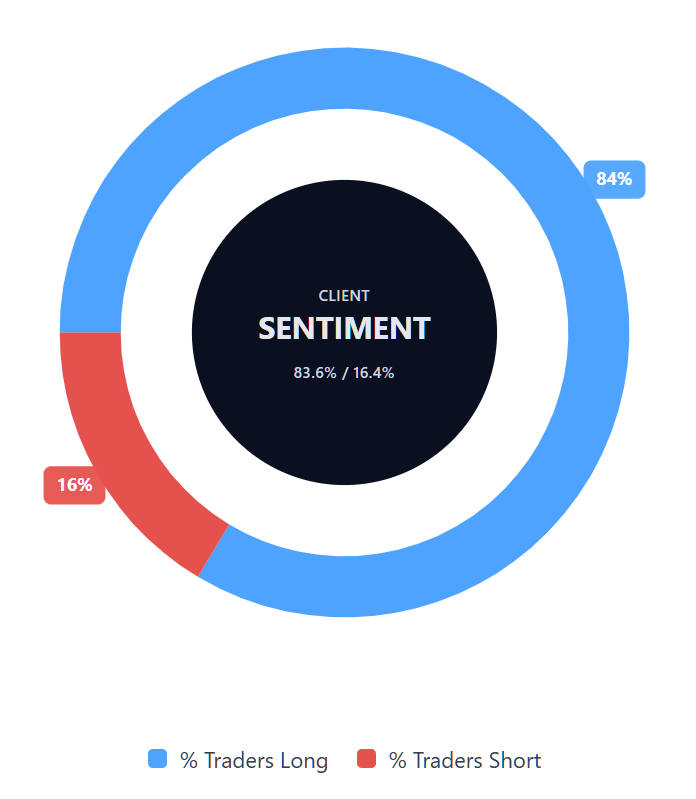
As of 27 July 2026, Capital.com client positioning in Bitcoin CFDs shows that 83.6% of open Bitcoin positions are long and 16.4% are short. This places long positions 67.2 percentage points ahead of short positions.
The figures represent open positions on Capital.com at a specific point in time and can change.
Summary – Bitcoin (2026)
- As of 1.44pm UTC on 27 July 2026, Bitcoin was trading near $65,569, below its 2025 all-time high of more than $123,000 but above late-2024 levels.
- The price remained above its short-term moving averages but below the 100-day and 200-day averages. An upper-neutral RSI and low ADX indicated limited trend strength.
- Key drivers included Federal Reserve policy expectations, spot Bitcoin ETF flows and institutional demand, all of which have coincided with moves in both directions.
- Attention remained on the 28–29 July FOMC meeting, changing ETF flows and crypto regulation across major jurisdictions.
Past performance is not a reliable indicator of future results.
FAQ
What is the latest Bitcoin crypto price prediction?
Forecasts published between 5 and 27 July 2026 point to a wide range of possible outcomes. Near-term technical models generally indicate levels between $65,000 and $88,000, while broader analyst estimates extend from around $38,000 to $200,000. These projections depend on assumptions about Federal Reserve policy, ETF flows, regulation and institutional demand. They’re indicative scenarios rather than guarantees, and unexpected market developments could make them inaccurate.
Who owns the most Bitcoin?
The article doesn’t identify the largest Bitcoin holder, as its focus is price forecasts, market drivers and technical conditions rather than ownership rankings. Bitcoin holdings can also be difficult to attribute because blockchain addresses don’t always reveal the individual, company or organisation behind them. Some large balances may belong to exchanges or custodians holding Bitcoin for clients, so wallet size alone doesn’t necessarily show beneficial ownership.
How many Bitcoins are there?
The article doesn’t provide a current figure for Bitcoin’s circulating supply. Bitcoin’s protocol limits the total supply to 21 million coins, but not all of them are currently in circulation. New Bitcoin enters circulation through mining, while some existing holdings may be permanently inaccessible because owners have lost their private keys. As a result, the amount available to trade may be lower than the recorded circulating supply.
Could Bitcoin’s price go up or down?
Yes. The article highlights several factors that could move Bitcoin’s price in either direction, including Federal Reserve policy expectations, spot Bitcoin ETF flows, institutional demand, regulation and broader liquidity conditions. Technical indicators also showed no firmly established trend at the time of writing. Bitcoin remains sensitive to changes in sentiment and the unwinding of leveraged positions, so price movements can be rapid and may not follow third-party forecasts.
Should I invest in Bitcoin?
That depends on your financial circumstances, objectives, experience and tolerance for risk. This article doesn’t provide investment advice or recommend buying or selling Bitcoin. It outlines third-party forecasts, technical indicators and market factors to help readers understand the range of possible outcomes. Bitcoin can be highly volatile, and forecasts may prove inaccurate. Consider conducting your own research and seeking independent financial advice where appropriate before making any investment decision.
Can I trade Bitcoin CFDs on Capital.com?
Yes, you can trade Bitcoin CFDs on Capital.com. Trading crypto CFDs lets you speculate on price movements without owning the underlying asset and to take long or short positions. However, contracts for difference (CFDs) are traded on margin, and leverage amplifies both profits and losses. You should ensure you understand how CFD trading works, assess your risk tolerance, and recognise that losses can occur quickly.