

Gold stuck in a tug-of-war as momentum fades
Gold remains range-bound as traders react to the latest developments in the Middle East.
Gold’s price action over recent weeks reflects a market that has lost its sense of urgency. After a powerful rally over the past 18 months, driven by geopolitical tensions, central bank buying and inflation hedging, the metal now looks increasingly range-bound rather than explosive, struggling to justify another leg higher in the current environment.
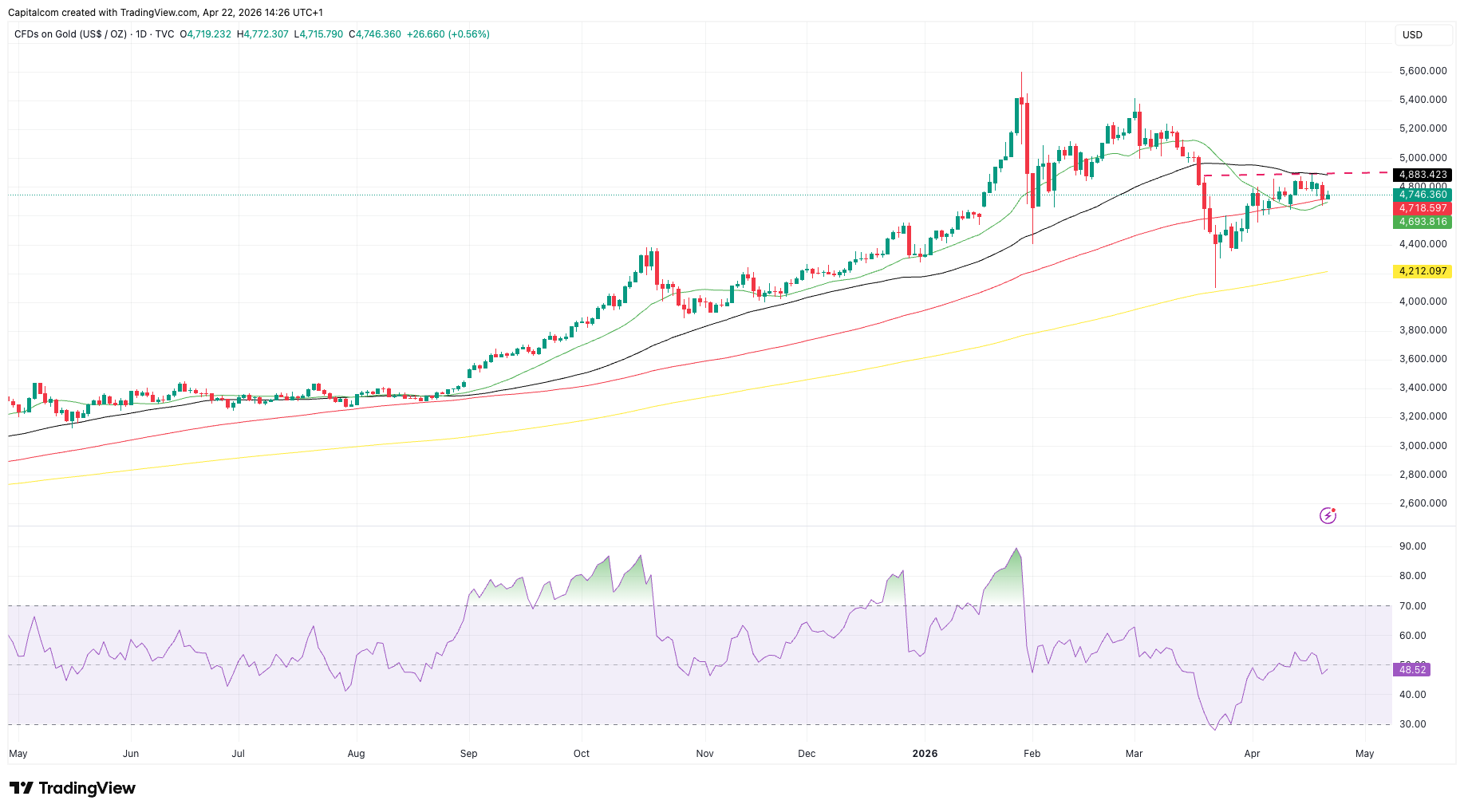
Technically, the chart tells a clear story. Gold has repeatedly failed to break above the $4,885 resistance zone, with each attempt met by selling pressure. The rebound from March lows has been steady but unconvincing, with price consolidating just below that key level. Momentum indicators reinforce this view, with RSI sitting near neutral, signalling a lack of strong directional conviction. This is no longer a market in panic-buying mode, it is one searching for a catalyst.
Gold (XAU/USD) daily chart
Past performance is not a reliable indicator of future results.
That shift reflects a broader change in how gold is being used. Traditionally a safe haven, gold initially moved higher as the US–Iran conflict escalated, briefly pushing above $5,300. But since then, its behaviour has become more inconsistent. Instead of acting purely as a defensive asset, gold has increasingly been used as a liquidity trade, sold to fund moves in oil or equities. This helps explain why gold has fallen in tandem with rising geopolitical tensions at times, a break from its usual playbook.
At the same time, macro forces are pulling gold in opposite directions. On one hand, ongoing uncertainty in the Middle East and elevated inflation risks should support demand. On the other, higher energy prices are pushing inflation expectations higher and, crucially, keeping interest rates elevated for longer, a headwind for non-yielding assets like gold. This “tug-of-war” dynamic has left gold stuck in a holding pattern, unable to fully benefit from either narrative.
Looking ahead, the path for gold hinges on whether it can break out of this consolidation phase. A decisive move above $4,885–$5,000 would likely signal a return to bullish momentum, potentially driven by renewed safe-haven demand or a shift in monetary policy expectations. Conversely, failure to break higher could see gold remain trapped in a range or even drift lower as capital continues to rotate into higher-yielding or riskier assets.
Ultimately, gold is no longer the obvious trade it was earlier in the cycle. The long-term fundamentals remain intact but in the short term, it has become less about fear and more about flows. Until a clear catalyst emerges, gold may continue to underwhelm, consolidating rather than surging as markets look elsewhere for opportunity.