

Gold stabilises as safe-haven role reasserts, but upside remains constrained
Gold bounces higher as yields and oil drop, but strong resistance lies ahead.
Gold has regained some footing after a difficult few weeks, rebounding toward the middle of its recent range as investors reassess the balance between geopolitical risk and rising yields. The metal had come under pressure through April as equities rallied sharply, the dollar firmed and markets reduced expectations for rate cuts following the renewed surge in oil prices and a more hawkish Federal Reserve tone.
Gold’s recent price action reflects a market that is still very much a safe-haven asset, but one that had become stretched before the latest conflict even began. After more than two years of sustained upside, positioning in gold was already elevated heading into the US–Iran tensions, leaving the metal vulnerable to a correction rather than a fresh surge. That vulnerability was exposed as the conflict escalated. While gold initially benefited from safe-haven demand, the combination of surging oil prices, rising yields and a stronger dollar quickly shifted the narrative. Instead of rallying, gold came under pressure, as higher real rates increased the opportunity cost of holding non-yielding assets. In that sense, the conflict acted less as a catalyst for upside and more as a trigger for a positioning-led correction in an already crowded trade.
As the weeks progressed, that downside momentum began to stabilise. Technically, gold found support and started to consolidate, reflecting a market that had worked through some of the excess positioning. However, the upside remained capped, with elevated yields and high oil prices continuing to act as headwinds, preventing a meaningful breakout despite ongoing geopolitical uncertainty. At the same time, the broader market backdrop worked against gold. Equities — particularly in the US — pushed higher, largely ignoring geopolitical risks as a strong earnings season and resilient profit margins anchored investor sentiment. Markets effectively priced out the worst-case scenarios for the conflict, reducing the urgency for defensive positioning and further limiting gold’s appeal.
More recently, the tone has shifted again. With a potential peace deal emerging and the probability of de-escalation increasing, oil prices and yields have begun to ease. This has provided gold with some breathing room, allowing it to recover and “catch up” after lagging behind other assets during the risk rally. The key question now is whether this recovery can evolve into a sustained move higher. On one hand, the pullback in yields and oil should support gold, and the metal’s role as a hedge against uncertainty remains intact. On the other, positioning remains a constraint, and there is still lingering uncertainty around the path of interest rates. If markets continue to delay expectations for rate cuts, gold may struggle to attract strong, sustained inflows.
In short, gold is no longer the one-way trade it was over the past two years. It remains fundamentally supported, but the combination of prior positioning, a resilient risk environment and uncertainty around policy means buyers may remain selective rather than aggressive.
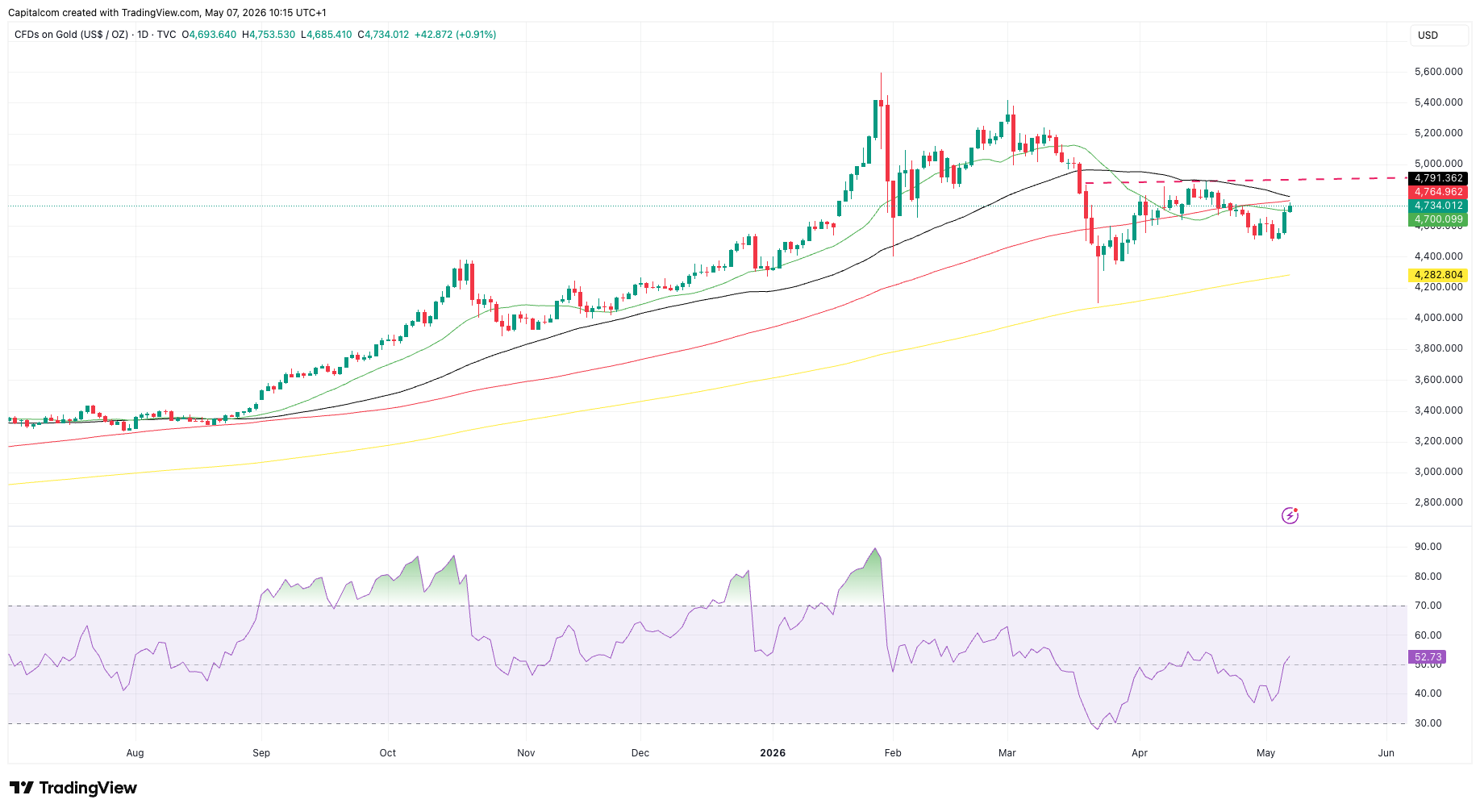
Technically, gold appears to be attempting a stabilisation phase rather than a full bullish breakout with price rebounding from support near the $4,500 area and reclaiming short-term moving averages, while the RSI has recovered from oversold territory. However, the metal continues to struggle below the key resistance zone around $4,800–4,900, an area that has repeatedly capped upside attempts over recent weeks. Until that level is decisively broken, the broader structure still looks more like consolidation than a renewed uptrend.
Gold (XAU/USD) daily chart
Past performance is not a reliable indicator of future results.