

US midterm elections 2026: metals, the issue no one is campaigning on
Metals have barely featured in the 2026 midterm campaign. Candidates have campaigned on petrol prices, healthcare and the war with Iran, not on rare earth magnets.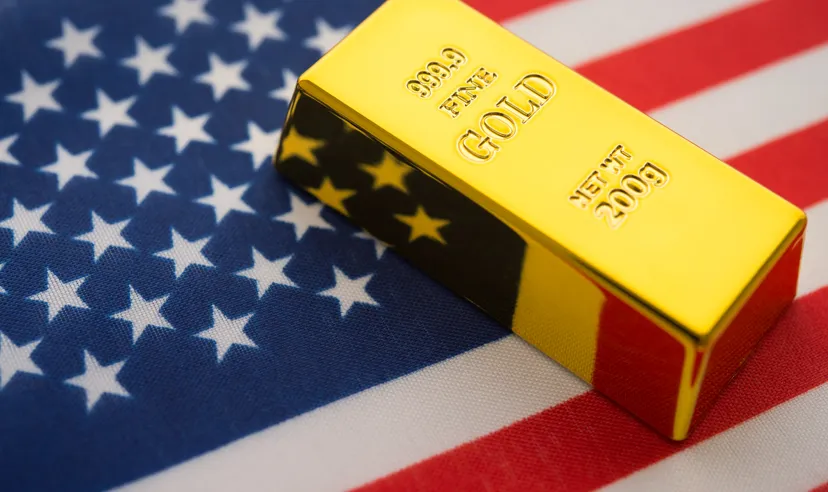
Yet just a few months ago metals were driving the headlines: silver and gold set records in January, Washington extended copper tariffs in April and debated duties on Russian palladium in May, and in June Beijing added US rare earth producers to its export control list.
The vote on 3 November will not change who occupies the White House, but it will shape how much room President Donald Trump has for his industrial, trade and fiscal agenda. For metals, the biggest constraint lies beyond the reach of any ballot. China dominates the refining of the materials the US needs for defence, electrification and AI, and no Congress can rebuild that capacity within two years. For industrial and critical metals, the East–West balance will be set largely by trade talks between Washington and Beijing.
The midterms decide how freely the president can negotiate, and how far Congress can restrain or support him.
Three scenarios for 3 November
Three outcomes are possible. In the first, Republicans retain both chambers, the least likely according to prediction markets:the president keeps a free hand on spending, taxes and deregulation. In the second, Democrats win the House while Republicans keep the Senate: Congress becomes a veto point on budgets, the debt ceiling (due by mid-2027), and a constrained president is likely to focus on what he controls alone: tariffs, export controls and China. In the third, Democrats win both chambers, currently the most likely outcome: prediction markets give them around a 91% chance in the House and 62–67% in the Senate (Source: Kalshi). Congress would become a strong check on the White House. A Democratic Senate would also have a say in any new Fed appointment, and Lombard Odier suggests Jerome Powell could then step down from the Board. Even a small shift in the Fed’s make-up could influence the rate outlook, and through it, precious metals.
Why metals matter for the US economy
The AI boom runs on metals. Data centres need copper for power and cooling, and rare earth magnets drive electric motors, robots, missiles and fighter jets. Silver is in almost every chip and solar panel. With supply chains spread across many countries, relations with trading partners matter as much as domestic policy.
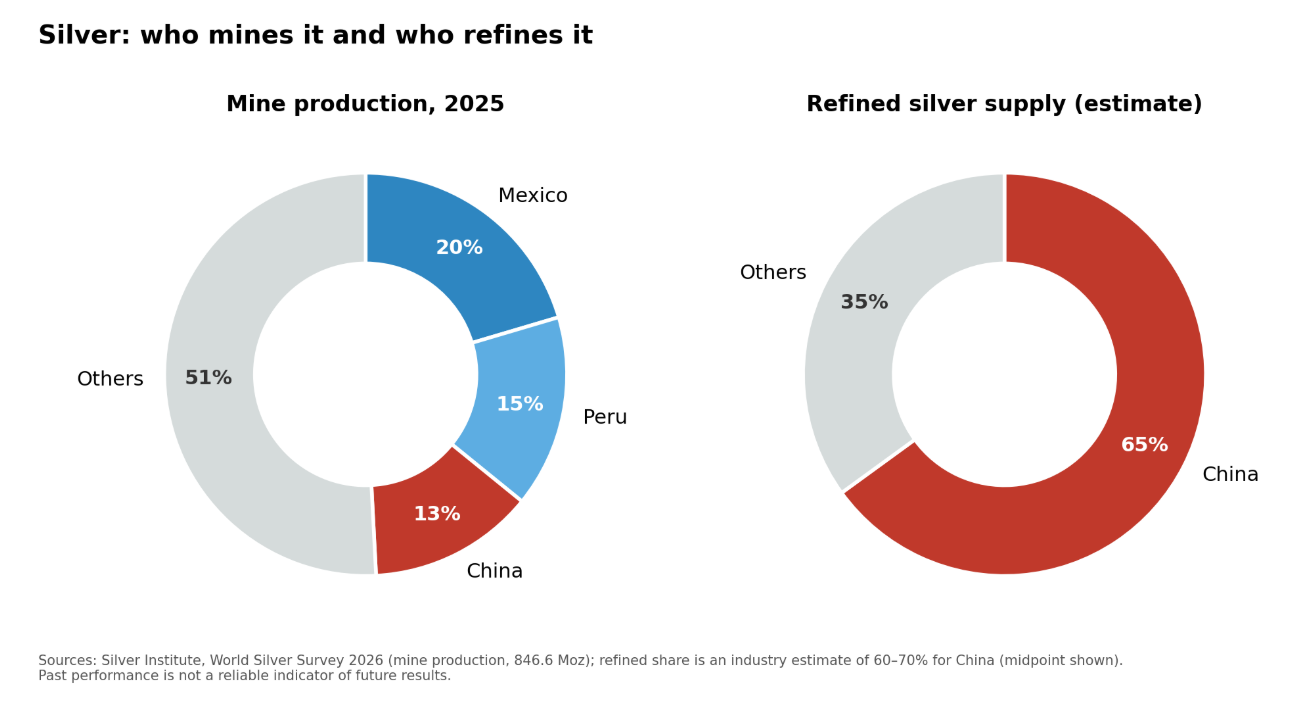
Processing is also a major bottleneck, and here China leads. It controls around 90% of rare earth processing and magnet production, according to the Bloomsbury Intelligence and Security Institute, and roughly half of copper smelting. Since January it has also restricted silver exports. The US has only two active copper smelters, and mining permits take seven to ten years. Energy costs near data centres have become a campaign issue, with metals underneath the debate.
Gold
Gold has few industrial uses. Its role is monetary: a store of value, held by central banks and investors, that carries no credit risk and cannot be printed.
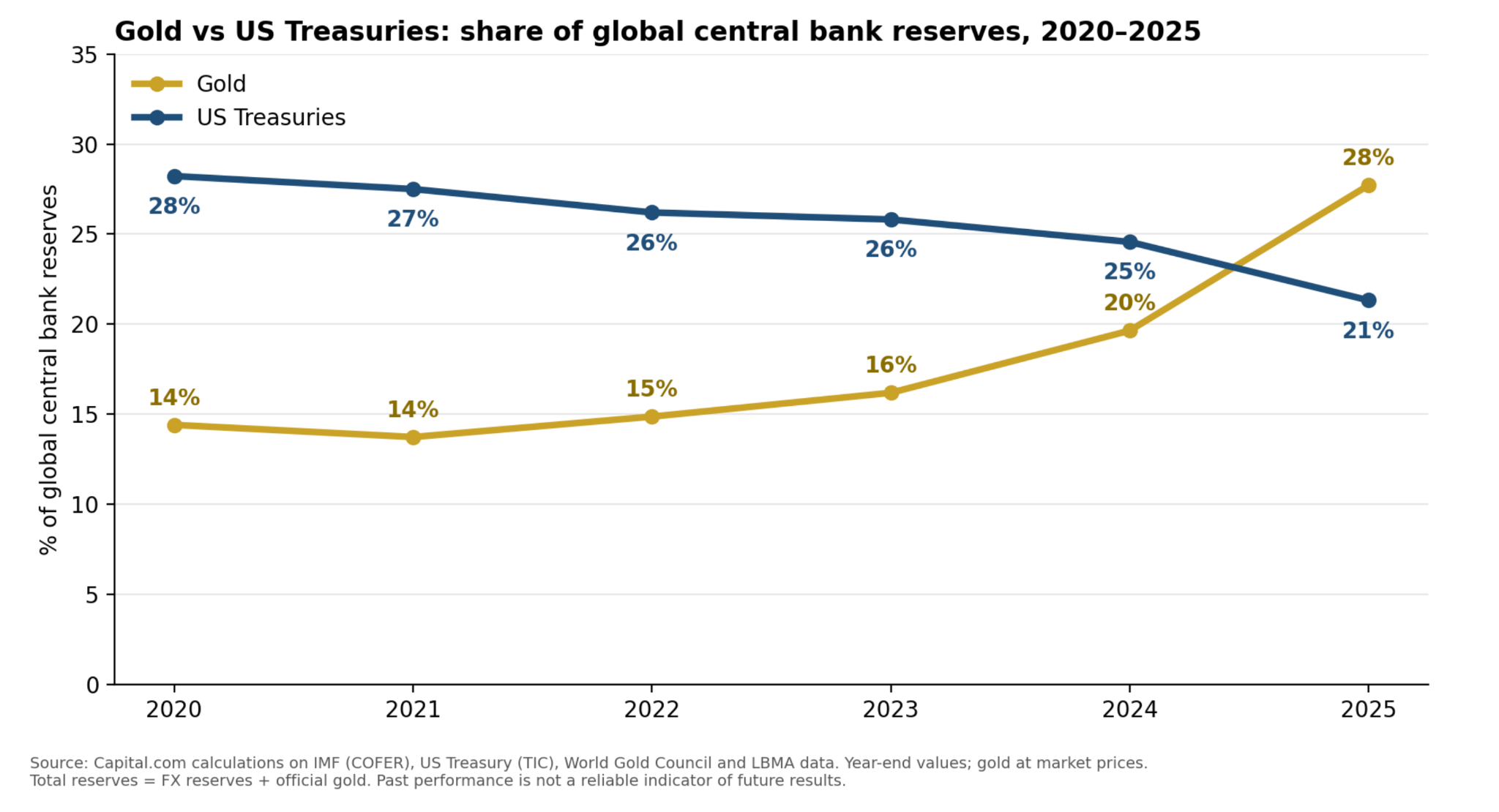
For central banks, gold has become the main alternative to US Treasuries. ECB data show it made up 28% of global central bank reserves at the end of 2025, overtaking Treasuries at 21%. The buying has continued this year, with a net 170 tonnes in the first eight months, according to the World Gold Council, despite high real yields. That demand has cushioned the fall in prices. Any political shift, or continuity, can change how foreign players view Washington’s future path on spending, fiscal sustainability and interest rates, and with it their appetite for Treasuries and Gold.
Past performance is not a reliable indicator of future results
Scenario with the biggest effect: Republican sweep, though it is also the least likely. A Republican win would likely bring more spending and tax cuts, lifting growth, inflation and borrowing (source: VanEck). That would keep the Fed cautious, push bond yields higher and support the dollar. Both could weigh on gold at first: J.P. Morgan Asset Management notes this is what happened after the 2014 midterms. The picture could change if yields rise because investors doubt Washington can control its deficit. Gold would then benefit as protection against fiscal risk. A Democratic sweep, which ING expects to weaken the dollar slightly, could be mildly supportive.
Silver
Silver is both a precious and an industrial metal, with more than half of demand coming from industry. The best electrical conductor of all metals, it is essential in solar panels, electric vehicles, medical equipment and electronics, from chips and servers to data centre power systems. Two decisions in late 2025 fuelled its rally. On 26 October, China limited silver exports to 44 approved companies from January. On 7 November, the US added silver to its critical minerals list, opening the door to tariffs.
Scenario with the biggest effect: divided Congress. China is one of the world’s largest refiners and exporters of silver, and since January it decides who can sell it abroad. Relations with Washington seem calmer than a year ago: the truce agreed at the Trump–Xi Busan summit in October 2025 holds until January, and the two leaders appear to be on good terms. A Republican win would keep the president busy on many fronts, making a clash with China less likely. A divided Congress is riskier: blocked at home, the president would likely turn to trade, where he can act alone, as J.P. Morgan Asset Management notes, just as the truce expires. Tighter Chinese exports or US tariffs would lift prices and volatility. A Democratic sweep could ease tensions, with Beijing more inclined to wait for 2028 than to escalate.
Past performance is not a reliable indicator of future results
Rare earths
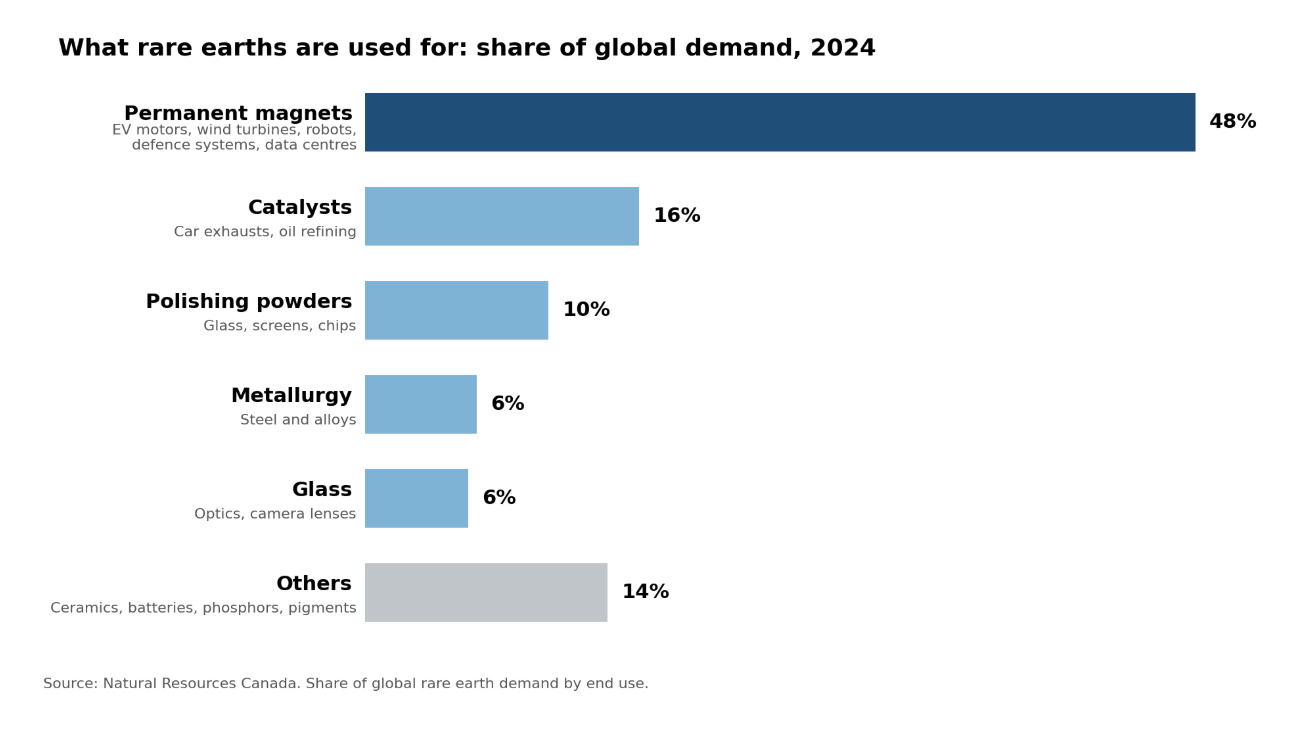
Rare earths are a group of 17 elements used in small quantities but with no easy substitutes. They go into the permanent magnets inside electric motors, wind turbines, missiles and fighter jets. This is where US dependence is greatest. China still licenses exports of seven key rare earths, with broader controls paused only until January 2027, and has blacklisted ten US companies. Washington’s support for domestic producers relies on the Defense Production Act, which Congress must renew by 11 December.
Here, politics directly shapes supply.
Scenario with the biggest effect: divided Congress, again. In this scenario two problems could arrive at once. First, Democrats could hold up the renewal of the Defense Production Act in December to win concessions, slowing US efforts to produce its own rare earths. Second, as with silver, a president with little room at home may try to show strength abroad, just as the China truce ends in January. Beijing’s usual answer, as the Council on Foreign Relations has documented, is to cut rare earth exports, leaving US companies facing shortages and higher prices. A Democratic sweep would give Congress more say, but make a clash with China less likely. A Republican sweep would mean business as usual.
 Past performance is not a reliable indicator of future results
Copper
Copper carries electricity. It is in power grids, motors and every data centre, and demand is rising with electrification and AI: JPMorgan estimates AI data centres alone add around 110,000 tonnes this year. Chile is the largest producer. The US mines copper too, but refining is its weak point: China, again, handles roughly half of global smelting, according to Columbia University’s Center on Global Energy Policy. Washington already applies a 50% tariff on semi-finished copper to boost US manufacturing. Once again, relations with trading partners are crucial.
What each scenario could mean. A Republican win would give the president a free hand, and the Commerce Department has already recommended tariffs on refined copper imports of 15% from 2027 and 30% from 2028. If they go ahead, copper would cost more in the US than elsewhere. A divided Congress would have a similar effect, since tariff policy would stay in the president’s hands. A Democratic sweep would be a bigger political change, but with less effect on prices. Local opposition to data centres is growing over electricity bills, and J.P. Morgan Asset Management expects Democratic gains to spur state-level restrictions.
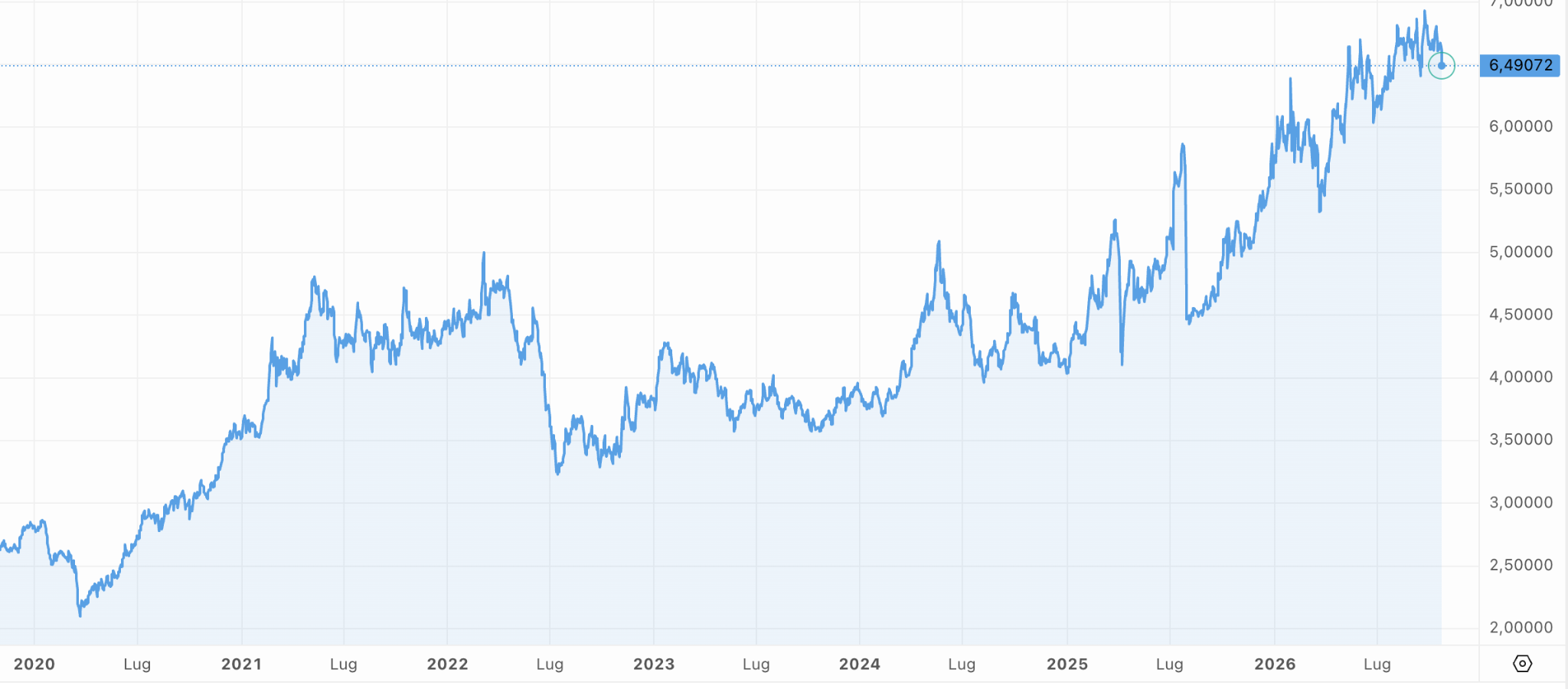
Copper price, 2020 - today, source: Capital.com. Past performance is not a reliable indicator of future results.
Platinum and palladium
Platinum and palladium are mainly used in catalytic converters, which clean exhaust from diesel and petrol engines. Platinum is also used in hydrogen fuel cells and jewellery. Supply depends on two countries: South Africa for platinum and Russia for palladium.
This year Washington came close to taxing Russian palladium. The Commerce Department found it was being sold too cheaply and proposed duties of 132.83%, but in May the US International Trade Commission ruled that American producers had not been harmed, so no duties were imposed.
Scenario with the biggest effect: Democratic sweep. A Democratic Congress would likely push the president to take a tougher line on Russia and to give more support to Ukraine. Tighter sanctions could reduce Russian palladium supply and lift prices.
Will the elections change the tide for metals?
The midterms are unlikely to change the main forces behind metals: central bank diversification away from Treasuries, the electrification and AI build-out, and China’s grip on refining and processing. What the result can change is how Washington deals with the rest of the world, whether it seeks deals or picks fights with its trading partners. For precious metals, the short-term driver remains the dollar, real yields and the Fed. For industrial and critical metals, it is the supply chain, which will be decided as much in Beijing as in Washington.