

Gold slides as high yields and rising oil reshape the outlook
Gold slides as higher yields and oil pressure the precious metal after rejecting recent highs.
Gold has come under renewed pressure at the start of the new month, extending its pullback from the late-August highs as rising oil prices, higher bond yields and a stronger US dollar outweigh the traditional safe-haven appeal of escalating geopolitical tensions. After trading above $4,650 last week, bullion has fallen back towards $4,300, with Tuesday alone seeing spot prices lose more than 2%.
Once again, the inflationary implications of the conflict have become the powerful driver. Higher oil prices are adding to concerns that inflation could remain elevated, adding further pressure on already rising global bond yields and strengthening expectations that the Federal Reserve may need to tighten monetary policy further. Right now, markets are pricing in a 70% chance of a 25bps hike this month.
This environment makes it challenging for gold as rising Treasury yields increase the opportunity cost of holding a non-yielding asset, while the stronger dollar makes bullion more expensive for buyers using other currencies.
From geopolitical hedge to inflation trade
During some of this year's geopolitical uncertainty, investors have been willing to look through the inflationary consequences and focus on gold's role as a hedge against political, fiscal and economic risk. However, it is becoming more challenging to look through the rapid deterioration in the bond market at a time when Fed Chair Kevin Warsh's hawkish message at Jackson Hole had already put upward pressure on rate expectations. The latest oil shock has reinforced that move. As a result, geopolitical risk is currently working against gold through the rates channel rather than providing the straightforward safe-haven boost normally associated with heightened Middle East tensions.
The speed of the correction also reflects the strength of the preceding rally. Gold gained around 10% during August and reached above $4,650 before momentum reversed sharply. Some profit-taking was therefore likely, but the subsequent break through important technical levels has accelerated the decline.
Gold technical analysis
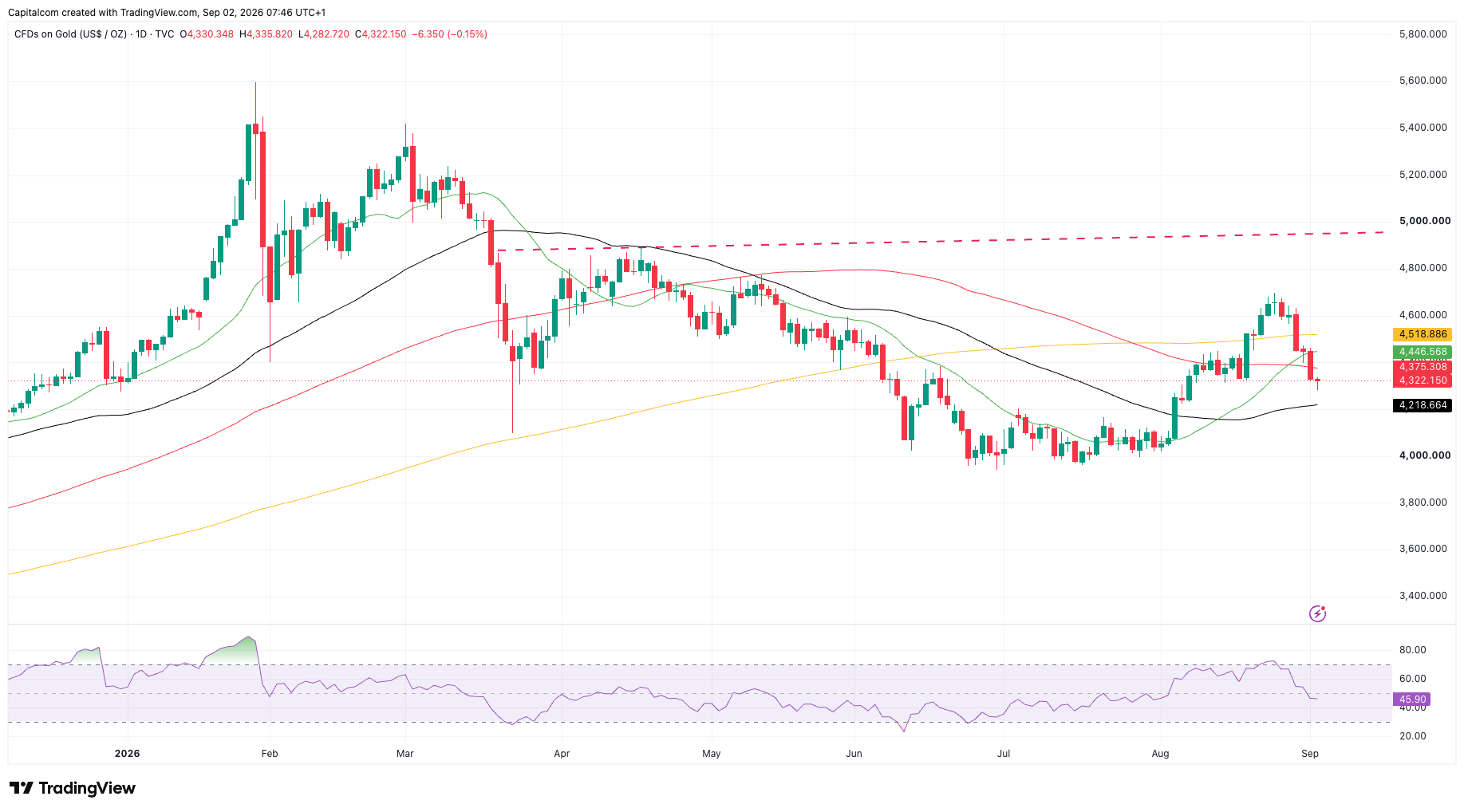
The technical picture has deteriorated noticeably over the past week. Gold failed to sustain the late-August push towards the $4,650-$4,700 region, triggering a sharp reversal that has taken price back below both the shorter-term moving average around $4,445 and the 200-day average around $4,520, which has already encouraged additional technical selling.
Attention now shifts towards $4,280-$4,300, where buyers are attempting to establish support. A sustained break below this area would leave the $4,200-$4,220 region as the next important downside target. Below there, the psychological $4,000 level would return to focus.
Gold (XAU/USD) daily chart
Past performance is not a reliable indicator of future results.
Momentum has also weakened significantly. The daily RSI has fallen back towards 45 after approaching overbought territory during the August rally. That suggests bullish momentum has been unwound considerably, although the indicator is not yet oversold enough to provide a strong contrarian signal.
On the upside, bulls first need to reclaim $4,445-$4,450. Above there, the $4,520-$4,550 area becomes the more important test. A move back above the 200-day moving average would help neutralise some of the recent bearish momentum, while $4,600-$4,670 remains the key resistance zone required to revive the broader recovery.
What comes next for gold?
The immediate outlook is likely to remain closely tied to US rates and geopolitical risk. Investors are watching Wednesday's ADP report before Friday's nonfarm payrolls for evidence that the US economy can withstand tighter monetary conditions.
A resilient jobs report could reinforce expectations for further Fed tightening, keeping Treasury yields and the dollar supported and potentially exposing $4,300 and then $4,200. Conversely, signs of labour-market weakness could challenge the recent repricing in rates, allowing yields to retreat and giving gold some room to recover.
There is also an important risk from the Middle East. A further escalation that threatens energy infrastructure or flows through the Strait of Hormuz could initially push oil and inflation expectations even higher, maintaining pressure on gold through rising yields.
For now, that leaves gold caught between two competing forces. The longer-term case for bullion remains supported by geopolitical and fiscal uncertainty, but the short-term environment has turned considerably less favourable as higher oil prices feed into inflation expectations and revive the prospect of tighter Fed policy.