

USD/JPY tests Japan’s limits as intervention risk becomes reality
USDJPY pulls back from recent highs as Japanese officials increase interventions in the Yen, but fundamentals remain unchanged.
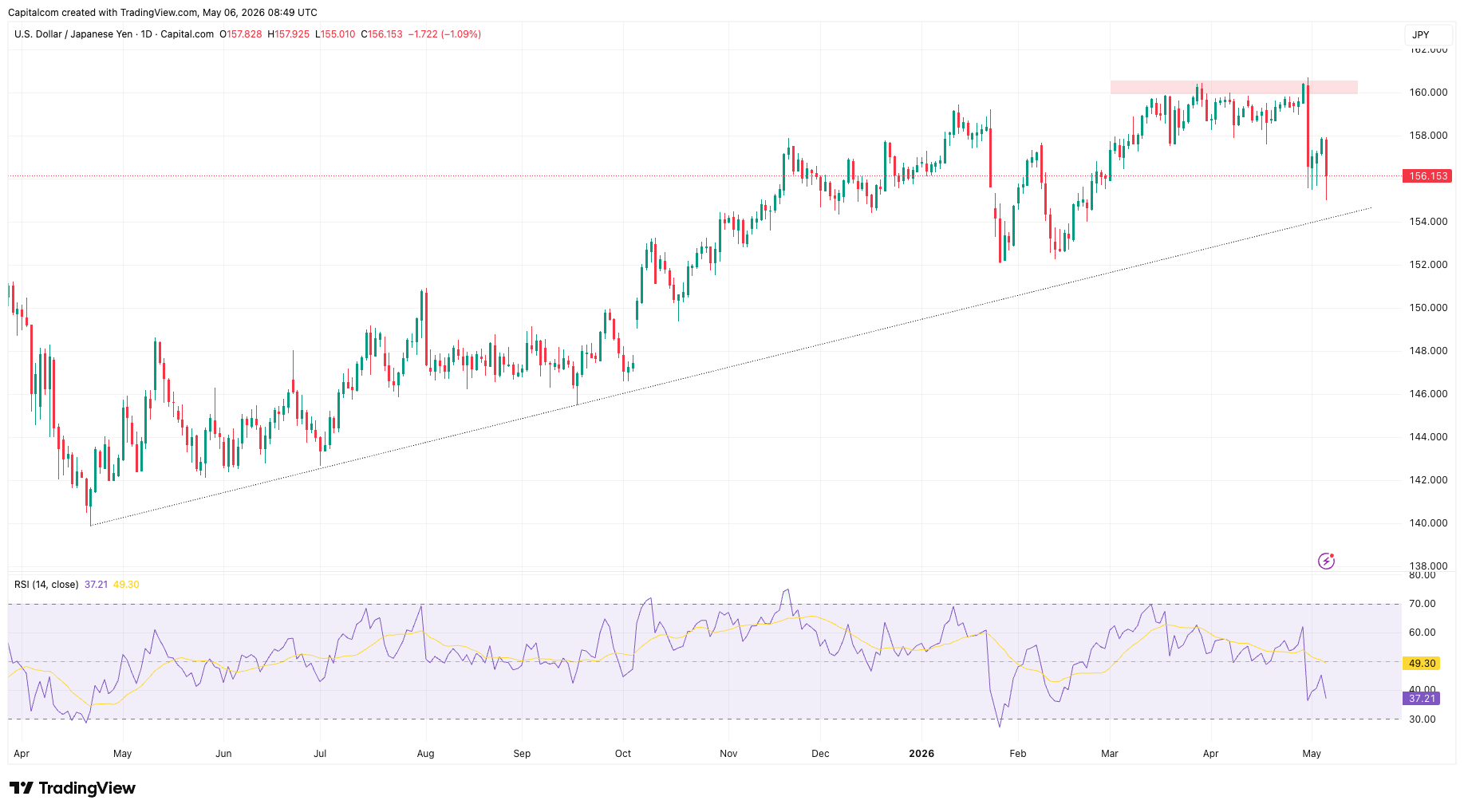
USD/JPY has spent the past several weeks hovering around the 160 threshold, a level that has increasingly become a clear line in the sand for Japanese authorities. The repeated tests of this zone, as shown in the chart, reflect persistent dollar strength driven by higher US yields and a wide rate differential with Japan. However, the latest price action confirms that this level is not just psychological, it is now actively defended.
USD/JPY daily chart
Past performance is not a reliable indicator of future results.
Rules of intervention in free floating currencies
Reports suggest the Ministry of Finance has intervened again, marking the fourth intervention since last week. The sharp pullback from the 160 area highlights how sensitive the pair has become to official action. Technically, the broader trend remains bullish, with higher highs and higher lows intact, but momentum has clearly stalled near the top of the range, with repeated rejections pointing to growing resistance.
Under IMF Working Paper WP/09/211, a currency classified as "free floating" — the designation Japan relies on for its standing in international frameworks — can sustain a maximum of three intervention instances in any rolling six-month period. Each instance can span no more than three consecutive business days. Japan has now consumed two of those three.
The distinction between an "instance" and a "round" is where the real constraint sits. The first three rounds — executed across Thursday, Friday, and Monday — counted as a single instance: three consecutive business days that exhausted that episode and closed it cleanly. Today's round opened a second instance. And this is where the MoF's timing becomes costly. A coordinated cluster across three consecutive days can deliver maximum market impact while consuming only one of the three available instances. A standalone round uses the same budget for a fraction of the firepower.
The next 48 hours are the decision window. If the MoF returns tomorrow, today becomes Day One of a three-day cluster. If they stay out, Instance Two closes at one day used, and the final instance is all that remains for the rest of the year.
That leaves one instance remaining before November. If USD/JPY recovers toward the Ministry's threshold, as it has after each of the previous rounds, the MoF will have at most three consecutive business days of capacity before the free-floating classification comes into question.
Repetition diminishes the effect
Intervention, even when technically permitted, loses effectiveness as markets adjust to its predictability. Each round since Thursday has produced diminishing price impact with a sharp initial move, followed by a sustained drift higher. This is consistent with the historical pattern in yen intervention cycles, where the first coordinated episode tends to anchor expectations more durably than isolated follow-up rounds. Markets have had five days to calibrate the MoF's presence; the element of surprise that accounts for a meaningful portion of intervention's mechanical impact is largely spent.
The broader backdrop compounds the difficulty. USD/JPY is, at its core, a rate-differential trade. As long as the Federal Reserve maintains rates materially above the Bank of Japan, the fundamental bid for dollars against yen remains structurally intact. Intervention can alter the pace and shape of moves but it cannot dissolve the carry dynamics that underpin them. Ultimately, the MoF is managing a trajectory, not reversing a trend.
From a market perspective, this creates a two-way risk environment. On one hand, the fundamental drivers — yield differentials and policy divergence — continue to favour a higher USD/JPY. On the other, the closer the pair trades to 160, the greater the probability of intervention, which can keep investors from increasing their speculative shorts on the Yen.
USD/JPY technical analysis
USD/JPY has spent the better part of the past year tracing a broad ascending channel, but the move is now under pressure. Today's intervention drove price as low as 155 before a partial recovery to 156.20, that low sits almost exactly on the ascending trendline that has connected the major swing lows since mid-2025. The pair could start to test the structural support that has held through three previous approaches. If intervention-driven flows push the pair through 155 on a daily close, the next meaningful support zone sits back at the January - February lows in the 151–152 area. A clean break would also represent the first structural damage to the ascending trend that has been in place for over a year, which could shift positioning dynamics in a way that reinforces the move.