

USD/JPY rebounds as Fed and BoJ deliver rate hikes
USD/JPY rebounds as the Fed and BOJ deliver two very different rate hikes.
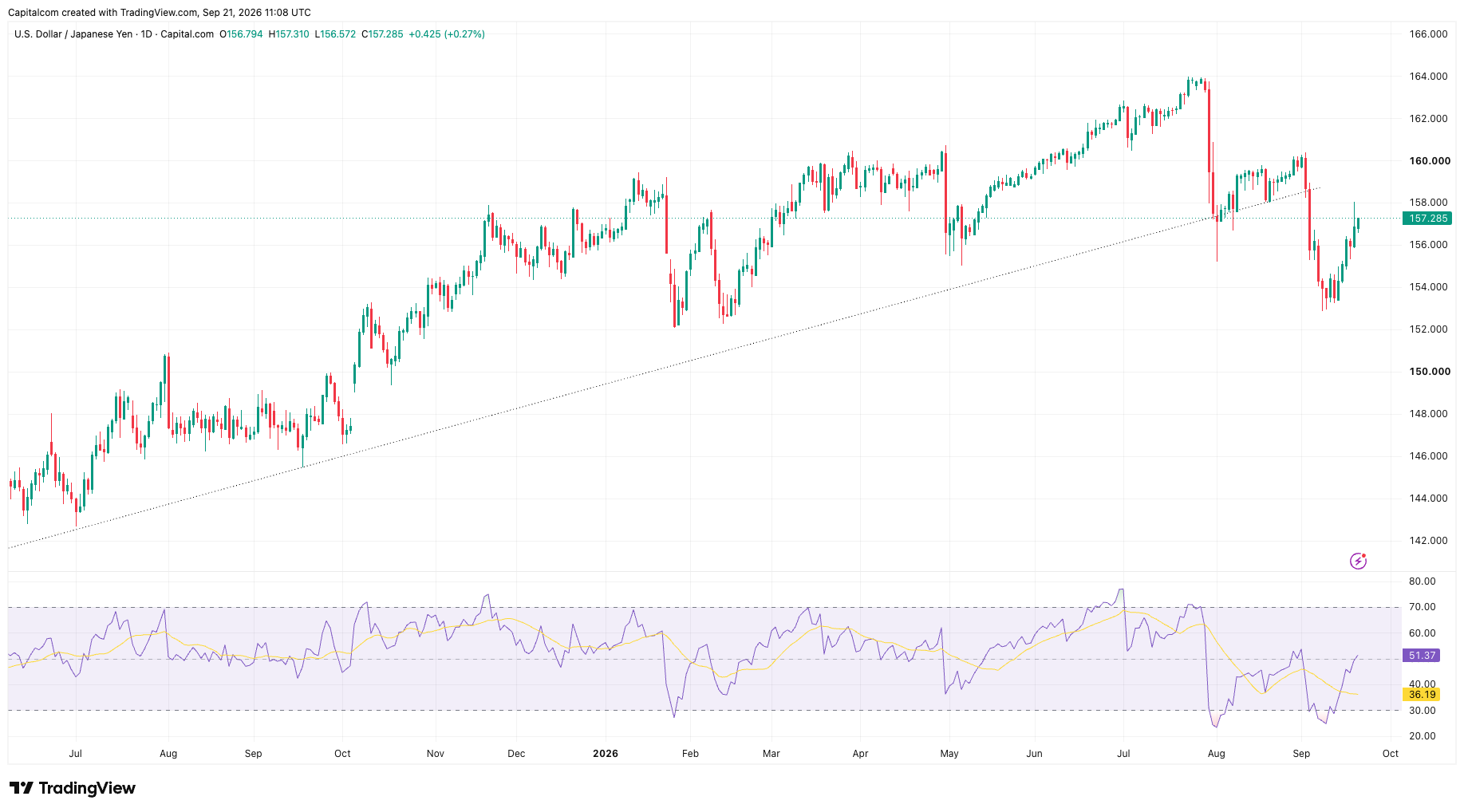
USD/JPY is starting the week back above 157, having staged a sharp recovery from the September lows near 153. The move is particularly interesting because both the Federal Reserve and Bank of Japan raised interest rates last week. In theory, simultaneous tightening should have left the pair relatively balanced. In practice, markets viewed the two hikes very differently, allowing the US-Japan rate differential—and expectations around where it goes next—to remain the dominant force.
USD/JPY daily chart
Past performance is not a reliable indicator of future results.
Fed keeps the dollar supported
The Federal Reserve raised the fed funds target range by 25 basis points to 3.75–4.00%, its first increase in three years. The hike itself was almost entirely priced, but Kevin Warsh’s message and the updated projections proved more consequential. The Fed continues to describe inflation as elevated, while the September projections lifted the median expected fed funds rate for the end of 2026 to 4.1% from 3.8% in June.
That was enough to keep the prospect of additional tightening alive. Rather than interpreting the September increase as a one-off adjustment, markets were forced to consider the possibility that the Fed may need to hike again if inflation remains sticky, particularly if energy prices stay elevated.
BoJ hikes, but the yen falls
The Bank of Japan also delivered the expected 25bp increase on Friday, taking its policy rate to 1.25%, the highest level in 31 years. Yet instead of strengthening, the yen weakened sharply after the decision, with USD/JPY briefly climbing above 158. The explanation lies in what accompanied the hike. Markets had already priced the increase and were looking for a stronger signal that the BoJ was prepared to accelerate normalisation. Instead, the decision included two dissenting votes, while policymakers offered relatively little explicit guidance suggesting another hike was imminent. That allowed investors to interpret what was objectively a rate increase as a comparatively dovish one.
That distinction dominated the trend in USD/JPY. The BoJ may be tightening, but if markets believe the Fed will also continue hiking—and potentially at a faster pace—the interest-rate differential can remain wide enough to support the dollar. This is effectively the opposite of what the yen needs for a sustained recovery. Japan does not simply need higher rates; it needs Japanese rates to rise relative to US rates.
Intervention risk is back
There is another important force now limiting USD/JPY's upside: intervention risk. The rapid post-BoJ rise reportedly prompted Japanese authorities to conduct a rate check on Friday, an action commonly interpreted by markets as a warning that direct FX intervention could follow if yen weakness becomes disorderly. The move helped pull USD/JPY back from above 158 towards 157.
This leaves the pair in a familiar position. The fundamental rates story continues to favour the dollar, but Japanese authorities are signalling that they have limited tolerance for another rapid move towards 160.mThe distinction between level and speed remains important. Tokyo has historically appeared particularly uncomfortable when yen depreciation becomes disorderly rather than responding mechanically to a specific exchange rate. That means USD/JPY could continue grinding higher while still facing the risk of sharp reversals if momentum accelerates.
USD/JPY technical outlook
The chart reflects this increasingly two-sided fundamental backdrop. USD/JPY has rebounded strongly from the 153–154 support region, with RSI recovering from deeply oversold territory to just above 50. That suggests the extreme bearish momentum seen earlier this month has faded. The pair is now testing the 157–158 region, which has become an important near-term battleground. A sustained move above 158 could bring 159–160 back into focus, although the closer the pair gets to that area, the greater the risk that intervention concerns begin limiting momentum.
On the downside, 156 is the first area to watch, followed by 154–155. A renewed break beneath 153 would represent a more meaningful deterioration in the technical structure and suggest that narrowing rate differentials are finally beginning to dominate.