
Ueda signals further rate rises while the yen stays near 158
Ueda keeps further hikes on the table, but without a timeline the yen has made little headway. This article looks at the rate spread, carry demand and the USD/JPY levels to watch before the October BoJ meeting.
The Bank of Japan is signalling further tightening, yet the yen has struggled to extend its September gains. With USD/JPY near 158, the question is whether another Japanese rate increase would change the expected return on holding dollars enough to move the currency beyond its recent trading range.
In his reported remarks at the National Securities Convention on 6 October, Governor Kazuo Ueda reiterated that further increases would depend on economic activity, prices and financial conditions. The direction remained towards higher rates, but the timing was open. For a market looking for evidence that the next move is getting closer, that left no clear signal.
At 14:58 UTC+3, or 11:58 GMT, the four-hour chart showed USD/JPY at 158.023, down 0.12% on the displayed candle. That candle was still open, so the figure is an intraday snapshot rather than a measure of the total response to the speech.
The recovery from the September low near 153.00 has stalled below 159.00. Recent trading has clustered beneath 158.50, while the area around 156.60 remains a support reference. Some candle wicks extend below it, so the chart supports treating it as a zone rather than an unbroken floor.
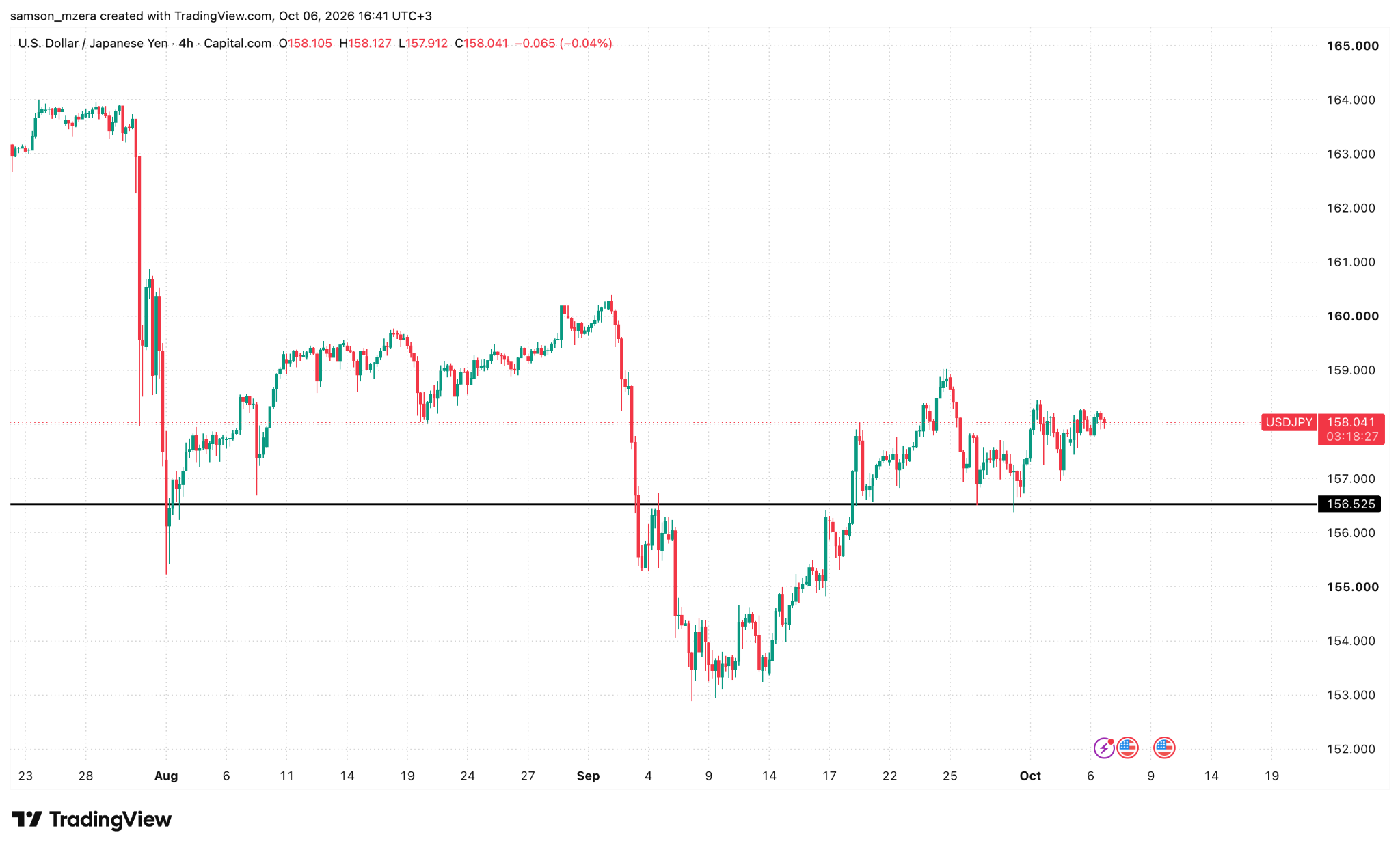
Source: TradingView; Capital.com prices. Levels refer to this snapshot. Past performance is not a reliable indicator of future results.
Ueda’s guidance confirmed the direction of travel but did little to shift the rate differential that continues to underpin USD/JPY.
Two factors explain why the pair has held its range.
1. Higher rates need to change expectations
September’s hike took the policy rate to 1.25%, the highest in about 31 years, but the BoJ’s tightening bias is well established and largely priced. A restatement of intent does little to reprice the expected path, and it is that path relative to the Fed’s that drives USD/JPY.
The US–Japan yield spread remains wide enough to sustain yen-funded carry. That keeps a bid under the dollar, even if it doesn’t dictate every move in the pair. The main threat to those positions is a sharp yen rally, which would quickly erase the carry earned.
Compressing the spread requires either a faster BoJ path or a lower expected Fed path. Until inflation and activity data force a repricing of timing or terminal rate, hawkish rhetoric alone is unlikely to dislodge the range.
2. The October meeting gives the outlook a test
The 29–30 October meeting, with the Outlook Report on the 30th, is the BoJ’s next opportunity to move from guidance to action, or at least to firm up the timeline.
Firm wage growth and sticky services inflation would strengthen the case for back-to-back hikes; soft consumption or easing underlying inflation would argue for patience. A hike alone may not be enough. The yen’s reaction would hinge on whether the forward guidance shifts expectations for the pace of subsequent moves.
What to watch
The first downside reference is 156.60. A sustained four-hour close below the support area, followed by a failed recovery, would provide stronger evidence of renewed yen strength than another brief wick beneath it. The chart then leaves the September trading areas around 155.00 and 153.00 as lower references, rather than assured targets.
On the upside, a sustained recovery through 158.50 would bring the late-September high near 159.00 back into focus. Clearing that high would strengthen the recovery from the September trough and put the earlier peak around 160.40 into view. Until then, the pair remains below an established swing high.
For now, USD/JPY has neither decisively lost the 156.60 support area nor recovered 159.00. A narrowing expected rate gap would give a downside break a clearer economic basis. Without that change, hawkish BoJ language can coexist with a yen that struggles to gain ground.