
EUR/USD tests July support as traders look for a reason to buy
EUR/USD tests key July support at 1.13656 as market participants analyze technical levels, ECB-Fed rate policy, and inflation data shaping the pair.
The euro is back where buyers appeared in July. The August recovery has faded, September’s selling has broken the 1.14519 level, and price is testing the lower boundary again. The recent structure favours sellers. But at support, the next question is whether they can hold the price below it, or whether the decline has reached an area where buyers are prepared to return.
Two weeks after the ECB’s 10 September decision, the hike itself is part of the backdrop. Another increase would matter most if it changed expectations for European rates relative to the United States. That connects the economic story to the chart: the euro needs a more favourable shift in relative rates or growth to give a recovery firmer support, while an unchanged outlook could leave rallies vulnerable.
At 15:39 UTC+3 on 24 September, EUR/USD stood at 1.13624, just below the marked July support at 1.13656. A move of only 3.2 pips beneath that line establishes a test, not a confirmed breakdown.
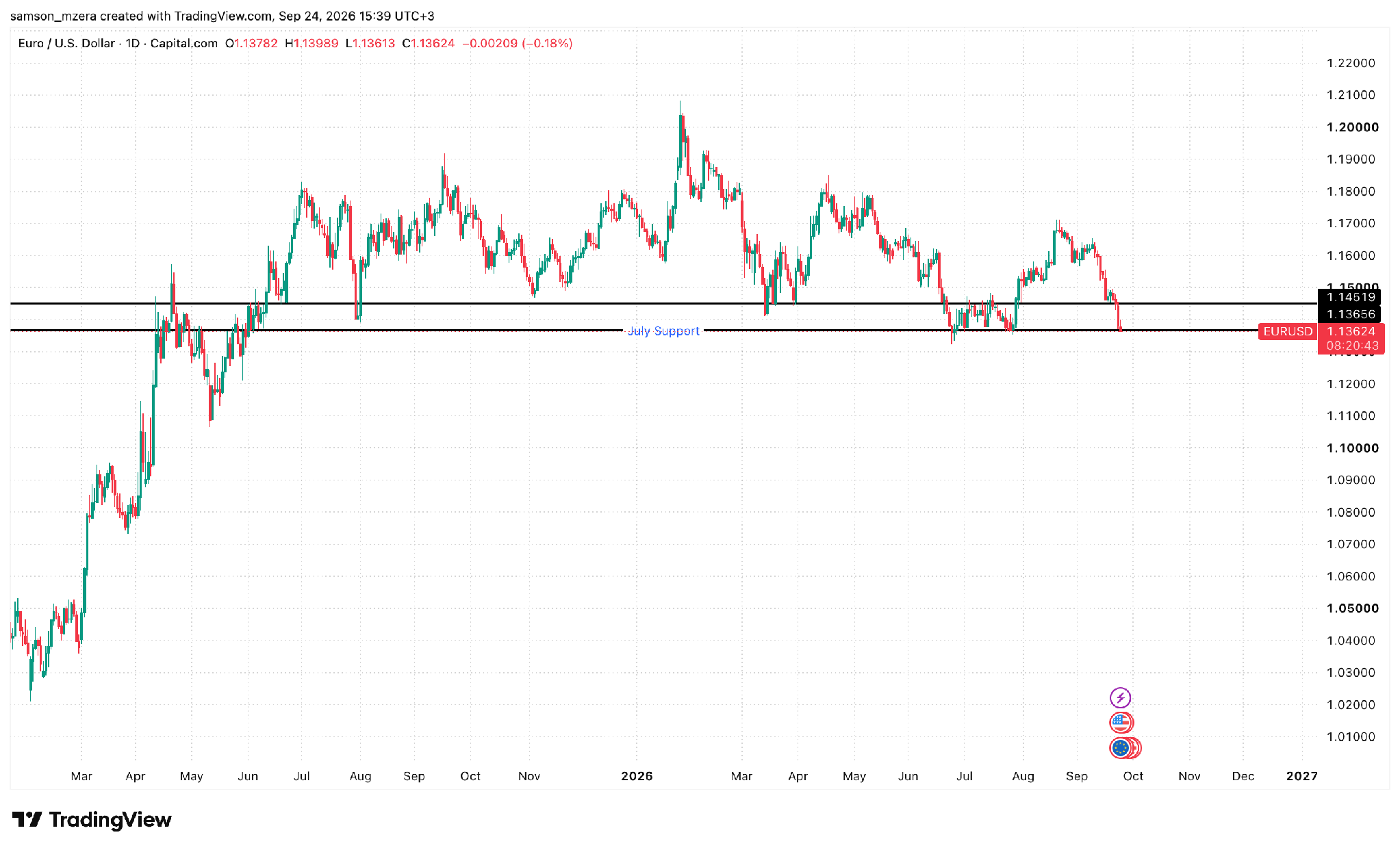
EUR/USD daily chart, 24 September 2026, 15:39 UTC+3. Source: TradingView; Capital.com prices. Levels refer to this snapshot. Past performance is not a reliable indicator of future results.
For traders, this separates two questions. The price action identifies where the bearish view needs confirmation. Incoming inflation, activity and energy data help explain what might provide that confirmation, or give buyers a reason to challenge it.
1. The rate gap matters when expectations change
The ECB deposit rate is 2.50%, compared with the Fed’s 3.75%–4.00% target range. The US advantage of 125–150 basis points helps explain why an ECB hike alone need not make the euro more attractive. But a known gap may already be reflected in the exchange rate. Its existence cannot, by itself, explain September’s decline.
The Fed’s September projections put the median policy-rate midpoint near 4.1% at the end of both 2026 and 2027. Those forecasts are conditional, but they provide a reference point for US rates remaining relatively high. A European hike that leaves that comparison largely unchanged may give the euro little lasting help.
The more useful question is what could narrow the expected gap. European inflation proving more persistent than anticipated could lift expected ECB rates. Softer US inflation or activity could lower the expected Fed path. Either would improve the euro’s rate argument, other things equal. Conversely, resilient US data alongside weaker European activity could reinforce the case for dollar strength.
Energy complicates that comparison. Higher costs can lift expected ECB rates while weakening household spending and business activity. Cheaper energy can improve the growth outlook but reduce the need for tightening. For euro buyers, the question is which effect changes Europe’s relative appeal more, rather than whether oil simply rises or falls.
This is why the response to a release matters alongside its headline. If euro-area inflation surprises higher but European rate expectations barely move, traders have less evidence that the release has changed the currency’s outlook. A recovery through 1.14519 would carry more economic support if the rate comparison were improving at the same time.
2. Inflation must change the expected policy path
August inflation shows why that improvement is not straightforward. Headline inflation reached 3.2%, but services inflation eased from 3.3% in July to 3.0%. Energy was pushing the total higher while an important measure of domestic pressure was slowing.
| Component | Contribution to August inflation |
|---|---|
| Services | 1.43 percentage points |
| Energy | 1.29 percentage points |
| Non-energy industrial goods | 0.30 percentage points |
| Food, alcohol and tobacco | 0.22 percentage points |
Contributions total 3.24 percentage points, consistent with the headline rate rounded to 3.2%.
Source: Eurostat August 2026 inflation release
Services contributed more because households spend more on them. For the trader, the distinction is whether inflation is spreading beyond energy. Stronger wage growth or renewed services pressure could persuade markets that more tightening is needed. A rise concentrated in energy may instead deepen concern about squeezed incomes and weaker growth.
That spread takes time. A transport company may feel higher fuel costs immediately, while a restaurant faces them when its electricity contract expires and adjusts prices later. Wage negotiations may follow. A softer headline reading can therefore coexist with delayed pressure, although weak demand may force firms to absorb costs through lower margins.
Currency weakness adds another channel because oil is commonly priced in dollars. A falling euro raises its domestic cost, even if the dollar price is unchanged. Taxes, contracts and hedging affect the final impact. Traders should watch whether the pressure appears in services and wages, strengthening the rate argument, or mainly squeezes spending and growth.
The ECB’s refusal to promise a path therefore has no automatic currency direction. Persistent domestic inflation could pull expectations higher; fading pressure could pull them lower. The evidence arriving between meetings matters more than the absence of a promise.
3. Technical context and key market levels
From a technical standpoint, the market is testing the July support zone near 1.13656. Because intraday wicks extended beneath this level during July trading, a temporary spike lower differs significantly from a sustained daily closing breakdown. Market participants typically assess whether price holds below support or rejects it to gauge directional momentum.
Below current spot prices, the July lows in the 1.1330–1.1340 region and the 1.1300 psychological level serve as reference points on the chart. On the upside, reclaiming 1.13656 and stabilizing above 1.14519 would signal an offset to the recent selling pressure.
These key chart levels align with the broader macroeconomic background. Extended weakness below support reflects an environment where US rate expectations remain firm or euro-area activity slows. Conversely, stabilizing price action coincides with scenarios where the relative interest rate differential narrows or European growth indicators improve.
If price moves back above 1.14519, the 1.1600–1.1700 trading range represents the next major overhead technical area. Short of that, bounces from current support leave the September retracement intact within the broader structure.
The currency pair remains at a pivotal technical boundary. Whether price sustains a break below July support or rebounds back toward broken overhead levels depends on how incoming inflation, growth, and central bank rate expectations evolve.