
Swiss franc strength: Monday's move and the USD/CHF outlook
The Swiss franc started the week firm, pushing USD/CHF back to its autumn floor near 0.82. What drove the move, how the August–October swing unfolded, the event risks ahead and what the charts show. Not investment advice.
Zurich had barely opened its shutters when the franc was already on the move. By 03:45 New York time on Monday, 2 November, USD/CHF had slipped 0.56% to 0.8200. Not long after, the 4-hour chart printed 0.8189, the lowest the pair had traded since late September.
What was the market running from? Or, the better question, what was it running to?
The answer came in three key factors driving the market shift:
- Market Sentiment & Safe-Haven Demand: Wall Street stumbled into the weekend led by falling chip stocks, and Asia opened Monday in a similar uneasy mood with Tuesday's US midterm elections looming. In times like these, capital traditionally flows toward Swiss assets.
- US Yield Pressure: Following the Fed's decision to hold interest rates at 4.00% on 28 October, US Treasury yields drifted lower, dampening the US dollar's yield advantage.
Easing Oil Prices: As Washington and Tehran prepared for renewed talks, crude oil prices softened. This reduced inflation concerns and further diminished expectations of aggressive Fed rate hikes.
Swiss manufacturing data did little to slow the franc. The 5-minute chart shows a steady slide from the early high, a break through 0.8200 before midday and a low of 0.8189. A rebound to 0.8218 faded, and by mid-afternoon the pair was back on the floor. Bending again, or finally breaking?
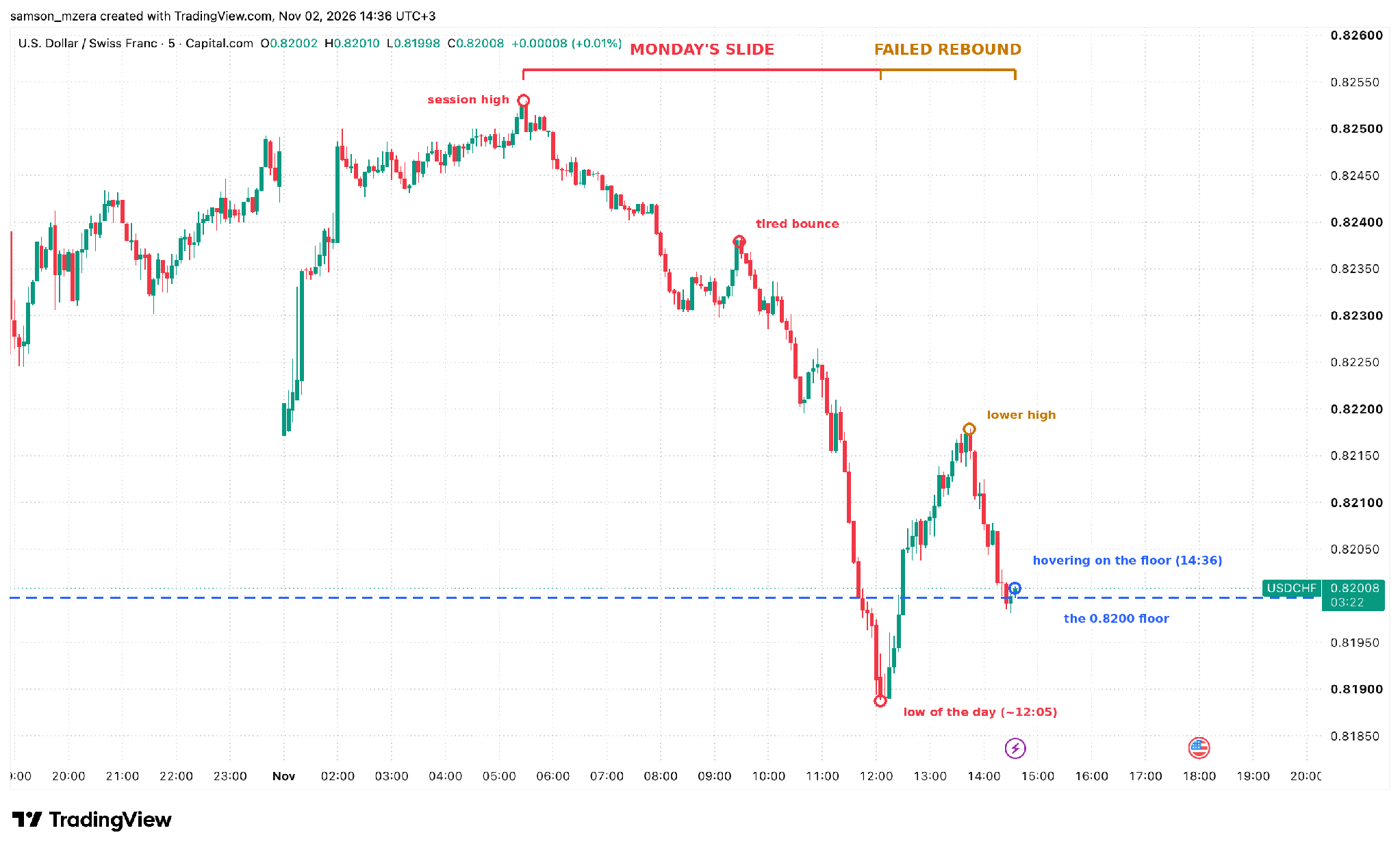
USD/CHF, 5-minute chart (Capital.com), 2 November, UTC+3.
Historical Context: How USD/CHF Reached Current Levels
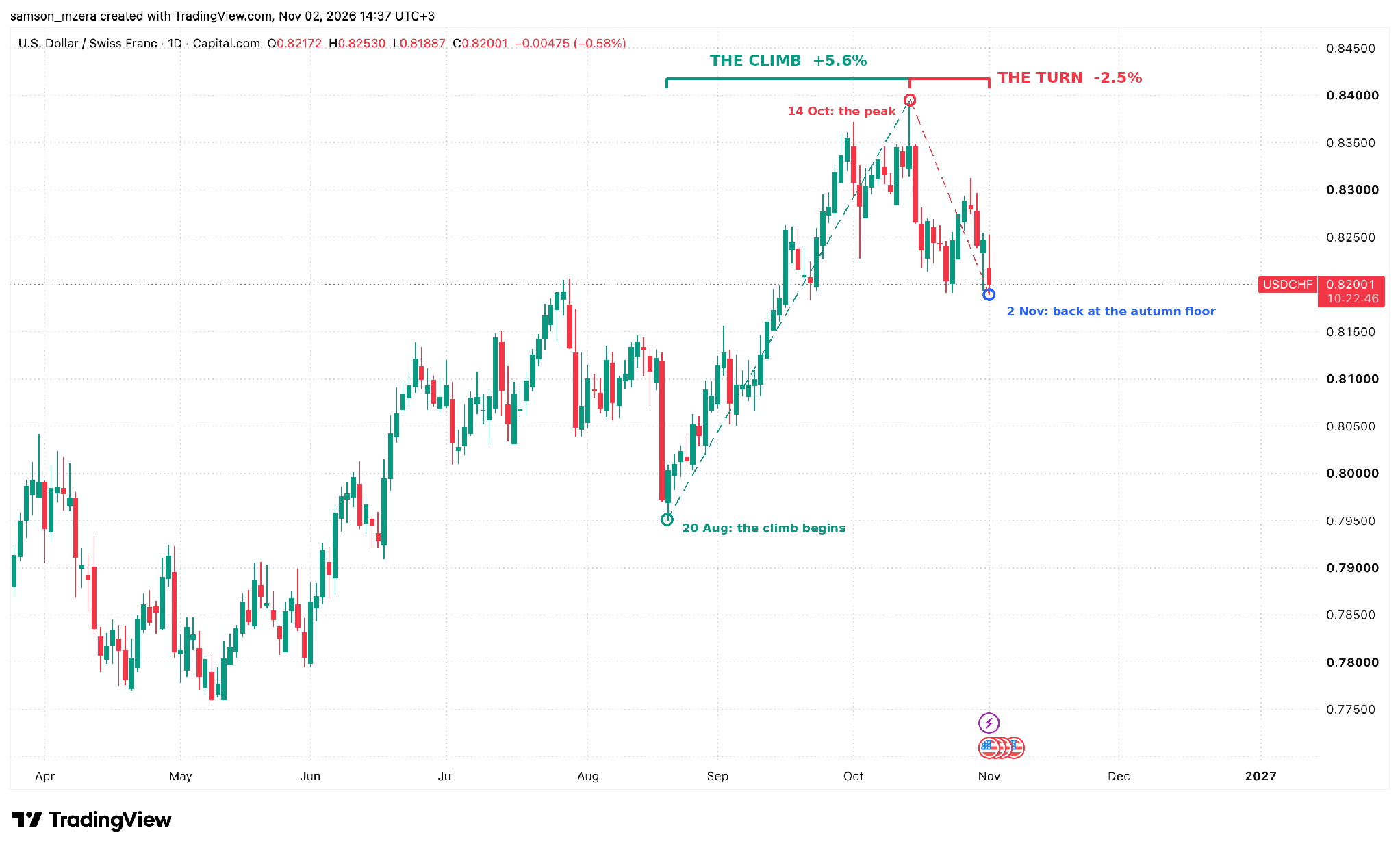
USD/CHF, daily chart (Capital.com), April to 2 November 2026.
Key Takeaway 1: The August–October Rally Driven by Fed Hawkishness
Late August. Fed Chair Kevin Warsh sounds hawkish at Jackson Hole, and on 16 September the Fed follows through with a 25bp hike to 3.75–4.00%, its first since 2023, citing sticky inflation and the energy shock from the Iran war. The US 10-year yield touches 5.04% that week, its highest since 2007.
In Bern, the SNB sits still at 0% and signals no change. One central bank tightening, the other standing still: the gap could only widen.
USD/CHF climbed from 0.7950 on 20 August to 0.8395 on 14 October, a gain of 5.6% and its highest level in a year. The final push came on the very day US inflation data beat forecasts.
Key Takeaway 2: The October Reversal as Yields and Rate Expectations Eased
Peaks rarely announce themselves. This one gave about two sessions' notice. Within two days the pair had dropped roughly 2% as Treasury yields slid to a three-week low. Traders began to price a pause from the Fed, and on 28 October the pause arrived: rates held at 4.00%, with Warsh sounding measured rather than combative. Diplomacy in the Middle East chipped away at the dollar's own appeal as a refuge.
By Monday the pair had surrendered 206 pips, or 2.5%. That is close to half of the entire autumn climb, gone in under three weeks. Past performance is not a reliable indicator of future results.
Fundamental Dynamics: Why a Low-Yielding Franc Remains Strong
There is something odd about this story. The Swiss National Bank pays 0%, the lowest rate among the major central banks. Low-yielding currencies often weaken when other central banks are raising rates. So why is the franc strengthening?
Because the race is relative. The Fed sits at 4.00%, and markets still lean toward another hike on 8–9 December, with odds of roughly 75–80%. But Warsh's October tone cooled bets on anything beyond that, and yields have come down from their September highs. The dollar has not lost its edge. It has simply stopped sharpening it.
Geopolitics pulls in two directions at once. Talks to end the US–Israeli war with Iran have taken away some of the dollar's appeal as a refuge. If those talks stall, though, or if tensions rise again after the midterms, the franc has historically been one of the currencies that tends to draw demand, helped by Switzerland's large current-account surplus, low public debt and long record of stability. Low Swiss rates add a quieter twist: institutions that borrow in francs often repay some of that funding when markets turn nervous, which can lift demand for the currency on days when little else is rising. No currency is free of risk, and these patterns do not always hold.
Upcoming Market Catalysts and Potential Scenarios
On Tuesday, 3 November, Americans vote in the midterms, and Washington has not ruled out further military action against Iran once the ballots are counted. On Friday, 6 November, the October jobs report lands. A strong number would revive talk of Fed hikes and lend the dollar a hand; a weak one would only deepen the franc's advantage. Somewhere in between, the Iran talks and the fate of the Strait of Hormuz will keep nudging demand for safety up or down.
December brings the bigger set pieces. The Fed meets on 8–9 December, with a hike largely priced in, so a hold would be the real surprise. The SNB delivers its quarterly assessment the same month, and it has never been fond of a strong franc.
Days like these come with their own weather. Around election results and the jobs report, spreads can widen, prices can gap between one quote and the next, and moves that would normally take a day can happen in minutes. Standard stop-loss orders are not guaranteed in those conditions and may be filled at a worse price than the one set.
From here, the story can branch three ways:
In the first, nothing much changes. Yields stay soft, nerves stay frayed, and USD/CHF stays pinned near its floor. Signs it is playing out: US yields drifting lower, equities under pressure, and each rebound in the pair peaking below the last.
In the second, the dollar finds its feet. A strong jobs report or a firm December Fed lifts yields again, and the pair climbs away from the floor. Signs it is playing out: US yields turning higher, markets adding to bets on a December hike, and the pair breaking its run of lower highs.
In the third, Switzerland pushes back. The SNB has form here: it capped the franc at 1.20 per euro in 2011, then scrapped the cap without warning in 2015. With the franc firm across the board, a word of warning from the SNB, or something stronger, could reverse its gains in a single session. Signs it is playing out: SNB officials talking about the franc's strength, or a sudden franc-wide drop that is not explained by US news.
None of these potential scenarios is guaranteed, and currency markets can evolve in unexpected ways. This analysis is intended solely as general commentary to highlight key technical levels and macro drivers, rather than serving as trading guidance.
Technical Analysis: Key Levels on the USD/CHF Chart
4-Hour Chart Insights: Descending Triangle and Critical Support
The floor near 0.82 has now been tested four times: in late September, twice in late October, and again on Monday. Each time, it held. Above it, every rally since mid-October has peaked lower than the one before. The result is a textbook descending triangle.
The floor also lines up with the 38.2% retracement of the August–October climb. Below it, the midpoint of that rally marks the next zone, untested since September. On the hourly chart, price has been boxed in just above the floor since 30 October, and Monday's dip through it was bought back within the session.
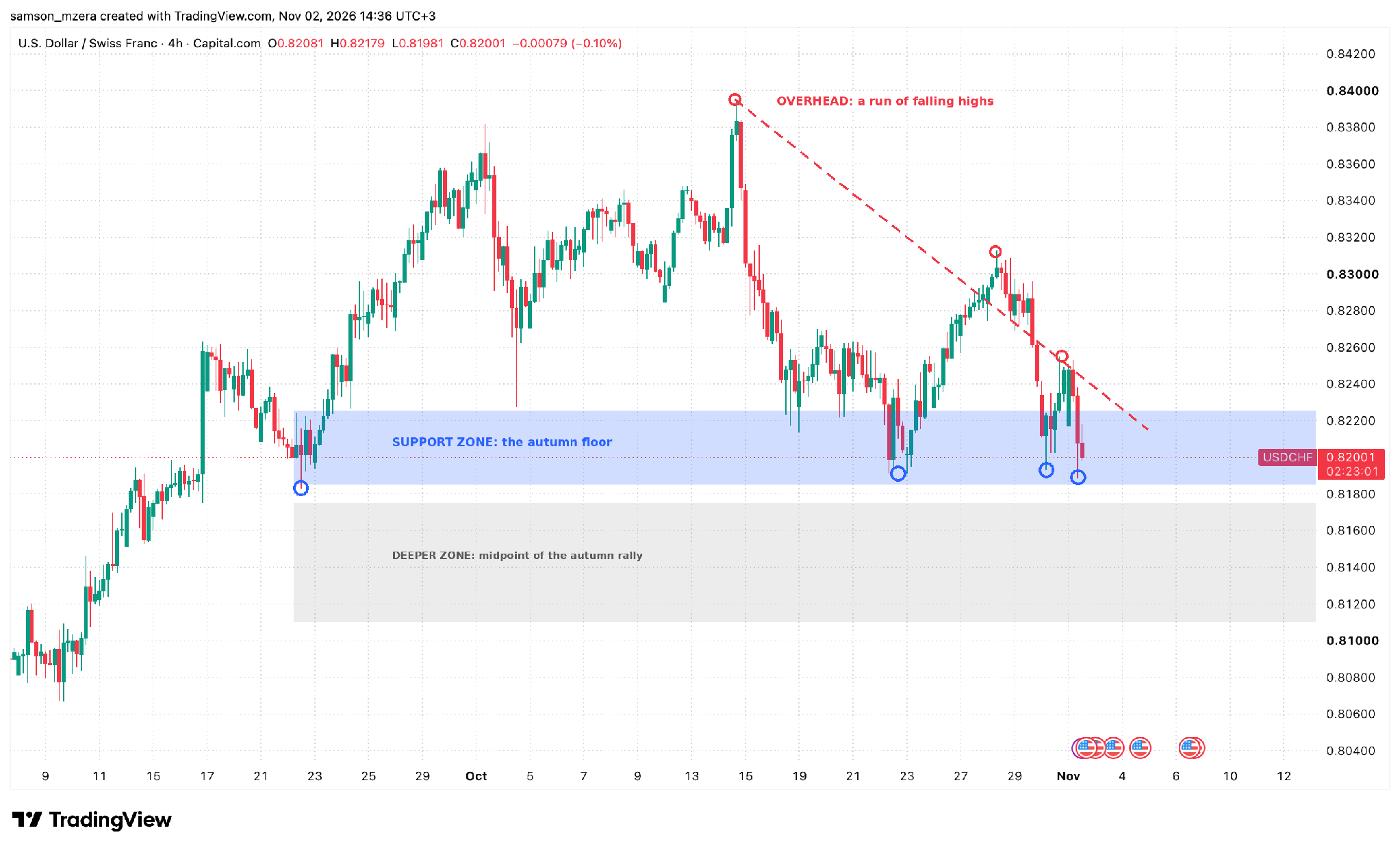
USD/CHF, 4-hour chart (Capital.com), September to 2 November.
What would change the plot? A decisive daily close beneath the autumn floor would complete the triangle and shift attention to the deeper zone. A rally that breaks through the run of falling highs would do the opposite, suggesting the turn has run its course. Until one of those happens, the chart is undecided, and so, it seems, is the market.