
EUR/USD falls as a hawkish Fed and softer oil weigh on the euro
Hawkish Fed signals support the dollar as softer oil eases the case for further ECB tightening, adding pressure on EUR/USD.
The euro is losing ground as hawkish Fed commentary and falling oil prices pull rate expectations in the dollar’s favour. US officials continue to highlight persistent inflation, while cheaper energy eases one of the pressures behind the ECB’s hawkish stance.
Chicago Fed President Austan Goolsbee highlighted strong spending and AI investment as possible contributors to persistent inflation. St. Louis Fed President Alberto Musalem argued for additional policy restraint and favoured earlier action. Neither votes on policy this year, although both participate in the discussions. Their comments followed the Fed’s 25 basis point increase on 16 September and reinforced expectations of further tightening.
At the same time, oil’s retreat appears to be weakening part of the euro’s rate support. High energy prices helped underpin the case for European tightening. Their decline eases that pressure while leaving the broader inflation concerns raised by Fed officials unresolved. The combination offers an explanation for why the euro has continued falling despite an improvement in Europe’s energy outlook.
Diplomatic developments have encouraged that reassessment. Iranian President Masoud Pezeshkian departed for New York to attend the UN General Assembly. His trip was confirmed, though a meeting with US President Donald Trump was not. Iran has also reportedly offered to reopen the Strait of Hormuz within seven days if Washington begins easing military pressure, with the proposal conveyed through a mediator. It remains a conditional initiative rather than an agreement already restoring commercial passage.
Cheaper energy also benefits European households and businesses, so falling oil is not inherently negative for the euro. In the current episode, however, the currency’s weakness is consistent with the relative rate effect outweighing that economic benefit: European inflation pressure is easing at the margin while the Fed continues to signal concern.
The hourly chart reflects the continued weakness. EUR/USD has formed a succession of lower highs and lower lows, with a brief consolidation between approximately 1.1458 and 1.1491 interrupting the decline. Repeated rebounds stalled near the upper boundary before the range broke lower.
The subsequent recovery above 1.1458 did not hold. Price slipped beneath the former range floor again and traded near 1.1441 in the updated snapshot. Buyers responded at the lows, but the rebound failed to restore the pair to its previous range, leaving the broader downward structure intact.
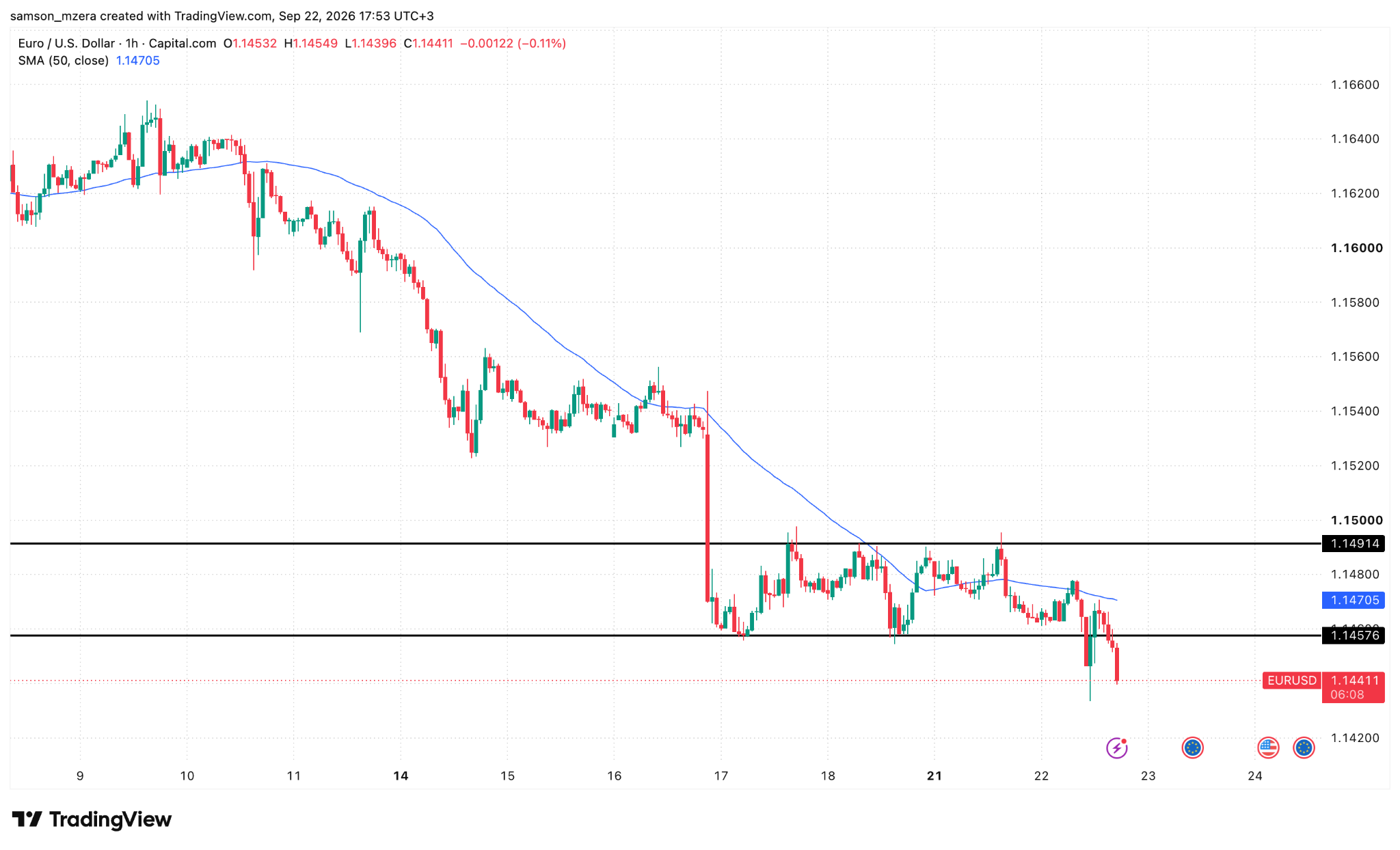 EUR/USD, one-hour chart, September 22, 2026, 17:28 UTC+3. Source: TradingView; Capital.com prices. Levels refer to this snapshot. Past performance is not a reliable indicator of future results.