
Carry versus safety in the Swiss franc
Zero Swiss rates argue for a weaker franc. Safe-haven inflows argue the other way. Both are live, and USDCHF is caught between them.
The Swiss Franc (CHF) sits between two forces pointing in opposite directions. The Swiss National Bank (SNB) is holding its policy rate at zero while the Federal Reserve is expected to tighten and the ECB has already moved, leaving the franc with a clear yield disadvantage. Through that channel alone, CHF should weaken. It is a bias rather than a rule.
However, there is an offset which is demand for safety. The franc appreciates when investors reduce risk, regardless of where the SNB sits relative to its peers. With Brent above $100 and equity markets unsettled, both forces are active at once. That is why USDCHF has been range-bound rather than trending.
The dollar's uneven grip
Dollar strength is landing unevenly across pairs, and that is the informative part. USDJPY has pushed to around 154 as the US-Japan yield gap widens, helped by a US 10-year yield above 5% for the first time since 2007. USDCHF has gained too, but less readily, and holds inside its late July range. A funding currency under pressure from rate differentials would normally give way faster. That CHF not doing so is consistent with safe haven flows absorbing part of the move. Gold has fallen three weeks running under higher real yields while the franc held, so CHF is doing work that XAUUSD is supposed to.
Price action
USDCHF trades at 0.8176 after reclaiming 0.8140 and tagging the 0.8190-0.8206 supply zone that capped the pair in late July. That zone is the immediate test. A sustained move above 0.8206 would open the upper 0.82s. Rejection returns 0.8140 to focus, with 0.8080 beneath it as the range floor.
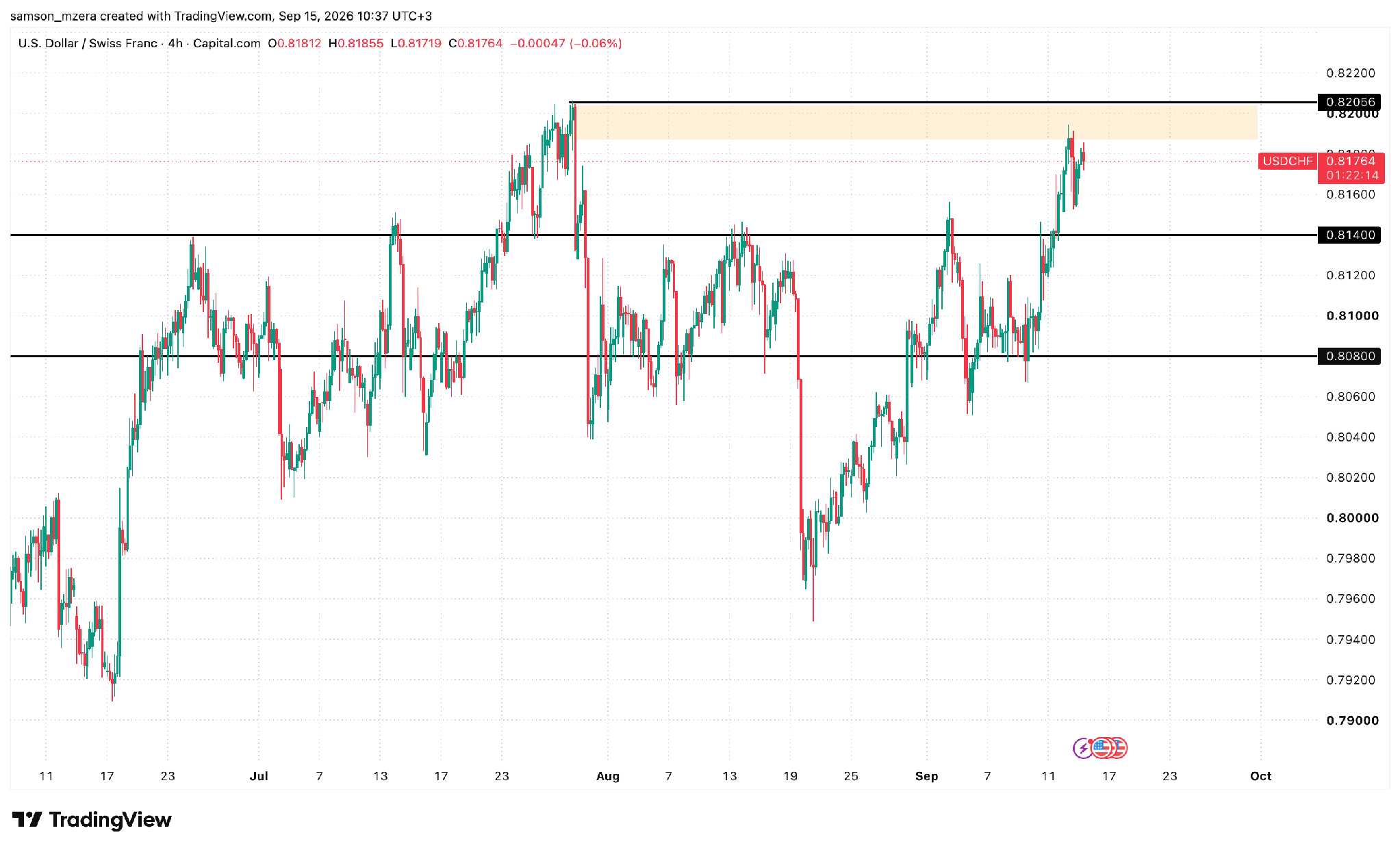
USD/CHF four-hour chart, 15 September 2026, 10:37 UTC+3. Source: TradingView; Capital.com prices. Levels refer to this snapshot. Past performance is not a reliable indicator of future results.
The chart cannot establish the cause of the advance, only that it has stalled below prior highs. A break higher would carry more weight alongside a hawkish Fed outcome. A rejection would matter more if it coincided with renewed risk aversion, the condition under which the franc has historically ignored its yield gap.
Why the SNB stays put
Swiss inflation gives the SNB room to wait. Annual inflation rose from 0.4% in July to 0.8% in August, almost entirely on petroleum prices, and the June forecast kept inflation below 1% through 2028 at a zero policy rate. Energy passing into services and wages would change that; a temporary oil effect would not. Intervention, not the policy rate, is the SNB's active tool. It has signalled greater willingness to counter rapid and excessive appreciation, which puts a soft floor under USDCHF that rate logic alone would not.
What traders should watch
The Fed decision on 16 September is the near-term driver. A quarter-point hike is close to fully priced, so the reaction is likely to hinge on the guidance rather than the move. A path implying more would widen the US-Swiss gap; any softening removes the clearest support USDCHF has.
The SNB assessment later this month is the second event. A rate change is not expected. The language on intervention, and any revision to the medium-term inflation forecast, carries more information than the decision.
Oil and the exchange rate pull against each other. Higher crude raises Switzerland's import bill, while a stronger franc cheapens dollar-priced energy at home. Renewed geopolitical stress can support CHF even as its yield disadvantage persists.
For now 0.8190-0.8206 defines the range, with 0.8140 and 0.8080 below. The broader question is whether widening rate expectations stay stronger than demand for the franc as a haven.