
The Fed hiked and signalled more. Four reasons the Nasdaq rebounded anyway
Why did the Nasdaq 100 rebound after the Fed raised interest rates? Explore how resilient earnings, committed AI spending and easing bond yields supported the recovery and what the US 100 chart suggests could come next.
The Federal Reserve raised rates on 16 September for the first time since July 2023, and signalled that it probably isn’t finished. Sixteen of eighteen officials expect at least one more increase this year, while the median projection points to no net reduction through 2027.
Equities initially fell, but the Nasdaq’s recovery developed into a more constructive pattern on the hourly chart. Sellers pushed below the recent support around 28,907 but could not hold price there. The subsequent rally broke above the previous swing high near 29,265, interrupting the sequence of lower highs. The next pullback found buyers around 29,360–29,380, establishing a higher low before the advance resumed.
By the morning of 18 September, price had reached 29,470 and was testing former support near 29,481 from below. Reclaiming that area and holding it on a pullback would strengthen the bullish structure and bring the next overhead resistance around 29,605 into focus.
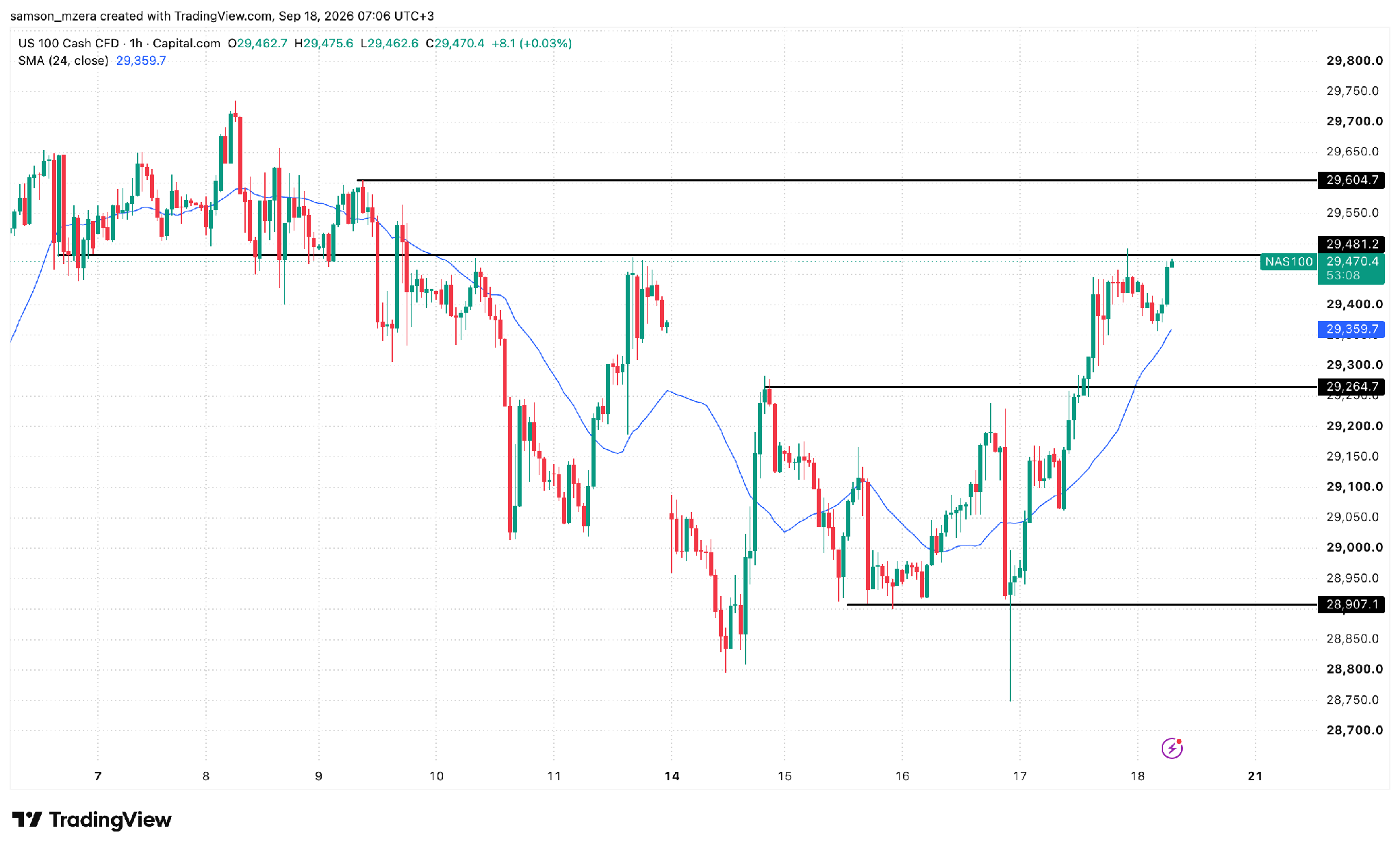
US 100 Cash CFD, one-hour chart, 18 September 2026, 07:06 UTC+3. Source: TradingView; Capital.com prices. Levels refer to this snapshot. Past performance is not a reliable indicator of future results.
The move looks surprising when higher rates make borrowing more expensive, reduce what investors will pay for future earnings and make bonds a more attractive alternative. But the businesses behind the index help explain why buyers returned.
Apple, Microsoft, Nvidia, Amazon, Alphabet, Meta and Broadcom are among the Nasdaq-100’s largest constituents. Their existing earnings, financial resources and investment plans give investors more to consider than the direction of interest rates alone.
1. The Fed upgraded growth in the same breath
Alongside the higher rate projections came a firmer economic outlook: growth of 2.3% this year and unemployment of 4.1%. The Fed also described productivity growth as strong and capital investment as robust. It was raising rates in an economy it still considered resilient.
For shareholders, that offers some reassurance. A company’s value depends both on what it is expected to earn and on the return investors demand for owning its shares. Higher rates put pressure on the second part, but stronger earnings can provide an offset.
When rates rise into a weakening economy, businesses face higher financing costs just as customers become more cautious. If demand remains healthy, they have a better chance of growing through the increase.
Investors could therefore take encouragement from the Fed’s outlook, even while recognising that the same economic strength gives policymakers room to tighten further. The rebound is consistent with the market placing more weight on resilient earnings than on the immediate increase in rates.
2. The index isn’t just a long-duration bet
Growth stocks tend to be sensitive to interest rates because investors are paying today for earnings expected well into the future. The further away those earnings are, the more their present value falls when investors demand a higher return. That sensitivity is what analysts are describing when they call a stock long-duration.
When bonds offer more income, investors need a stronger reason to wait years for a company’s profits. They may pay less for its shares even if the earnings forecast has not changed. The effect is greatest where much of the valuation depends on growth that is still a long way off.
That logic still applies to the Nasdaq. But companies such as Microsoft, Alphabet and Meta also generate substantial cash from established businesses today. They can use it to fund expansion, giving them more flexibility than companies that need fresh borrowing to keep operating or investing.
Cash holdings can provide another offset. As short-term investments mature and are reinvested at higher yields, interest income can rise. Businesses with floating-rate debt face the opposite effect as their interest bills increase. The benefit depends on the balance sheet; it does not apply equally across the index.
Strong current earnings do not automatically make a stock short-duration, since its valuation may still assume years of rapid growth. They do, however, help the business absorb tighter conditions. If earnings continue growing, they can offset some of the pressure from investors paying a lower multiple.
3. Committed AI spending gives earnings some protection
The Fed itself has highlighted the strength of AI investment. Before the hike, Warsh estimated that the buildout accounted for more than half of that year’s growth in business capital spending, while credit markets showed little evidence of policy restraint. That suggests some of the activity driving growth has been relatively resilient to prevailing interest rates.
Much of this investment is planned years ahead. Hyperscalers secure equipment, power and capacity through agreements that can involve deposits, minimum purchases and cancellation costs. Once funding is arranged and construction is underway, higher rates have less immediate influence over that spending. Companies must weigh the cost of changing course against the value of completing projects they have already committed to.
For suppliers such as Nvidia, Broadcom, Micron and SK Hynix across the wider AI supply chain, those commitments can support sales over several quarters. Signing a contract does not immediately create reported revenue: Nvidia, for example, recognises product revenue when control of the equipment passes to the customer. As successive deliveries meet that requirement, earlier orders become revenue in later earnings reports.
Provided those orders proceed, suppliers can therefore report growing revenue even as financing conditions tighten. The protection comes from spending already committed and deliveries still to be completed. That gives investors a reason to expect near-term earnings to hold up and it also helps explain why the companies supplying the buildout can remain supported after a hawkish Fed decision.
4. Oil and the long end offered some relief
The following day’s retreat in oil prices and Treasury yields gave buyers another reason to return. Cheaper crude could ease inflation pressure and reduce the need for further tightening, while lower long-term yields helped support equity valuations.
Long-term yields do not have to rise alongside the Fed’s overnight rate. They also reflect expectations for future policy, growth and inflation. If investors believe tighter policy will contain inflation, or that falling oil prices will make additional hikes less necessary, those yields can ease.
For companies valued on years of future earnings, lower long-term yields reduce some of the pressure on what investors will pay today. That can give stocks room to recover despite the hike. However, a renewed rise in oil would make the argument harder to sustain.
What to watch
The near-term case rests on earnings holding up and committed AI spending continuing to reach suppliers. Gains spreading beyond chips and AI infrastructure would make the recovery more convincing, because the index would be less dependent on one investment cycle.
The vulnerability is that resilience itself could give the Fed room to keep tightening. Businesses dependent on borrowing may feel the pressure first, but cash-rich companies still face tougher investment decisions as the returns available elsewhere rise.
For now, the rebound suggests investors see enough earnings support to absorb tighter policy. The next test is whether new orders remain strong as existing commitments are fulfilled and whether oil and bond yields give valuations enough room to hold.