
Japan 225 forecast: JGB yields, BOJ rate decision
Japan 225 tracks 225 large Japanese companies. On 10 September 2026, the 10-year JGB yield was around 2.93% ahead of the Bank of Japan's 17–18 September meeting. Explore third-party J225 price targets and technical analysis. Past performance is not a reliable indicator of future results.
The Nikkei 225 index – referred to as the Japan 225 (J225) on CFD trading platforms such as Capital.com – traded near 64,907 JPY in early European trading at 9:46am UTC on 10 September 2026, within the session's 64,155–65,697 JPY range. Past performance is not a reliable indicator of future results.
Japanese government bond yields also moved higher, with the 10-year JGB yield reaching around 2.93% (GuruFocus, 10 September 2026). Brent crude traded above $101 a barrel amid escalating attacks on shipping in the Middle East, adding to inflation concerns ahead of the Bank of Japan's 17–18 September policy meeting (Reuters, 10 September 2026). Expectations of a possible rate rise to 1.25% also coincided with a stronger yen, while US Treasury yields remained near multi-year highs (Reuters, 10 September 2026).
Third-party Japan 225 outlook: BOJ rate hike and rising yields
As of 10 September 2026, third-party Japan 225 predictions use institutional research, surveys and model-based projections with different methodologies and time horizons. Their figures therefore aren't directly comparable.
Nomura
Nomura projects the Nikkei 225 at 70,000 JPY by the end of 2026, rising to 73,000 JPY by the end of 2027 and 76,000 JPY by the end of 2028. Its corresponding TOPIX targets stand at 4,400, 4,600 and 4,800. The brokerage forecasts 19.2% growth in TOPIX earnings for fiscal 2026, while noting that a sharp rise in Japanese government bond yields could reduce valuation support (Investing.com, 5 September 2026).
QUICK Corporation
QUICK's monthly survey of 114 securities-firm and asset-management respondents put the Nikkei 225 one-year forecast at 71,704 JPY and its six-month forecast at 68,374 JPY. Both were revised down from 74,369 JPY and 71,179 JPY respectively in the previous survey, as respondents cited concerns over higher long-term interest rates linked to fiscal policy under the Takaichi cabinet (QUICK, 21 August 2026).
RoboForex
RoboForex's technical forecast identified resistance near 67,025 JPY, with an upside scenario towards 67,845 JPY and a downside scenario towards 64,545 JPY if 65,365 JPY gave way. The outlook followed a pullback from around 69,500 JPY as investors considered the Federal Reserve's rate path alongside demand for AI infrastructure (RoboForex, 27 August 2026).
Trading Economics
Trading Economics' global macro model projected the Nikkei 225 at 64,157.61 by the end of Q3 2026, with a 12-month projection of 53,453.71. Its econometric approach incorporates macroeconomic variables, making it different from brokerage forecasts based more directly on earnings and valuations (Trading Economics, 9 September 2026).
Wallet Investor
Wallet Investor's machine-learning model projected a September 2026 range of 64,959.20–66,835.97 JPY, with the index reaching 66,072.42 JPY by 31 December. The model derives its projections from historical price patterns rather than fundamental or macroeconomic analysis (Wallet Investor, 10 September 2026).
Predictions and third-party forecasts are inherently uncertain, as they cannot fully account for unexpected market developments. Past performance is not a reliable indicator of future results.
Japan 225: latest and upcoming developments
The Bank of Japan holds its next policy meeting on 17–18 September 2026. A Reuters poll of 68 economists conducted from 1–8 September found 97% expected a rate rise to 1.25%, up from 57% in the previous survey. More than a third expected a further increase to 1.50% by December (Reuters, 9 September 2026). BOJ Governor Kazuo Ueda said on 1 September that policymakers would debate raising rates as they assessed economic and inflation risks (Reuters, 2 September 2026).
Nikkei Inc also announced that Capcom, Kokusai Electric and JX Advanced Metals will join the Nikkei 225 from 1 October, replacing Archion, Konica Minolta and Kanadevia. The changes add exposure to areas including semiconductors, gaming and advanced materials (BigGo News, 4 September 2026).
Japanese manufacturer sentiment improved for a second consecutive month in September, supported by semiconductor and data-centre demand, according to a Reuters report carried by Arab News Japan (Arab News Japan, 9 September 2026). Oil prices, bond yields and yen movements remain additional cross-asset influences.
J225 index price: technical overview
As of 9:46am UTC on 10 September 2026, TradingView data shows the J225 index below its 20-, 50- and 100-day simple moving averages at approximately 66,065, 66,251 and 65,403, while remaining above its 200-day average near 59,274. The 200-day exponential moving average sits around 59,784. With the 20-day average below the 50-day, the shorter-term averages don't show a clear upward alignment.
The 14-day relative strength index (RSI) stands near 47.06, within neutral territory, while the average directional index (ADX) at 15.18 indicates limited trend strength.
Above the latest price, the 100-day moving average near 65,403 and classic pivot around 66,208 provide nearby references, followed by R1 near 69,712 and R2 around 73,113. Below the price, S1 sits near 62,807, followed by the 200-day moving-average area around 59,274.
A move higher could bring 65,403 and 66,208 into focus before 69,712, while a decline could shift attention towards 62,807 (TradingView, 10 September 2026).
This is technical analysis for informational purposes only and does not constitute investment advice or a recommendation to buy or sell any instrument.
Japan 225 index history (2024–2026)
The Japan 225 index has moved substantially over the past two years. In September 2024, the index traded in the mid-36,000s before falling to an intraday low near 30,456 in early April 2025 as US tariff announcements affected global markets. It subsequently recovered through 2025 as investors assessed Bank of Japan policy, earnings and currency movements.
The index moved higher again in 2026, starting the year around 51,101 before gains in AI- and semiconductor-related shares helped take it to an intraday record of 73,645.50 on 22 June. The period also included sizeable reversals, including a move to 62,332.50 on 11 June, followed by further volatility as bond yields and Bank of Japan rate expectations changed.
As of 10 September 2026, Japan 225 traded near 64,907 JPY, roughly 27.0% higher year to date and around 47.6% higher year on year, while remaining about 11.9% below its June record.

Past performance is not a reliable indicator of future results. Prices are indicative and may differ from live market prices.
Japan 225 (J225): Capital.com analyst view
Japan 225's performance through 2026 has included both gains and sizeable pullbacks, with the index rising from around 51,000 JPY at the start of the year to a record near 73,645.50 JPY in June before trading closer to 64,900 JPY in September. The rise coincided with corporate earnings growth, gains in AI- and semiconductor-related shares and changing expectations for Bank of Japan policy.
Several of these influences can work in either direction. Stronger corporate earnings or sustained technology-sector demand could support the index, while higher Japanese bond yields may put pressure on equity valuations. A stronger yen could weigh on overseas earnings for some exporters, while a weaker yen may provide support but could also increase imported inflation.
Energy prices and global yields add another influence. Lower oil prices or easing bond yields could support sentiment, while higher energy costs or further increases in yields could weigh on it. Bank of Japan decisions and guidance may therefore remain relevant alongside earnings and currency movements.
Capital.com’s client sentiment for Japan 225 CFDs
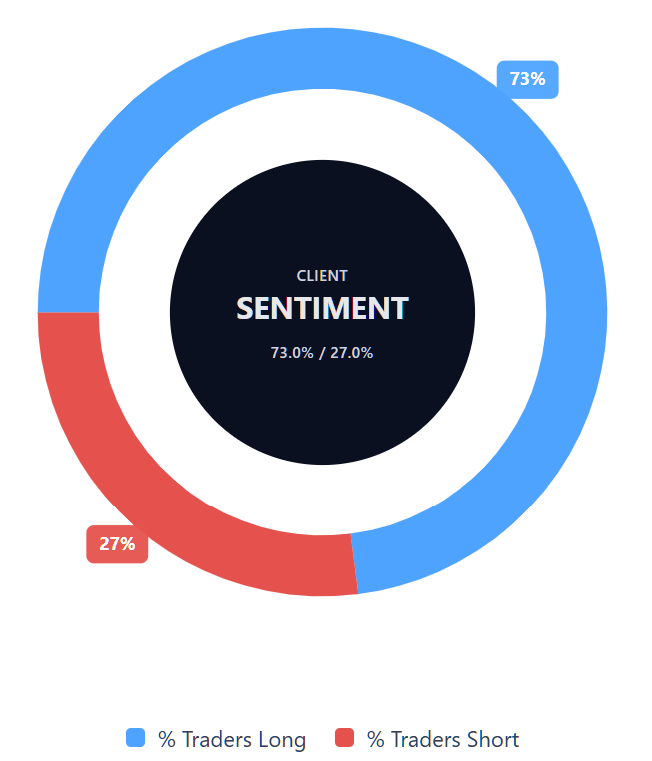
As of 10 September 2026, Capital.com client positioning in Japan 225 CFDs shows 73% long and 27% short. This reflects open positions on Capital.com at the time of measurement rather than future price direction and can change.
Summary – Japan 225 2026
- As of 9:46am UTC on 10 September 2026, Japan 225 traded near 64,907 JPY, within an intraday range of 64,155–65,697 JPY.
- According to TradingView data, the index was below its 20-, 50- and 100-day moving averages but above its 200-day average, while RSI stood near 47 and ADX near 15.
- Key factors include Bank of Japan rate expectations, Japanese bond yields, oil prices, the yen and corporate earnings.
- Stronger earnings or technology demand could support the index, while higher yields, yen appreciation or weaker results could weigh on it.
- Recent developments include the upcoming Nikkei 225 rebalance and a Reuters poll showing broad expectations for a September rate rise.
Past performance is not a reliable indicator of future results.