
NVIDIA stock forecast: Q3 earnings, CEO transition
US semiconductor giant NVIDIA (NVDA) reported third-quarter fiscal 2027 revenue of $115.8bn on 17 November 2026, up 103% year on year. Explore third-party price targets and technical analysis. Past performance isn't a reliable indicator of future results.
NVIDIA Corporation (NVDA) traded at $160.44 as of 9:18am UTC on 18 November 2026, near the upper end of its $150.68–$162.36 intraday CFD range, according to Capital.com data. Past performance is not a reliable indicator of future results.
The US semiconductor giant reported third-quarter fiscal 2027 revenue of $115.8bn, up 103% year on year, including $107.6bn from its data-centre business. The results followed Jensen Huang's resignation as CEO and Colette Kress's appointment as interim CEO, while the company established a board committee overseeing national security and export controls. Across the wider semiconductor sector, concerns over AI infrastructure spending persisted, with the Philadelphia Semiconductor Index falling 5.3% on 16 November (Reuters, 16 November 2026; Investing.com, 17 November 2026; NVIDIA, 17 November 2026).
Third-party NVIDIA outlook: Q3 earnings, CEO transition
As of 18 November 2026, third-party NVIDIA stock predictions reflect differing assessments of the company's leadership transition, AI infrastructure demand and earnings outlook.
Lynx Equity (revised price target)
Lynx Equity cut its NVIDIA share price target to $135 from $250, citing uncertainty over the leadership transition. In its pre-earnings assessment, the firm expected interim CEO Colette Kress to scale back the following year's revenue and gross margin guidance (Investing.com, 17 November 2026).
HSBC (maintained price target)
HSBC analyst Frank Lee maintained a $170 NVIDIA share price target and reiterated a Hold rating (StreetInsider, 18 November 2026).
Bernstein (neutral outlook)
Bernstein analyst Stacy Rasgon maintained a $200 NVIDIA share price target and reiterated a Neutral rating, leaving the firm's previous assessment unchanged (MarketScreener, 18 November 2026).
Piper Sandler (revised price target)
Piper Sandler lowered its NVIDIA share price target to $230 from $300 while maintaining an Overweight rating. Citing uncertainty over the CEO transition, the firm reduced the valuation multiple applied to its calendar 2028 earnings estimates from 14 times to approximately 10 times (Investing.com, 18 November 2026).
Jefferies (revised price target)
Jefferies lowered its NVIDIA share price target to $250 from $300 while retaining a Buy rating. The firm noted that cloud industry backlog had reached $2.5tn, up from $2tn three months earlier, and cited higher GPU rental rates as evidence that demand continued to exceed available supply. It also noted uncertainty over NVIDIA's longer-term strategic direction following the CEO transition (Investing.com, 18 November 2026).
Predictions and third-party forecasts are inherently uncertain, as they cannot fully account for unexpected market developments. Past performance is not a reliable indicator of future results.
NVDA stock price: technical overview
The NVDA price stood at $160.44 at 9:18am UTC on 18 November 2026, within its $150.68–$162.36 intraday CFD range. The price remained below TradingView's 20-, 50-, 100- and 200-day simple moving averages, at approximately $193, $212, $211 and $204, respectively. The 14-period relative strength index (RSI) registered 22.50, a reading conventionally described as oversold, though it doesn't confirm a reversal. The average directional index (ADX) stood at 45.44, indicating an established trend but not its direction.
On the upside, the nearest classic pivot above the quoted CFD price was S2 at $173.86, followed by S1 at $189.25. A daily close above the first level could bring the second into focus, although neither level predicts future price movements. The main classic pivot at $216.31 lay further above the quoted price.
On the downside, the Hull moving average at $154.04 lay below the last price, with the classic S3 pivot at $131.41 providing a further reference level. Neither represents confirmed support (TradingView, 18 November 2026).
This is technical analysis for informational purposes only and does not constitute financial advice or a recommendation to buy or sell any instrument.
NVIDIA share CFD price history (2024–2026)
According to Capital.com price data, NVIDIA CFDs closed at $147.53 on 19 November 2024 before ending the year at $134.34, ahead of further price swings in 2025 and 2026.
In January 2025, NVDA CFDs fell from $142.54 on 24 January to $121.29 on 27 January, amid concerns about competition in artificial intelligence (AI). Further declines followed in April amid US tariff-related market turbulence, with prices reaching an intraday low of $86.13 on 7 April. Prices subsequently recovered, with NVIDIA CFDs closing 2025 at $186.63.
The recovery extended into 2026, with NVIDIA CFDs closing at $237.95 on 14 May before reaching an intraday high of $243.53 on 6 October. Prices then declined through October and November, amid renewed scrutiny of AI investment, semiconductor export restrictions and NVIDIA's leadership changes. The CFD closed at $161.59 on 17 November.
As of 9:18am UTC on 18 November 2026, NVIDIA was trading at $160.44, approximately 14.0% below its end-2025 close.

Past performance is not a reliable indicator of future results. Share prices are indicative and may differ from live market prices.
NVIDIA (NVDA): Capital.com analyst view
NVIDIA’s latest price moves coincided with growing scrutiny of AI infrastructure spending, Jensen Huang's departure as CEO and tighter US semiconductor export restrictions. These developments have added uncertainty around NVIDIA's operations and valuation, although price movements can't be attributed to any single factor.
Third-quarter fiscal 2027 results showed revenue growth of 103% year on year to $115.8bn, with data centre sales reaching $107.6bn. Continued AI infrastructure investment could support demand, although questions remain over spending sustainability and potential supply constraints. Export restrictions may limit access to certain markets, while demand elsewhere could offset some of that exposure. The leadership transition introduces further uncertainty, with its longer-term implications yet to become clear (NVIDIA, 17 November 2026).
Capital.com’s client sentiment for NVIDIA CFDs
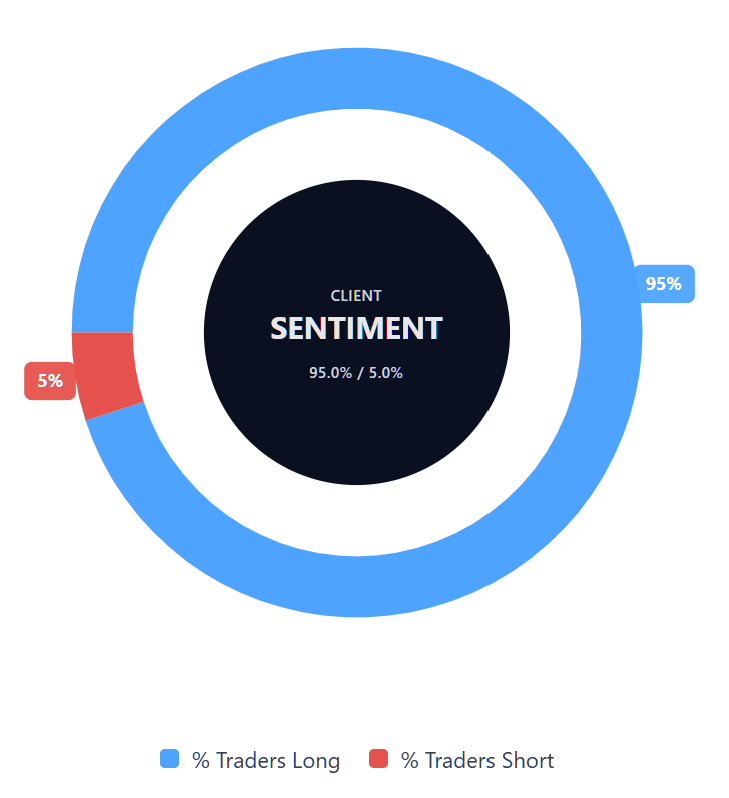
As of 18 November 2026, Capital.com client positioning in NVIDIA CFDs shows 95% buyers versus 5% sellers in the supplied snapshot, a gap of 90.0 percentage points. These figures reflect positioning among Capital.com clients rather than broader market sentiment, and may change over time.
Summary – NVIDIA 2026
- As of 9:18am UTC on 18 November 2026, NVIDIA (NVDA) CFDs traded at $160.44, within an intraday range of $150.68–$162.36.
- Technical indicators placed NVIDIA below its major simple moving averages, with the 14-period RSI at 22.50 indicating oversold conditions without confirming a reversal.
- Key considerations include AI infrastructure spending, semiconductor export restrictions and leadership uncertainty, alongside growth in data-centre revenue.
- NVIDIA reported quarterly revenue of $115.8bn, up 103% year on year, as its leadership transition and changes to export-control oversight drew attention.
Past performance is not a reliable indicator of future results.