
Fed Rate Hike September 2026: Gold Price Reaction and Outlook
Gold rebounded after the Fed’s September 2026 rate hike. Can the recovery hold? Explore the market reaction, oil risks and key price levels to watch.
The Federal Reserve raised rates on Wednesday, but for markets the bigger issue was how long they might stay elevated. Gold sold off sharply before recovering much of the decline, leaving traders to weigh a familiar tension: persistent inflation and a firm economy against prices that already reflect some expectation of tighter policy.
The unanimous 25-basis-point increase took the federal funds target range to 3.75%–4.00%. The accompanying projections put the median rate at 4.1% at the end of both 2026 and 2027, consistent with another increase this year and little appetite for cutting soon afterwards. Those projections can change, but they gave traders more to consider than the hike alone.
There was a political contrast, too. Trump had chosen Kevin Warsh with expectations of lower rates, encouraging speculation that a new chair would make cuts easier to secure. After Wednesday’s decision, Trump again called for rates of 1% or less. For markets, the unanimous vote offered a useful reminder that presidential preferences are a poor substitute for assessing the committee’s economic outlook.
Little comfort from the press conference
Warsh described an economy that appeared to be strengthening. Hiring, earnings and business investment had improved, credit was flowing, and broad financial conditions were not, in his assessment, restrictive. He characterised the increase as removing “a dose of accommodation.”
That leaves a different impression from a central bank reluctantly tightening into a weakening economy. His remarks suggested the Fed believed activity could withstand higher borrowing costs while it addressed inflation.
He was also unconvinced that the summer’s inflation readings showed sufficient improvement. Warsh estimated August headline PCE inflation at around 3.6% and core PCE at about 3.2%, compared with core CPI of 2.4%. The gap demonstrates that a softer CPI reading does not necessarily mean the Fed’s preferred PCE measure is approaching its 2% objective at the same pace.
Oil complicates that assessment. Disruption to Saudi Arabia’s East-West pipeline had raised supply concerns before the meeting. News of additional Saudi cargoes through Oman subsequently offered some relief, helping Brent fall 2.7% on Wednesday to $105.83 a barrel. Energy prices had eased, but remained high enough to keep inflation concerns alive.
Gold recovers but has ground to regain
US stocks finished lower, the dollar strengthened and the 10-year Treasury yield traded around 5% following the decision. Higher yields and a firmer dollar presented headwinds for gold, which pays no interest and becomes more expensive for overseas buyers when the dollar rises.
On the hourly chart, gold fell from around $4,360 towards $4,260, before a subsequent candle reached roughly $4,235. By 09:44 UTC on Thursday, it had recovered to about $4,310.
That is a substantial rebound, although it leaves gold below its pre-sell-off high. The move beneath $4,260 failed to hold; the recovery has yet to reclaim $4,360. Neither side has much confirmation from price at the middle of that range.
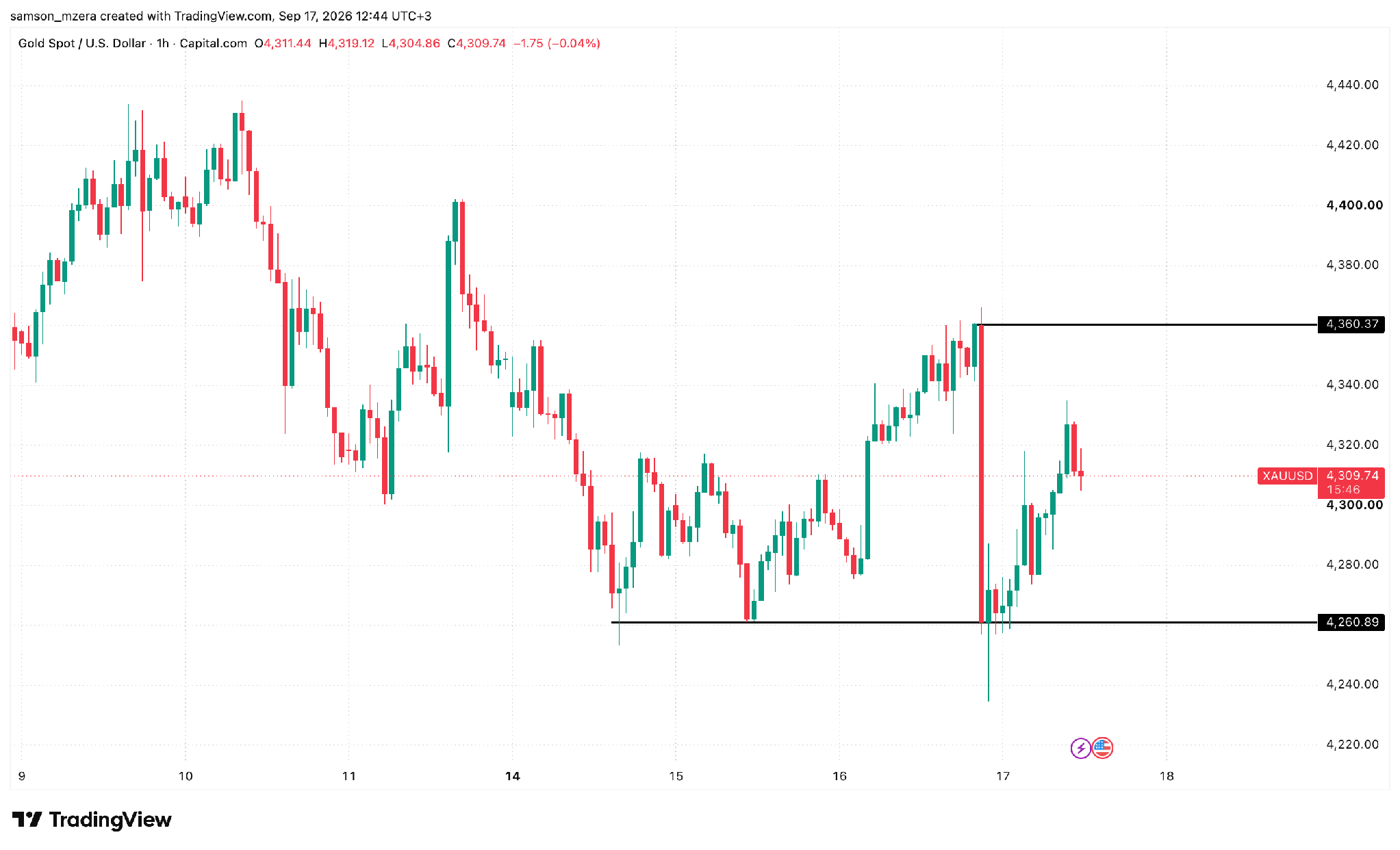
Gold spot/US dollar, hourly, 17 September 2026, 12:44 UTC+3. Source: TradingView; Capital.com prices. Levels refer to this snapshot. Past performance is not a reliable indicator of future results.
The immediate test is whether gold can build on the recovery while yields and the dollar remain firm. A sustained move through the rebound high near $4,330–$4,335 would bring $4,360 into focus. Failure to hold above $4,300 would leave $4,260 exposed again, with the low around $4,235 below it. These are reference areas, not guaranteed turning points.
Beyond the chart, oil supply updates and the next inflation and employment releases deserve attention. Softer underlying inflation and cooling demand could reduce expectations for another hike. Continued economic strength alongside persistent price pressures would give the Fed less reason to change course.
Gold has recovered from the first shock. Whether that recovery lasts will depend partly on what happens next in bonds and the dollar and whether incoming data soften the rate outlook that Wednesday’s meeting left behind.